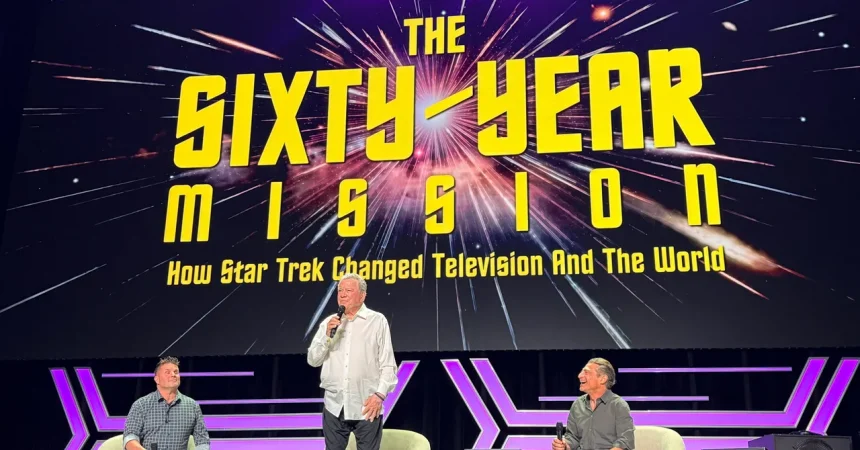
At ninety-five, William Shatner has become a kind of monument: the captain who once commanded the starship Enterprise now commands the room merely by walking into it. But on the night of the New York premiere of The Sixty-Year Mission: How Star Trek Changed Television and the World, he seemed less like a monument and more like a man who still worries about whether his work is good enough. The Regal Times Square theater was packed with the restless energy of New York Comic Con, and the audience was eager to celebrate anything with a Star Trek logo on it. Shatner, however, chose to lower expectations. “Maybe you’ll like it, maybe you won’t,” he told them, with the kind of shrug that only a ninety-five-year-old can deliver. Then he added, “But you’re going to see a lovely film made by people who cared.” It was a humble introduction to a documentary that is itself surprisingly humble. Directed and written by Mark A. Altman, the creator of the Inglorious Treksperts podcast, The Sixty-Year Mission focuses on the original Star Trek series, which ran from 1966 to 1969. The film explores the show’s cultural impact and legacy, but it also demonstrates how much the show was a product of the political climate in which it was made. It is not a fan hagiography; it is an attempt to understand a strange, beautiful accident of television history. And as Shatner stood on that stage, slightly unsteady but unmistakably present, he seemed to know that the film was bigger than him. It was about the relationship between a canceled TV show and the people who refused to let it die.
Altman’s central argument is that the sixties shaped Star Trek as much as Star Trek shaped the sixties. “I think audiences are pleasantly surprised that Sixty-Year Mission shows how the ‘60s shaped Star Trek,” he explains. It would be easy to assume that a show about the future would be an escape from the present, but Star Trek was never that. It was born in the wake of the Kennedy assassination, during the escalation of the Vietnam War, and in the midst of the civil rights movement. The series asked questions that Americans were already asking themselves: What kind of world are we building? Can we survive our own technology? What does it mean to be human? Gene Roddenberry, the show’s creator, who died in 1991, is a central presence in the documentary, even though he is heard mostly through archival interviews and the memories of those who knew him. Roddenberry was a World War II veteran with a progressive bent, a man who had spent years in traditionally conservative institutions like the United States Army and the Los Angeles Police Department. That unusual background gave him a worldview that was both idealistic and tough. He believed in equality, diversity, and diplomacy, but he also believed in strength and vigilance. Altman puts it memorably: “Captain Kirk was ‘JFK: Space Captain.’” President Kennedy’s New Frontier was reimagined as the final frontier, and the starship Enterprise became a vehicle for a distinctly American optimism—an optimism that said the future could be better, but only if people were brave enough to pursue it. The documentary uses clips, interviews, and archival footage to show how the show’s storylines reflected the headlines of the day: cold war standoffs, racial prejudice, the dangers of technology, the seduction of authoritarianism. It also shows that Roddenberry’s vision was never fully realized in production; the network interfered, budgets were tight, and scripts were sometimes clumsy. But the series’ very contradictions made it feel real. It was not a sanitized utopia. It was a place where ideals were tested against the hard edges of the world, and that is why it still speaks to us today.
The emotional heart of The Sixty-Year Mission is the testimony of people who saw themselves in Star Trek when they could not see themselves anywhere else on television. Mary L. Trump, the niece of former President Donald Trump and a self-described Star Trek fan, praises the show’s pioneering representation, singling out Nichelle Nichols’ Lieutenant Uhura. In the 1960s, a Black woman sitting on the bridge of a starship was more than a casting choice; it was a political statement. Nichols’ presence told millions of viewers that the future would be integrated, that intelligence and grace were not limited to any one race, and that the universe was big enough for everyone. George Takei, who played Sulu, offers an even more personal testament. He recounts his harrowing childhood in an internment camp for Japanese Americans during World War II, one of the darkest chapters in American history. For Takei, Star Trek was a form of redemption: it imagined a world in which an Asian American could stand on the bridge of a starship as an equal, in which the humiliation his family had endured was finally left behind. The documentary also explores how Spock, the half-alien science officer played by Leonard Nimoy, became an unlikely hero for queer fans. As an outsider who struggled with his dual identity, Spock embodied the experience of anyone who felt different, who had to hide parts of themselves, who feared they would never be accepted. The fact that his crewmates accepted him—even loved him—sent a message of hope that resonated far beyond the show’s intended audience. These stories are not footnotes to Star Trek history; they are the history. The documentary gives them room to breathe, allowing each person to reflect on what the show meant in their own life. It is a reminder that representation is never abstract. It is always about real people, real wounds, and real hopes. And it helps explain why Star Trek did not fade away when it was canceled in 1969. It survived because it had already planted itself in the hearts of the people who needed it most.
Shatner’s own memories are central to the film, but they are not the triumphalist recollections one might expect. He is refreshingly honest about his initial motives. “I didn’t think in those terms when they offered me the role,” he says. “I thought, ‘I got a regular paid job.’ Only later did the magic of Star Trek happen.” That admission is one of the most human moments in the documentary. It suggests that the meaning of Star Trek was not invented in advance by its creators or actors. It was discovered over time, through contact with the audience. Shatner, who served as an executive producer on the film, speaks with affection and wonder about the show’s afterlife. “Star Trek had an effect on people’s lives,” he says simply. That is an understatement. Over the decades, he has met countless scientists, astronauts, doctors, and artists who trace the spark of their careers to the episodes they watched as children. The documentary honors that effect by treating fans as seriously as stars. Simon Pegg, who played Scotty in the modern reboot films, appears to discuss what the original series meant to him. Jonathan Frakes and Brent Spiner, beloved stars of Star Trek: The Next Generation, also offer their perspectives. The film becomes a conversation across generations, a passing of the torch from the original cast to their successors and to the fans who kept the dream alive. Shatner’s journey from pragmatic actor-for-hire to keeper of the flame is, in many ways, the story of Star Trek itself: a thing that was made for practical reasons, then transformed by love. He may not have set out to change the world, but he did. And now, at ninety-five, he seems both amazed and grateful that he was part of it. His voice may be softer, his step slower, but the spark in his eye when he talks about the show is still unmistakably that of a man who found his life’s work almost by accident.
The most illuminating passages of The Sixty-Year Mission are those that wrestle with Star Trek’s politics. Altman is careful not to reduce the show to a simple liberal slogan. “Roddenberry was liberal on social issues but hard-nosed on defense, and that is absolutely what Star Trek is,” he says. “We need our phasers to defeat the Klingons, but we believe in a diverse crew.” This synthesis is the key to understanding the show’s broad appeal. Star Trek did not offer an easy, one-sided message. It acknowledged that the universe was dangerous, that evil existed, that sometimes force was necessary. But it also insisted that force must be guided by ethics, that diversity is a strength, and that the most important battles are not always fought with weapons. Kirk could be a warrior, a diplomat, a philosopher, and a romantic all in the same episode. The Enterprise was a ship of war, but it was also a vessel of exploration and discovery. That balance mirrored Roddenberry’s own biography. He had seen enough of the world to know that pacifism alone could not stop a tyrant, but he had also seen enough to know that militarism without compassion was its own kind of tyranny. In an age of political polarization, this nuanced vision feels almost impossible. Yet it may be exactly why Star Trek has endured. It refuses to fit neatly into any box. It is idealistic but not naive, tough but not cruel. It imagines a future in which humanity has overcome its worst instincts without losing its fighting spirit. The documentary makes clear that this was not an accident. It was a carefully constructed philosophy, one that allowed Star Trek to speak to people across the political spectrum. That may be the show’s most radical achievement: it created a space where different values could coexist, where the argument itself was the adventure, and where the crew of the Enterprise could be both soldiers and dreamers at the same time.
In the end, The Sixty-Year Mission is not a comprehensive history or a critical takedown; it is a love letter. It celebrates the show’s imperfections as well as its triumphs, because both are part of the story. The title suggests that the mission is still in progress. Star Trek has evolved through multiple series, films, and reboots, but the original vision remains its foundation. Shatner’s opening words—“maybe you’ll like it, maybe you won’t”—were the perfect introduction. They acknowledged uncertainty, but also trust. He knew that the filmmakers had made something sincere, and he was willing to let the audience decide. “You’re going to see a lovely film made by people who cared,” he promised. That care is visible in every interview, every clip, every archival photograph. Altman and his team assembled a remarkable range of voices, from Shatner and Pegg to Frakes and Spiner, from Mary L. Trump to George Takei, and they allowed those voices to speak with honesty and emotion. The documentary reminds us that television can be more than entertainment. It can be a lifeline. It can be a mirror. It can be a map of possibilities. Star Trek gave generations of viewers a future worth fighting for, and in doing so, it changed the present. As the audience left the Regal Times Square theater, carrying their memories and their hopes, it was hard not to feel that the sixty-year mission is really a never-ending one. The people who cared are still here, and they are still passing the torch. The final frontier, it turns out, is not out there. It is in us, in the stories we tell ourselves about who we are and who we might become. And as long as there are people who care, the mission will continue.