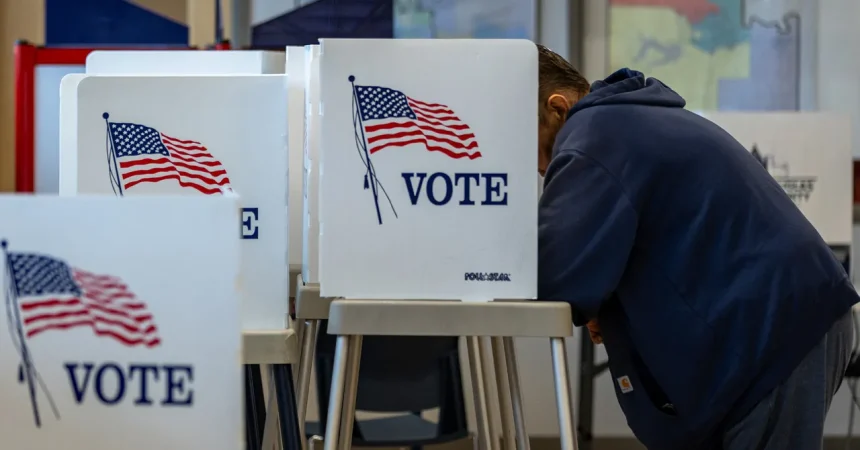
Across the United States, in communities that have lived through the chaos and cruelty of mass immigration enforcement, a deeply human transformation is underway. It is not the kind of change that shows up in a poll or a headline, but it can be felt in conversations at kitchen tables, in the voices of volunteers knocking on doors, and in the quiet resolve of voters who have decided that fear will not make the decision for them. Jill Garvey, executive director of States at the Core, an organization that works to counter authoritarianism and political extremism, describes what she has witnessed in places where residents have come face-to-face with some of the worst of ICE’s violence and intimidation. These are not abstract encounters. They are real moments of trauma: agents descending on neighborhoods, families separated, children asking questions no adult can answer. And yet, Garvey says, the people who have endured this are not paralyzed. They understand that preparation is essential. They understand how traumatizing and chaotic these raids are, because they have seen them with their own eyes. But they also understand something less obvious: they have survived it before, and they know how quickly escalation can happen. That knowledge, born of painful experience, has become a kind of power. It has stripped away the illusion that safety is guaranteed. It has replaced it with something more grounded and more useful—the certainty that they can respond, organize, and show up even when the world around them feels dangerous. As Garvey puts it, these communities are “frankly, a little less scared.” Not because the threat has disappeared, but because fear has been transformed into familiarity, and familiarity has become resolve.
In Arizona, that resolve is visible in the work of Living United for Change in Arizona, or LUCHA, a group that has spent years building trust with working-class Latino voters. The group’s get-out-the-vote efforts have always mattered, but this year feels different. César Fierros, a spokesperson for LUCHA, says that in a single recent week, volunteers knocked on thousands of doors across the state. The conversations were not always easy. People are tired, worried, and carrying the weight of threats that feel both distant and immediate. But something unexpected happened. One thousand of those voters told LUCHA that they had already cast their ballots, either by voting early or mailing them back. That number, Fierros says, is something the group has “really never seen before.” It is a sign that people are not sinking into despair; they are moving toward action. The voters Fierros describes are not naive. They see the threats looming. They know what is at stake. And still, they are choosing to show up. “People are saying, ‘Yes, there are threats out there, looming, but we’re still going to show up regardless,’” he says. There is a profound humanity in that statement. It is not the language of false hope or enthusiasm divorced from reality. It is the voice of people who have been counted out many times before, who know what it means to be targeted, and who have decided that their response to fear will be presence rather than retreat. The doorsteps, the phone calls, the ballots dropped into mailboxes—these are the small, cumulative acts of courage that make democracy feel real, not just as an idea but as a daily practice.
The same spirit can be found in DeKalb County, Georgia, where volunteers from the Save America Movement, an anti-Trump group, have been standing outside early polling locations since the first day of voting. Mary Corcoran, the group’s cofounder and executive director, describes a scene that feels almost defiant in its normalcy. “We’re hearing it everywhere our Vote Safe team members are,” she says. “Voters came through in a steady stream from the moment the polls opened until they closed.” There was no hesitation in the line, no sense that people were showing up out of resignation. Instead, person after person told the volunteers that nothing was going to keep them from voting this year. They knew what the administration was trying to do. They knew that their right to participate was being challenged, not just by rhetoric but by policies and procedures that made voting harder for some people than for others. And they were refusing to be scared out of their own democracy. Corcoran’s words capture something essential about this moment: the act of voting is not simply a civic ritual. It is a statement of belonging, a declaration that one’s voice matters, and a refusal to accept the premise that power belongs only to the powerful. In DeKalb County, that message was delivered by the steady rhythm of feet walking through polling place doors. It was delivered by ordinary people who might have stayed home, who might have let exhaustion win, but who instead chose to stand in line and make their presence known. There is a quiet joy in that kind of participation, a joy that comes from knowing you are part of something larger than yourself, something that connects you to your neighbors and to the long, unfinished story of democracy.
In Nevada, Secretary of State Cisco Aguilar is running for reelection against Jim Marchant, an election denier, and he believes that the language of polite reassurance will not be enough to reach people who have every reason to doubt that their vote matters. Aguilar, who is Latino, has spent time in community events speaking honestly and directly about what is at stake. He does not sugarcoat it. He does not offer empty slogans. Instead, he says, leaders need to “get real” with voters. At one Latino community event, he put it bluntly: “We have to actually fucking vote to tell these motherfuckers to fuck off.” The language is raw, but the sentiment is rooted in something deeper than anger. It is a recognition that many voters have been lied to for years, told that participation is pointless, that politicians do not care, that the system is rigged. Against that backdrop, a polished campaign speech can feel hollow. What breaks through, Aguilar argues, is authenticity—the willingness to stand beside people, to speak their language, to acknowledge their frustration, and to say plainly that their voices have power. When voters know that an elected leader is willing to fight for them, he says, they begin to believe that showing up might actually make a difference. That is not cynicism. It is a hard-earned form of hope, one that has been tested by betrayal and disappointment. It recognizes that trust is not given automatically; it has to be built through actions and honest words. And in that honesty, there is a strange kind of comfort. People do not need their leaders to pretend that everything is fine. They need them to stand in the storm and say, with conviction, that they will not let fear have the final word.
Suzanne Almeida, vice president of states with the voting rights group Common Cause, sees this defiant energy as essential to the fight for democratic participation. She argues that organizers and leaders should “lean into that defiance” rather than try to reassure voters that the system is fair and working perfectly. The truth is messier, and voters know it. They can see when restrictions are placed on early voting, when mail-in ballots are challenged, when poll sites are moved or closed. They can feel when the rules are being changed in ways that seem designed to limit who gets to participate. Almeida suggests that the response to this reality should not be denial. It should be honesty. Voters should be told that the opposition would not make it so difficult to vote if voting did not matter. The difficulty itself is proof of power. If casting a ballot were meaningless, no one would bother to put up barriers. That message reframes the struggle. It turns frustration into determination. It reminds people that the obstacles they face are not evidence of their weakness but evidence of their strength. Almeida also points to something that is easy to forget in the middle of a crisis: “The threats are real, but so is the joy, and there is a real joy that comes in participating in democracy.” That joy is not naive. It is the joy of connecting with neighbors, of standing in line with strangers who share your hopes, of holding a ballot and knowing that you have done something concrete in the face of fear. It is the joy of refusing to be silenced. It is the joy of being part of a community that values its own voice enough to defend it.
Taken together, these stories paint a picture of a democracy that is wounded but not defeated. Communities that have faced the worst of ICE’s violence, that have watched their neighbors detained and their families threatened, are not retreating. They are preparing. They are organizing. They are voting. The experience of being targeted has not broken them; it has clarified what matters. They know that threats are real, that escalation can happen quickly, and that the government has the capacity to do immense harm. But they also know that they have survived before, and that knowledge has given them a kind of peace that outsiders might find surprising. They are not waiting for permission to participate in their own democracy. They are standing in line, knocking on doors, and telling their stories. They are refusing to be scared out of something that belongs to them. The phrase “a little less scared” captures it perfectly. It is not the bravado of people who have never been tested. It is the calm of people who have walked through fire and come out the other side. They know that the fight is not over, that the danger is not imagined, and that the path ahead will require courage and sacrifice. But they also know that they are not alone. In Arizona, in Georgia, in Nevada, and in countless other places, ordinary people are choosing to show up for one another. That choice is the heartbeat of democracy. It does not guarantee victory. It does not erase pain. But it ensures that the story is not over—that the final word has not yet been spoken. And in that unfinished story, there is room for hope, for defiance, and for the quiet, unstoppable joy of participation.