It is a peculiar kind of tragedy when a company that once defined the bleeding edge of its industry collapses under the weight of its own ambition. For Roli, the London-based music technology firm, this was the stark reality. The company, renowned for its revolutionary Seaboard keyboard and its pioneering work in the expressive MIDI standard known as MPE, was once the darling of the music world. Artists like Grimes and RZA championed its hardware, which allowed musicians to bend pitch and shape sound with the subtlety of a cellist or a saxophonist, breaking the rigid confines of traditional keyboards. The fall, however, was as dramatic as the rise. A bankruptcy filing in late 2024, followed by a total rebrand and a shift in focus away from its core instruments, left a community of devoted musicians feeling abandoned, frustrated, and heartbroken. The sentiment expressed by a former employee rings painfully true: Roli was always fundamentally a great company, built on the all-powerful, singular vision of its founder, Roland Lamb. Yet, that same reverent devotion to a single vision proved to be the critical, fatal flaw that ultimately unraveled the entire enterprise.
The story of Roli is inextricably linked to its breakthrough technology, a genuine leap forward in a hardware space that had been stagnant for decades. Along with other touch-sensitive innovations like the Linnstrument and the Sensel Morph, Roli was the primary force behind the rise of MIDI Polyphonic Expression, or MPE. This technology was not just a new feature; it was a new language for musical performance. Traditional MIDI treats the keyboard as a binary trigger, a simple on/off switch. MPE, by contrast, allows each individual note to be shaped in real-time by the player’s touch. As a finger presses deeper into the squishy, silicone-covered keys of the Seaboard, or slides up and down their surface, it generates a stream of continuous data that alters pitch, timbre, and volume. This allowed keyboardists to emulate the expressive slides of a guitar string, the vibrato of a violin bow, or the subtle breath control of a wind player. The Seaboard was not just a product; it was a producer’s dream, an entire new palette of sound available at one’s fingertips.
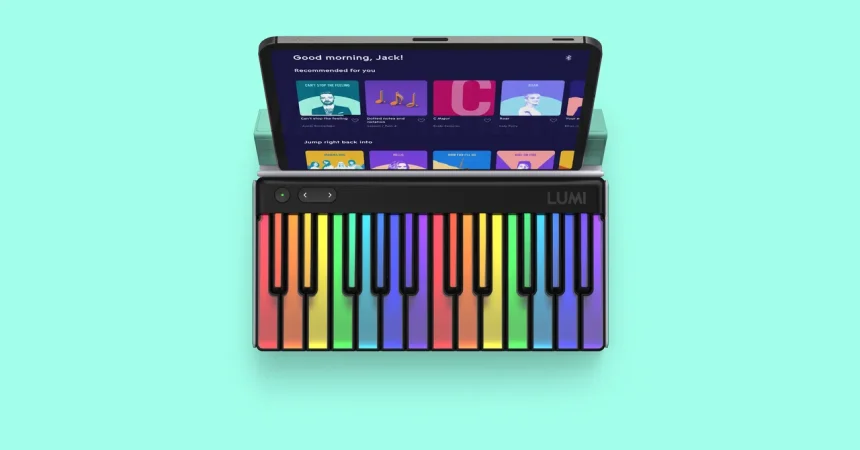
Yet, for all its technical marvel, Roli was playing a high-stakes game with a very niche market. Inventing an entirely new instrument is a monumental challenge, but convincing the world that they need it is an even greater one. Roli tried to bridge the gap between the professional studio and the mainstream consumer with its smaller, modular “Lightpad Block” devices, even partnering with Apple to sell them in their flagship stores. They were attempting to build an Apple-sized audience, but they were fundamentally working in a product category that was, by definition, hard to scale. The economics of hardware manufacturing are brutal, and the company’s model was reliant on high-volume sales to offset heavy research and production costs. When the COVID-19 pandemic struck in 2020, it exacerbated these inherent vulnerabilities. Dire supply chain issues meant that when the demand and interest in digital music creation was booming, Roli could not keep its product in stock. The company was bleeding cash, and years of a single-minded focus on the founder’s vision meant there were few co-pilots in the cockpit to steer the company away from the financial turbulence. After the pandemic, the company was left in a perilous, weakened state, with little left to push it forward save for the founder’s will, which, according to insiders, was a double-edged sword.
The aftermath of Roli’s collapse has been a strange cocktail of grief, frustration, and do-it-yourself ingenuity. The company’s business bank account was frozen first, leaving it unable to fulfill existing orders, and then employees were paid off for the work they had already completed, while all other payments were halted. For the users and developers who had bought into the Roli ecosystem, the news was a devastating blow. They had invested significant sums of money in hardware that was suddenly at risk of becoming an expensive paperweight. The company’s proprietary software, the Roli Dashboard, was essential for configuring the instruments, but after the collapse, it became increasingly unreliable in the operating systems, and the company was nowhere to be found to provide support. The subreddit, r/ROLI, became a digital wake, where heartbroken owners shared their stories and their fears that their beloved instruments would become useless. However, out of this digital mourning emerged a resilient and resourceful community determined not to let their expensive equipment die. The refusal to let a beloved piece of technology become obsolete in the wake of a corporate failure is a powerful testament to the value of community and open-source collaboration.
Leading this charge is Sam Hocking, a UK-based audio engineer who runs his own audio tools company, Demix.me. Like many others, Hocking is the proud owner of multiple Roli Seaboard Blocks. Even before the company went into administration, he had been tinkering with the technology out of a sense of self-preservation, building software that could keep his equipment working as a capable, standalone MIDI device. When the company officially died, Hocking stepped up to share his “vibe-coded” configuration tools publicly on the Roli subreddit and on GitHub. His software bypasses the need for the defunct Roli launcher entirely, allowing the Grand, Rise, Airwave, and Block devices to communicate directly with a computer and operate as full-featured MPE controllers. Hocking’s work has been a lifeline. His Seaboards, he notes, are nearly 10 years old and still function perfectly, which is a testament to their quality, but the software needed to run them was the point of failure. He, like many others, simply cannot afford to see his investment go to waste. “They’re quite a unique product; there’s not another keyboard type out there,” Hocking says, perfectly capturing the sentiment of the entire community. “Nobody likes to spend money and then not be able to use it.”
The ripples of Hocking’s selfless contribution have been profound. Other users on the subreddit have joined the effort, adding their own tweaks, fixes, and improvements to the software, creating a living, breathing open-source project that has taken on a life of its own. This is the other tale of Roli’s fall—a story of community resilience that stands in stark contrast to the corporate tragedy. It highlights a deep human need to nurture and preserve, even when the original creators have departed. These devices are more than just commodities; they are extensions of the musician’s body, capturing a level of expressivity that flat, lifeless keyboards cannot. The fact that these users are banding together to reverse-engineer their own instruments and keep them alive is a resounding statement about the value of their creative output. They are not just preserving hardware; they are preserving their ability to make art in a unique way.
In the end, the story of Roli is a cautionary tale about the fragility of innovation and the dangers of a single, all-powerful vision. It is also a tribute to the enduring power of the maker community. One former employee’s lament—“This was one of the leading lights of music technology in the world. It was truly an inventing company—the stuff it made had never been made before. So it’s a real shame”—encapsulates the feeling of a massive, wasted potential. The business side of the company may have failed, but the technology it gifted to the world refuses to be forgotten. The greatest success of Roli, beyond its undeniable contributions to the world of music, may ultimately be the community it spawned—a group of dedicated users and developers who, in the face of corporate abandonment, chose to begin again, to tinker, to build, and to ensure that the unique voices of their instruments would continue to sing for years to come. They have taken the founder’s vision and given it a more democratic, sustainable, and ultimately more human life, proving that the true legacy of a company is not just the products it makes, but the creative resilience it inspires.