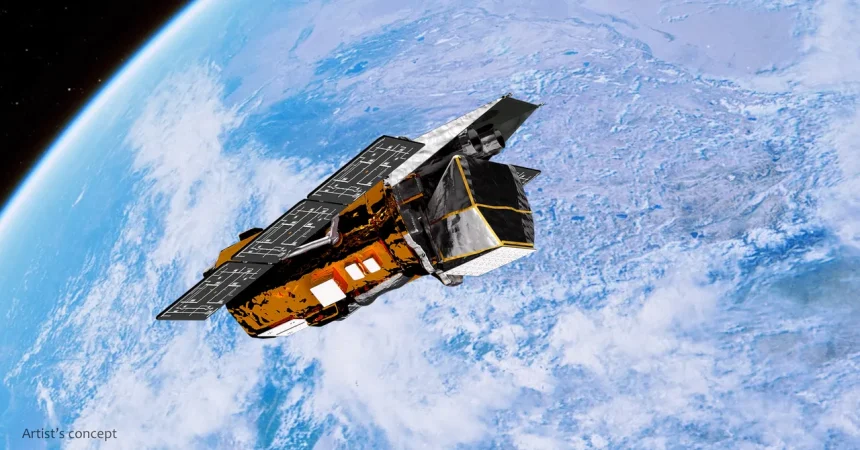
Some spacecraft end their lives with a whisper. After more than two decades of ceaseless watching, the Swift satellite is about to make its final, fiery descent through Earth’s atmosphere. Launched in 2004 and named for a nimble little bird, Swift was built to catch the quickest, brightest flashes in the universe: gamma-ray bursts, the cataclysmic explosions that signal the birth of black holes and the violent deaths of massive stars. During that extraordinary working life, it observed more than 2,000 gamma-ray bursts, nearly as many supernovas, and contributed to more than 7,000 research papers. That is a staggering record for a spacecraft never designed for such a long and eventful career. It was a cosmic detective, a first responder to the most mysterious alarms in the sky, and its observations changed how astronomers think about the universe. But every orbit eventually decays, every satellite eventually comes home. According to the United States Space Force, Swift is likely to crash on or around Friday, November 6, or at least whatever remains of it will. The journey ahead is not one of gentle landing, but of intense heat, fragmentation, and, in the end, a final resting place somewhere on a planet it spent so many years studying from above. The news of its reentry may sound sad, but it is also a reminder of how much one small satellite was able to accomplish, and how much of its work will continue long after the last radio signal goes silent. NASA’s acting associate administrator for science, during a recent message, offered a comforting thought: Swift leaves behind an extraordinary archive of multiwavelength observations that will fuel new discoveries for decades more. The mission is not ending; it is transforming.
What made Swift so special was not just the telescope itself, but how it moved. In the high frontier above Earth, Swift orbited with a single-minded purpose: to respond to the sudden, unexpected hiccups of the cosmos. The instruments aboard could detect gamma-ray bursts in a flash, localize their rough position in seconds, and then, with a nimbleness no other spacecraft could match, swivel around to point its X-ray and ultraviolet and optical telescopes in the same direction. That allowed astronomers to watch the afterglows of the most powerful explosions in the known universe, unraveling their origins and their causes. A gamma-ray burst is a sudden release of energy so enormous that, for a few seconds, it outshines every star in the galaxy combined. They are brief, unpredictable, and difficult to catch. Before Swift, astronomers were often blind to them, seeing only the final glimmer of a phenomenon that had already passed. With Swift, they could see the whole story: the initial flash, the fading afterglow, and the lingering heat emitted across a range of wavelengths. Over the years, Swift documented more than just gamma-ray bursts. It watched supernovas unfold, particularly the powerful type of stellar explosions that occur when giant stars collapse into black holes or neutron stars. It studied mysterious magnetars, roaming comets, near-Earth asteroids, and even the invisible flashes from colliding neutron stars far away. Its observations helped turn theoretical physics into direct evidence, and its alert system allowed observatories around the world to join the chase within minutes. Astronomers learned to trust Swift almost like a colleague, someone who would always point them toward the dramatic moments hidden in the dark. In that sense, Swift was more than a machine; it was a guide, an early-warning system for the grandeur and violence of deep space, and a bridge between the farthest corners of the universe and the laboratories, computers, and, eventually, the hearts of the scientists who studied it.
Now, however, the long working life of this remarkable spacecraft is drawing to a close. Swift was never designed to maneuver itself back into a safe, higher orbit. It had a limited fuel supply, and as its orbit slowly decayed because of atmospheric drag, mission controllers had no ability to push it upward again. The Earth’s gravity and the thin wisps of the outer atmosphere have been working on Swift for years, gradually pulling it down, and the end of that journey is no longer far away. The United States Space Force, which tracks satellites and debris with great care, estimates that the reentry will happen on or around Friday, November 6, but predicting the exact hour and location is a notoriously difficult business. The atmosphere is variable, the satellite’s orientation and shape affect how it falls, and small differences can change the descent by thousands of miles. What is certain is that most of Swift will not survive the reunion with Earth. It will enter the atmosphere at tremendous speed, compressing the air ahead of it, heating up to thousands of degrees, and in a matter of minutes, it will begin to break apart. The heat shield, the electronics, the solar panels, the telescope tubes, and the outer casing will all be consumed or vaporized, scattering into tiny particles in the upper atmosphere. Yet not everything will disappear. Dense pieces made of tough materials can withstand the reentry process and fall through to the surface. Brad Cenko, NASA’s chief scientist for the mission, told the Associated Press that some pieces made of tungsten and parts of the mirrors could survive. Dean Sladen, a quality manager and aerospace engineer at Accu Components, offered more detail to Space.com: the most likely survivors are the six heavy reaction wheels—the spinning flywheels that helped Swift aim itself—along with tougher telescope parts such as lenses and mirrors. These fragments will be small, blackened, pitted by heat, and barely recognizable. They will fall as lumps of scarred metal, rather than the elegant, intricate instrument that once studied the universe. It is a humbling image, but also a natural one; even in retirement, the satellite will be reduced to the basic material of which it is made.
The question people naturally ask is where those fragments will fall. The reentry zone monitored by the Space Force includes large areas of Africa, Australia, India, Southeast Asia, and Central and South America. But this is simply a broad corridor, not a precise target. In all likelihood, the remaining pieces will end up in the ocean, which covers about 70 percent of the planet, and even if they do land on ground, the chance of striking a human being is extraordinarily small. NASA has its own orbital debris requirements, which state that the risk of a human casualty from surviving debris shall not exceed one in 10,000. Sladen pointed out that, because NASA follows its own standards so carefully, it is highly likely the risk assessment for Swift has been done, but he wondered why the detailed numbers have not been made public. He believes the information should be published, as NASA has done for previous satellites. The risk is almost certainly very small, but releasing the analysis, he said, would give people a clear, factual picture rather than guesswork. There is something very human about that request. Whenever an object falls from space, people imagine the worst: a falling satellite on a house, a car, a person. The image of a two-thousand-pound spacecraft streaking across the sky can feel alarming, even though the odds are overwhelmingly on our side. The oceans are vast, the human footprint on Earth is relatively small, and most of Swift will burn long before it reaches anything. Still, transparency matters. Knowing the calculations, seeing the probabilities, and understanding how the experts arrived at their decisions helps turn a mysterious event into an expected, manageable one. And so, while the story of Swift’s last moments involves a certain amount of uncertainty, it is not a story of danger, but of probability, caution, and careful engineering.
In the end, the most important part of Swift’s legacy is not the hardware that falls into the ocean, but the data that remains in digital servers, scientific papers, and the minds of astronomers who will continue to study them for decades. NASA’s science community has built a deeply valuable archive of multiwavelength observations from Swift, covering the gamma-ray, X-ray, ultraviolet, and optical bands. Those observations are not just historical records; they are a living library of cosmic behavior. Future researchers will be able to go back to Swift’s measurements and ask new questions, test new theories, and make unexpected connections. The moments of high drama, like the detection of a neutron star collision that sent ripples through space-time, will be reexamined in the context of new discoveries. The supernovas that Swift watched fade over weeks and months will be compared to future observations from the James Webb Space Telescope and other instruments now being developed. The archive will become a baseline for understanding how the high-energy universe has changed over time, and it will be used in ways that current astronomers might not even imagine. It is the kind of gift that keeps giving, and it makes Swift’s legacy far more than the sum of the pieces falling back to Earth. The human story is also part of the archive: the graduate students who stayed up nights watching data, the engineers who kept the spacecraft healthy, the controllers who nudged it through near-disasters and long nights, and the teams around the world who responded to its alerts. Swift connected people who had never met, and it created a community that will remain long after the final log entry is written.
So, as the Swift satellite prepares to make its last atmospheric dive, we can pause to appreciate the quiet beauty of a mission complete. It will enter the sky as a streak of light, falling not as an enemy but as a returning traveler, reduced and scattered by the very atmosphere that protects us every day. There will be a moment when the spacecraft finally loses contact and the mission controllers close their consoles, perhaps with a sigh, perhaps with a tear, perhaps with a quiet sense of satisfaction. But Swift will not really be gone. Its observations have been stored, shared, and woven into the fabric of human knowledge. The gamma-ray bursts it captured are still illuminating the universe in papers and classrooms. The supernovas it watched are still teaching us about the life cycles of stars. The archive that it leaves behind will be a tool for the next generation of explorers, who will open the files and see the flashes of faraway energy and, through them, connect with a satellite launched in 2004, named for a bird, that taught us to look up and not look away. Nothing that matters is truly lost. Swift’s final fall will be the end of a hardware story, but not the end of the mission’s story. The little satellite that moved our understanding of the cosmos now becomes part of another story—one of gravity, atmosphere, ocean, and the human drive to learn. And in that, too, it remains remarkable. Goodbye, Swift. Your observations will continue to fly long after you have landed.