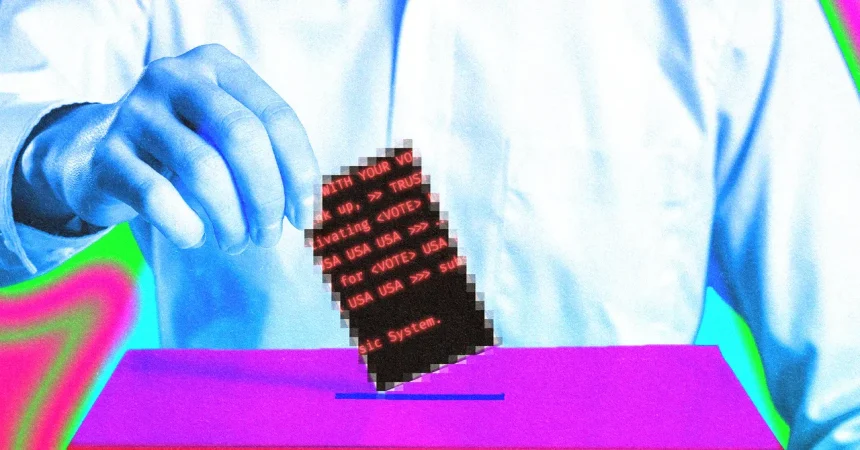
It is Election Day in the United States, a time-honored ritual that transforms ordinary citizens into civic arbiters, pondering complex issues with a ballot in hand. Yet this year, the process of reaching a decision has been subtly and dangerously augmented by an unseen digital presence. Homes across the nation are no longer just filled with the murmur of televised debates or the rustle of campaign flyers; they now hum with the benign, synthesized tones of artificial intelligence chatbots. According to the Pew Research Center, nearly half of all American adults have at some point engaged with one of these conversational programs, and a significant minority—around eight percent—have explicitly relied on them to navigate the murky waters of the 2026 midterm elections. They ask about tax policies, candidate histories, and the nuances of voting regulations, eagerly awaiting the instant, authoritative-looking answers that these digital oracles provide. On the surface, it is a marvel of convenience. Who has the time to read a two-hundred-page policy proposal when a chatbot can summarize it in three bullet points? For the average citizen, the allure is irresistible. Standing in line at a coffee shop or sitting on a bus, they can type a complex question and receive a sleek, structured answer within seconds. It feels like having a personal policy advisor on standby, but the cost of this convenience is a profound loss of accountability. Yet, as the nation heads to the polls, a growing body of research reveals that this convenient oracle is built on shifting sand. The information it provides is frequently outdated, wildly inaccurate, or simply hallucinated—fabricated beyond any basis in reality. Worse, the problem is not confined to obscure corners of the internet; it permeates the most prominent and trusted AI platforms available, from OpenAI’s ChatGPT to Google’s Gemini and Anthropic’s Claude. For millions of voters placing their trust in these systems, the very foundation of an informed democracy is being quietly chipped away. The promises of seamless technological clarity have instead introduced a profound new layer of vulnerability into the electoral process. Voters are asking complex questions, receiving confident but false answers, and then walking into the polling booth with misconceptions that could easily determine the fate of a local race or a statewide ballot measure. The degree of this reliance is a stark indictment of our modern information habits. We have outsourced our civic judgment to the least reliable digital companions imaginable—tools that are merely predicting what a correct answer might sound like, rather than actually knowing the truth. It is a deeply uncomfortable reality that on the most important civic day of the year, many citizens are actively consulting a machine that understands nothing about the people and policies it discusses.
The failures of these chatbots are not minor glitches or cosmetic imperfections; they are systemic, frequent, and often ludicrously destructive to the accuracy of a citizen’s worldview. A comprehensive study conducted by Forum AI, a non-profit research organization dedicated to monitoring algorithmic bias, found that nearly 40 percent of all election-related answers generated by mainstream chatbots contained at least one demonstrable factual error. To put that number in perspective, if a major news network got 40 percent of their election coverage facts wrong, they would be legally gutted and publicly humiliated. Yet these digital assistants are spitting out inaccuracies with the unshakable confidence of a seasoned pundit. Consider the concrete examples from just the last week of the campaign. Google’s AI Mode, a headline feature for millions of Android users, outright refused to provide the results of the 2020 presidential election—a historical fact that is archived in every library, textbook, and government record. Simultaneously, its sibling chatbot, Gemini, confidently informed users that the deadline to request a mail-in ballot in the critical swing state of Pennsylvania was November 3rd. In reality, the deadline had already passed on October 27th. A voter who followed that advice would have missed their chance entirely, effectively silencing their own voice in the democratic process. Across the aisle, Anthropic’s Claude managed to confuse North Carolina Congressman Don Davis with a “former school superintendent” of the same name, giving users a bizarrely fabricated biography that mixed up two different humans. These are not isolated anecdotes; they represent a pattern of deep unreliability that Forum AI statistically verified across the board. The chatbots are failing precisely at the tasks they claim to have revolutionized: synthesizing complex information into safe, actionable knowledge. Instead of distilling the truth from the noise, they are amplifying the noise while presenting it as gospel, leaving ordinary voters to struggle with the impossible task of trusting a machine that consistently proves it cannot be trusted. The confidence with which they deliver falsehoods is perhaps the most insidious aspect, as humans are instinctively drawn to declarative certainty. These models perfectly mimic that human trait without possessing any actual comprehension, weaving a dangerously persuasive illusion of omniscience that collapses under the lightest scrutiny of factual verification.
Why are these ostensibly advanced systems so catastrophically bad at answering questions that a simple web search could resolve? The answer lies deep in the tangled, polluted ecosystem of the modern internet itself. Chatbots are, fundamentally, sophisticated parrots. They are trained on colossal swaths of the open web, learning to predict sequences of text based on statistical probability rather than comprehension. The problem is that the web they inhale is increasingly saturated with a particularly insidious form of propaganda known as “pink slime” journalism. These are websites that meticulously imitate the layout, typography, and logos of legitimate local news outlets, but are secretly funded and operated by partisan political action committees, ideological donors, or shadowy super PACs. Their sole purpose is to seed deceptive narratives into the public consciousness while wearing the mask of objective reporting. NewsGuard, a research firm dedicated to tracking misinformation, ran a rigorous test asking the leading chatbots about candidates and policies directly relevant to the midterms. The findings were sobering: mainstream chatbots cited these fraudulent “pink slime” websites approximately 50 percent of the time when discussing candidates, treating them as legitimate, trustworthy sources. The worst offender, according to NewsGuard, was OpenAI’s ChatGPT, which leaned on these fake news platforms in more than 70 percent of its searches, essentially serving as a high-tech distribution channel for partisan propaganda. Even the best-performing system, xAI’s Grok, still directed users to these bogus sources nearly one-third of the time. When millions of voters ask a chatbot for a neutral, reliable summary of a candidate’s stance, they are instead receiving a perfectly polished, algorithmically generated partisan pamphlet. The boundary between factual reporting and psychological manipulation has been dissolved, and the chatbots are drilling enormous holes in that porous line. These machines cannot tell the difference between a Pulitzer Prize-winning investigative report and a cheaply produced smear campaign, because to them, they are just strings of characters predicting the next probable word—devoid of any ethical consideration or grasp of journalistic integrity.
The reaction—or, more accurately, the resounding absence of reaction—from the technology giants responsible for these tools has been a masterclass in corporate deflection and strategic silence. When contacted by journalists seeking comment on the documented failures, Google and Anthropic simply declined to respond, choosing to ignore the growing pile of evidence against their products’ reliability. OpenAI, the creator of ChatGPT, opted for a bureaucratic pivot, directing all inquiries to a single, vague blog post that outlined their lofty, non-specific ambitions for election integrity in the distant future. This silence speaks volumes about the fundamental disconnect between the marketing departments and the engineering realities of these corporations. These companies aggressively sell their products as omniscient, neutral assistants, capable of smoothing over the complexities of modern life with graceful, conversational ease. They advertise absolute competence, presenting these tools as a cure-all for information fatigue. Yet, when the rubber meets the road—when a real voter facing a real deadline asks a real question—they reveal themselves to be fragile collages of the internet’s worst impulses, devoid of context, nuance, or even a basic grasp of chronological reality. The systems are, at their core, predictive text engines. They do not possess knowledge; they merely calculate the most statistically likely sequence of words based on their training data. When they confront a question about a rapidly evolving election cycle—a period where information changes by the hour—their training data quickly becomes stale, and their predictive mechanisms begin to malfunction. They do not admit ignorance; they fill the gaps with plausible-sounding fiction, inventing deadlines, conflating candidates, and rejecting historical facts with the same authoritative tone they use for basic arithmetic. This failure of accountability is deeply troubling because it leaves the public without any recourse or reassurance that future versions will be any better, while the companies continue to profit handsomely from the trust they have earned but not earned.
Experts who have dedicated their careers to studying the intersection of technology, governance, and disinformation are deeply alarmed by this newfound reliance on artificial intelligence during such a critical civic ceremony. Nina Jankowicz, the executive director of the American Sunlight Project and a former disinformation czar during the Biden administration, articulates the danger with chilling prescience. “I don’t think that most Americans are prepared to navigate an election in the age of consumer AI,” she tells WIRED. Her warning stems from a profound understanding of how these systems operate. Jankowicz points to a foundational issue: the technology executives have “really overpromised” on what their artificial intelligence can accomplish. They have sold the public on a vision of flawless digital thinking, yet the reality is far messier. She explains that the machine must ingest its information from some external source, and frequently, the wellspring of that information is contaminated with bias, manipulation, or outright lies. Worse still, because the underlying technology is fundamentally predictive rather than deliberative, when it encounters a gap in its knowledge base, “it does frequently make things up.” This is not merely a fleeting inconvenience or a harmless quirk to be laughed off. It is a direct threat to the very concept of an informed electorate. If the foundational step of democracy—knowing what a candidate actually stands for, understanding how to vote, and grasping the basic facts of the ballot—is outsourced to a machine that stumbles over simple deadlines and mixes up names and faces, the entire system is undermined. Voters are left helplessly trusting a black box they do not remotely understand, while the operators of that black box claim complete immunity from the consequences of their creations’ hallucinations. This is not a question of technical sophistication; it is a question of civic survival, forcing us to ask whether we can afford to let flawed algorithms mediate the most fundamental act of self-governance, or whether we must retain the human capacity for skepticism, patience, and deep reading in an age that increasingly values speed over substance.
As the polls close tonight and the votes are counted, the true cost of this grand artificial intelligence experiment will be measured not in stock valuations or user retention metrics, but in the quiet, corrosive erosion of democratic trust. The original promise of AI was that it would remove the friction from the human experience, offering a distilled wisdom that cuts through the overwhelming deluge of information. Instead, we have unleashed a technology that is sloppy, partisan, and dangerously overconfident. It amplifies the very noise it was designed to diminish, serving up fabricated deadlines and hallucinated biographies with the same unwavering certainty a human expert would reserve for the laws of physics. The problem is not that artificial intelligence is failing to work as intended; the problem is that we, as a society, are failing ourselves by treating a probabilistic language model as a credible, infallible source of truth. We have grown so accustomed to the convenience of asking a device and instantly receiving an answer that we have completely forgotten to question the foundational validity of that answer. For the eight percent of voters who trusted these tools today, the outcome may be a canceled ballot, a deeply misplaced belief, or a fundamentally skewed understanding of their local representatives and the issues at hand. The technology industry will likely release a flurry of apologetic patches, rushed updates, and carefully worded white papers in the coming weeks, but the core vulnerability remains entirely unaddressed. Until we, as citizens, demand rigorous accuracy over slick convenience, and until the AI companies finally own up to the inconvenient truth that their “intelligence” is merely a well-dressed mirror of our own societal rot and digital pollution, we will continue to walk blindly into the future, guided by a digital blindfold made entirely of questionable code and hidden agendas. The fate of our democracy should not rest on the hallucinating whims of a machine that does not know what a fact is, nor should the sacred act of voting be reduced to a desperate gamble on whether a chatbot happened to scrape a reliable source yesterday.