My YouTube homepage has always felt a little bit like a diary I never actually wrote. It knows me in ways I don’t fully understand, and sometimes in ways I don’t want to admit. The algorithm has spent years absorbing my viewing history, my clicks, my skips, my weird late-night obsessions, and all the little breadcrumbs I leave behind without thinking. It knows that I’ll click on an Apple Watch analysis even though I’m not shopping for a smartwatch. It knows that I need the latest Big Brother season update, even though I tell myself I’m not that invested in reality TV. And it certainly knows that when Chris Fleming’s “I Lost to the Muppets” shows up, I’m going to watch it immediately. Click. Click. Click. My current top three videos were exactly those, and honestly, it felt less like a recommendation engine and more like a friend who has memorized my routine. There’s something intimate about that, and a little unsettling, but mostly it’s comforting. It’s the reason I keep coming back. YouTube’s algorithm isn’t perfect, of course. It sometimes gets stuck on a rabbit hole I long ago outgrew, or it suddenly assumes I want nothing but productivity content because I watched one video about morning routines. But most of the time, it just gets me. That’s why the idea of being able to nudge it, to actually tell it in plain words what I want more of, feels like a small revolutionary act.
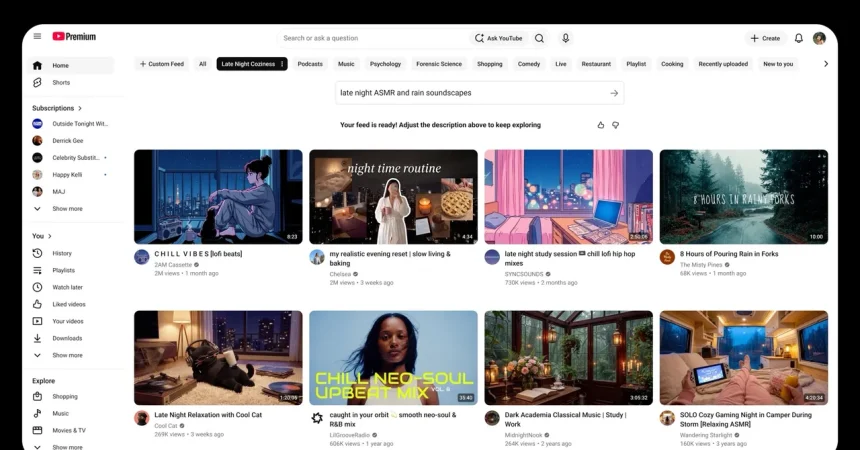
On Wednesday, during its Made on YouTube event, Google announced a handful of new features aimed at giving creators and viewers more flexibility. The one that caught my attention was Custom Feeds, a new button that lets users directly adjust what shows up on their home screen. It’s not just another like button or a “don’t recommend channel” action. This is different. It’s a chance to actually talk to the algorithm in natural language, like you’re ordering coffee, and have it build a whole homepage around your request. For anyone who has ever felt at the mercy of a recommendation system, this is huge. For anyone who has ever wanted to say, “No, I don’t want to see another video about that, I want to see more of this,” this is the moment. Emily Moxley, YouTube’s vice president of product management, framed it as a direct response to what users have been asking for. “Users are always telling us that they want more control,” she said. “They want more ability to steer their algorithm. With custom feeds, we’re giving them a natural-language way that they can do that. They can tell us exactly what they want.” That’s the promise: no more translating my wishes into the language of thumbs, percentages, and “not interested” signals. I can just say what I want, and the platform will listen.
So how does it actually work? It’s simpler than I expected. If you open YouTube, you’ll see a row of tabs below the search bar, the usual things like “Music” and “Podcasts.” Next to those sits a new option: “Your custom feeds.” Click it, and you’re prompted to type in a request for the kind of feed you’d like to see. You could ask for something practical, like “tech reviews from the past month,” or something purely atmospheric, like the example prompt YouTube showed me: “I want a rainy Shanghai vibe: café jazz, street food, and vlogs.” There’s something dreamy about that. It’s not just a search query; it’s a mood board. Under the hood, YouTube is using large language models to process your request, parse the vibe, the topics, the timeframe, and then pull together videos from all over the platform that match. It feels a little like having a personal programmer who also happens to understand metaphor. You can save multiple custom feeds, so you might have one for cozy cooking videos, one for long-form conversations, and one for short, mindless clips to watch before bed. Each feed is separate from your standard homepage, which means you don’t have to give up the familiar mix of recommendations you already love. The custom feed is just another layer, another tool, another way to shape the experience.
Of course, I had to try it for myself. The moment I saw the feature, I knew exactly what I wanted to ask for. After a long day, my brain doesn’t want deep documentaries or high-stakes drama. It wants gooey macaroni and cheese recipe videos, Caleb Hearon clip compilations, and crystal singing bowl videos under fifteen minutes. That’s the kind of content that lets me rot on the couch in the best possible way. So I typed it in, maybe a little shyly, as if the algorithm could judge me. It didn’t. Instead, it went to work. When my newly generated feed loaded, I was genuinely impressed. There, waiting for me, were videos that matched my strange request with an almost eerie precision. Mac and cheese, but not just any mac and cheese—the kind that splits slowly from the spoon, the kind that makes you want to crawl inside the screen. Caleb Hearon clips, exactly the ones I would have chosen if I’d had time to search for them. Crystal singing bowls, calming and spacious, all under fifteen minutes, all perfect for winding down. It was my ideal post-work binge, assembled in seconds. YouTube even suggested potential additions that I could tack onto my prompt, phrases like “uploaded this month” or “without talking or commentary.” I had to appreciate the specificity. The platform wasn’t just delivering what I asked for; it was helping me refine my own taste.
Custom Feeds isn’t entirely new. YouTube tested it as an experimental feature earlier this year, and apparently it did well enough that the company decided to make it a real part of the platform. The rollout will start soon, and it’s coming to all US users, whether you’re on mobile, desktop, or TV. That last part matters, because the living room is where so many of us actually watch YouTube. Having the ability to change your feed without digging through menus on a remote control makes a difference. And importantly, experimenting with a custom feed doesn’t replace your regular homepage. There’s still an “All” button that takes you back to the algorithmic mix you already know and love. That’s a comforting thought. The custom feed is more like an alternate universe, a carefully curated room you can step into whenever you want, without having to abandon the home you’ve built over years of watching and clicking. It’s also worth noting that the feature feels like a shift in how YouTube thinks about its relationship with viewers. For a long time, the algorithm was this mysterious black box that seemed to know everything but explained nothing. Now, the company is handing over a key, even if it’s just a small one. Moxley’s language makes it clear that this is about trust and control, about giving people a way to feel like they aren’t simply passive consumers. And in an era where so much of our online experience is shaped by invisible forces, any bit of agency feels meaningful.
Ultimately, Custom Feeds says something about how we relate to our screens and ourselves. We like to pretend we’re above algorithms, that our feeds are simply noise we tolerate. But the truth is, many of us have deep, complicated relationships with our homepages. That mix of videos isn’t just a list; it’s a reflection of who we are, what we’re curious about, what we turn to when we’re sad or tired or bored. It’s a mirror made of thumbnails and autoplay. So being able to speak to that mirror and say, “Show me what I need right now,” feels like a small act of reclaiming authority over our own attention. It also raises a fun question: if you could tell YouTube exactly what you wanted, what would you ask for? Would you ask for something productive and ambitious, like language lessons and career advice? Or would you ask for the visual equivalent of a weighted blanket, something soft and comforting and deeply familiar? I asked for mac and cheese, Caleb Hearon, and singing bowls, and I don’t regret it. Because sometimes the sacredness of an algorithm isn’t about being served what’s good for you. It’s about being served what makes you feel human. And if this tool lets more people find that exact comfort, then maybe the algorithm is finally becoming a little less mysterious and a little more like a conversation.