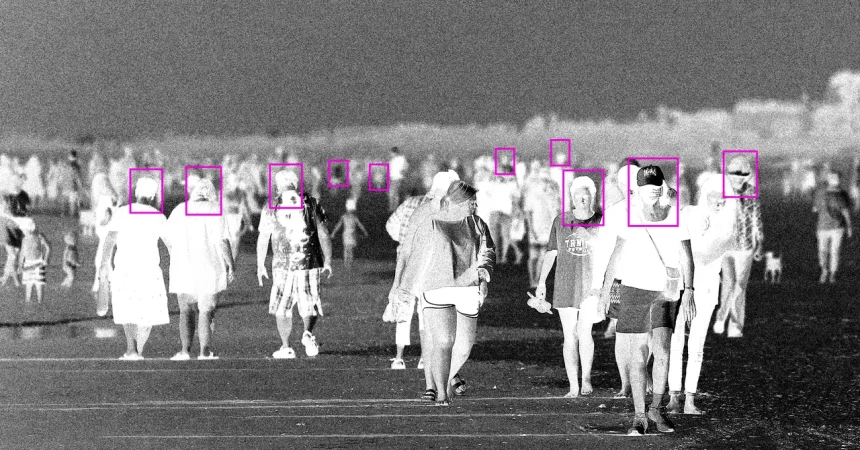
The story of Robert Dillon serves as a chilling reminder of how quickly a life can be dismantled when human intuition is surrendered to the cold, flawed logic of an algorithm. Dillon, a 52-year-old commercial crabber from Fort Myers, Florida, was an ordinary man living an ordinary life until a digital error shattered his reality. In November 2023, a man in Jacksonville Beach—a city over 300 miles away from Dillon’s home—allegedly approached a young girl at a McDonald’s, causing a localized police investigation that would eventually spiral into a personal nightmare for a stranger who had never even set foot in that town. The culprit was a facial recognition system known as FACES, a powerful database operated by the Pinellas County Sheriff’s Office that houses millions of Floridians’ DMV and mugshot photos. Because a computer algorithm spat out a “93 percent match” based on a grainy cellphone photo of a security screen, a hardworking father suddenly found himself branded a predator.
To understand the scope of this injustice, one must recognize the fundamental danger of how police use this technology. The system provided a high percentage score, but as experts and the ACLU have pointed out, that percentage is not a measure of certainty; it is merely a mathematical calculation of visual similarity between two images. Yet, when that number reached the hands of investigators, it was treated as an objective fact rather than a lead. The police report, which would later become the basis for a lawsuit, shows that the system’s output was taken at face value. The terrifying reality is that this “match” was blindly trusted by law enforcement, overriding the necessity for rigorous, evidence-based police work. It is a cautionary tale of how a shortcut in technology becomes a shortcut in justice, turning a tool meant to assist authorities into a weapon pointed at an innocent civilian.
The emotional and physical toll on Robert Dillon is impossible to quantify. He was arrested at his home in front of his wife, a humiliating and traumatic experience that stripped him of his dignity in an instant. He was held overnight in a freezing cell, transported in the back of a dark, caged van, and forced to put up the title of his only vehicle—his work truck—just to make bond. Because this happened during the peak stone crab season, his forced absence meant he couldn’t work, causing him to fall behind on his rent and bringing him to the brink of homelessness. Even after the legal system eventually checked its mistake, the damage remained; his mugshot stayed online for nearly a year, only disappearing after a persistent journalist brought it to light. Today, Dillon lives with the social consequences of a baseless accusation, as strangers in his own community approach him with suspicion, and he admits that he feels a painful, lingering fear even to be near children.
Perhaps the most egregious part of the story is what the police chose to ignore. The investigation was not just poorly executed; it was arguably negligent. When authorities ran a search for Dillon’s license plates in the Jacksonville area during the time of the crime, the results came back empty. There was simply no evidence that he had been anywhere near the location. Furthermore, a McDonald’s manager had informed police that the suspect was a “regular customer” in that specific neighborhood, a detail that clearly should have exonerated a man living three hours away. Records indicate that these exculpatory facts were conveniently omitted when the officer submitted the request for an arrest warrant to a judge. The warrant was signed based on an incomplete and misleading narrative, leading to a wrongful arrest that the state would later have no choice but to dismiss when presented with the truth.
The aftermath of the state’s admission of error highlights a systemic lack of accountability. Despite the fact that the State Attorney’s Office dropped all charges against Dillon in October, recognizing that he had been falsely accused, the official reaction from the police department was shielded by a baffling bureaucratic silence. Not only was the detective responsible for the reckless warrant application not penalized, but they were actually promoted by the end of the year. This sends a demoralizing message to the public: that the convenience of an algorithm is valued more than the life and reputation of a citizen, and that mistakes made in pursuit of a “match” carry no meaningful consequences for those in power. For Dillon, his exoneration was not a return to normalcy; it was merely the end of one struggle and the beginning of a long path toward rebuilding a ruined life.
Robert Dillon’s own words offer the most harrowing perspective on this ordeal. He speaks of the terror of wondering if he would ever see his daughter again, a fear that has been replaced by the heavy burden of “picking up the pieces.” His lawsuit against the state is not just about financial compensation; it is a plea for systemic integrity. He argues that police must stop hiding behind “dangerous technology” and return to the foundational duty of conducting actual, thorough investigations. His experience stands as a stark warning to society: when we allow machines to act as judge, jury, and executioner without the tempering presence of human discernment and the rigorous demands of evidence, we aren’t just creating a more efficient justice system—we are creating a system where the innocent are sacrificed at the altar of technological convenience.