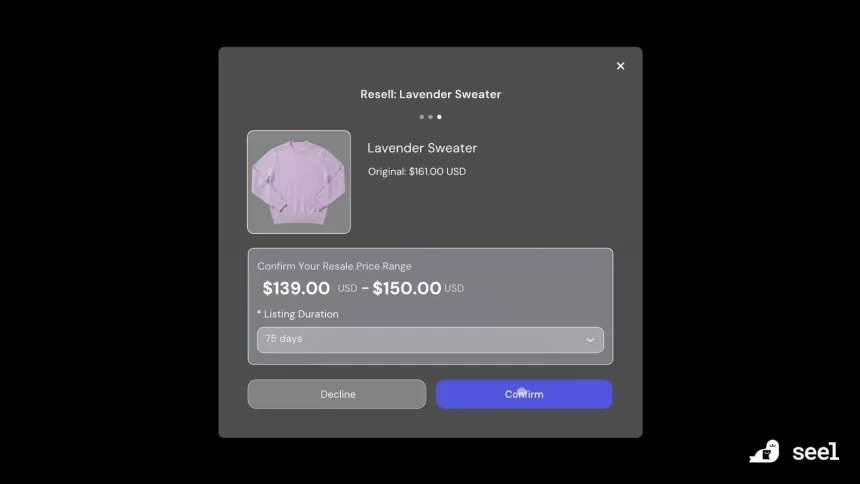
Here is a humanized and expanded summary of the provided text, presented in six paragraphs.
In the modern age of e-commerce, the ease of purchasing has reached a level of almost magical convenience. With a few taps on a smartphone in the dead of night, a shopper can have a package arrive at their doorstep the very next morning. This frictionless experience on the front end, however, often hits a frustrating wall on the back end, particularly when it comes to returns. The traditional post-purchase journey is riddled with timers and deadlines; once that return window slams shut, a shopper who bought the wrong size or had a change of heart is typically left with two unappealing options: keep an item they don’t want or go through the hassle of listing it on a secondhand marketplace themselves. This is the “last unsolved pain point” that Seel, an AI-driven operations platform for commerce, has now set its sights on, unveiling a new resale capability directly within its order center. The genius of this feature is its simplicity: it meets shoppers exactly where they already are, in the same portal they use to track their purchases, offering a graceful and valuable exit strategy when a traditional return is no longer on the table.
At its core, this new tool is about creating a win-win scenario out of a situation that usually feels like a loss. For the consumer, it transforms a dead-end into a dynamic marketplace, allowing them to recover financial value from gently used clothing instead of letting it gather dust in a closet. For the merchant, it’s a powerful tool for customer retention and brand loyalty, transforming a potentially negative experience—the dreaded “return denied” notification—into a positive, value-added interaction. Instead of severing the relationship at the point of sale, Seel’s feature extends the post-purchase experience, building trust and reducing friction. This is a stark contrast to the common customer service nightmare of speaking with a bot that regurgitates canned responses and fails to understand the simplest requests. Seel’s platform, by automating the entire resale process, aims to solve real problems, avoiding the historical brand pitfalls of two-day response times for critical issues like shipping address changes. As Zack Peng, CEO and cofounder of Seel, aptly puts it, “Consumers shouldn’t have to lose out just because a return window closes.”
The mechanics behind this innovative feature are a testament to the power of applied artificial intelligence. Seel essentially acts as an agentic layer over the entire commerce ecosystem, taking the burden of selling entirely off the shoulders of the shopper. Once a return is deemed ineligible, the platform steps in to handle everything. It takes the product information, generates a compelling and authentic listing that showcases the item’s current condition, and then syndicates that listing across seven different marketplaces to maximize exposure. This introduces a level of complexity that requires sophisticated inventory management—when an item sells on one platform, an AI agent automatically removes the listing from the other six to prevent double-selling and confusion. The platform also handles the dynamic aspects of selling, running auctions, updating prices based on real-time market data to find the ideal clearing price, and even messaging potential buyers. Fulfillment is automated as well, sending shipping labels and instructions to the seller, who then ships the item directly to the new buyer, creating a seamless peer-to-peer transaction.
This launch arrives at a pivotal moment of explosive growth for Seel, which has scaled sevenfold over the past year, reaching a triple-digit revenue run rate and becoming profitable. The company’s AI-powered features now serve more than 50 million consumers across a staggering $6 billion in annual gross merchandise value (GMV), a nearly tenfold year-over-year increase. Major clients include the likes of Poshmark, TikTok Shop, and Debenhams, with a roster that also features smaller retailers and brands such as Karen Millen, Roxy, and Boohooman. The core thesis driving this success, according to Peng, is the massive cost associated with moving products post-purchase—a $280 billion annual expenditure on support, reselling, and logistics. While the current focus is on solving these immediate logistical puzzles, the future holds significant potential. Peng hasn’t ruled out an IPO, calling it an “exciting milestone” for him as a founder, though he is more focused on building the company’s long-term impact than on a specific exit strategy. His ambition is clear: to become one of the biggest agentic commerce companies in the world.
The broader context for this innovation is a secondhand shopping market that holds immense promise but has been historically held back by friction. While offering affordable prices to buyers, liquidity to sellers, and environmental benefits by reducing waste, resale currently represents less than 3% of U.S. e-commerce transactions. The reason for this low penetration is the sheer hassle involved: creating listings across multiple platforms, constantly monitoring prices, and negotiating with potential buyers. Seel’s technology directly addresses this friction, making the process effortless for the consumer and thereby unlocking a massive, dormant market. This is a prime example of AI unlocking entirely net-new experiences that aren’t just about saving money, but about creating convenience and value where none existed before. It represents a fundamental shift in how brands can interact with their customers, moving beyond the initial transaction to foster an ongoing, sustainable relationship with their products.
Industry experts see this as a natural evolution in the e-commerce landscape, where the intense focus on conversion has often overshadowed the rest of the customer journey. Anamitra Banerji, managing partner at Afore Capital, an investor in Seel, points out that while giants like Amazon made returns easy, many other merchants have “forgotten everything that happens after the purchase.” An enormous amount of energy and capital goes into getting a shopper to click “buy,” but the experience that follows is what truly sets a brand apart. Seel’s technology allows smaller retailers to deliver these net-new, sophisticated experiences that would be impossible to build in-house, regardless of budget. This marks a significant application of AI beyond the realms of software and coding, moving into the very fabric of commerce. As Banerji notes, while AI is making inroads into various sectors, there’s a clear opportunity for a standout agentic commerce play—a platform that provides merchants with tools whose primary job is to generate sales and, in doing so, creates a more seamless, efficient, and satisfying experience for the end consumer.