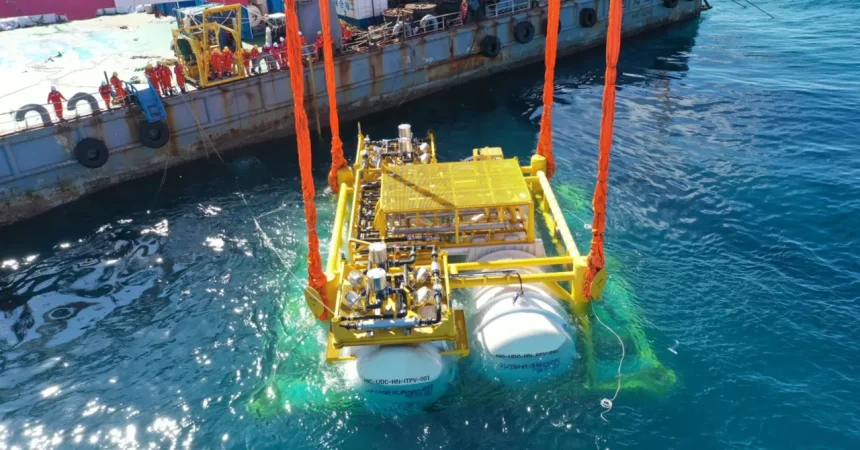
The digital age is often imagined as a cloud-based abstraction, but in reality, it is anchored by massive, power-hungry physical structures. As the demand for artificial intelligence explodes, so too does the need for computing power to support it. China has recently taken a bold step to bridge this gap, launching the world’s first offshore wind-powered underwater data center (UDC) off the coast of Shanghai. By submerging this high-tech facility ten meters beneath the surface in the Lin-gang Special Zone, China is not just trying to save energy; it is reimagining how the backbone of our digital infrastructure interacts with the natural world. This project, a $236 million collaboration between HiCloud Technology and China Communications Construction, serves as a blueprint for a future where technology is designed to coexist with the environment rather than drain it.
The genius of this underwater approach lies in its solution to one of the most persistent problems in tech: heat. Traditional data centers require massive amounts of electricity to keep their servers cool, with air conditioning systems often consuming up to 50 percent of their total power. By turning to the sea, this facility effectively replaces energy-intensive fans and cooling towers with the natural thermal capacity of seawater. This shift has resulted in a Power Usage Effectiveness (PUE) rating of 1.15—a near-perfect level of efficiency that sets a new gold standard for the industry. Because the ocean keeps the servers naturally chilled, the facility slashes its cooling energy requirements by nearly 40 percent compared to older, land-based centers, proving that a more sustainable architecture is not just possible, but highly functional.
Beyond cooling, the Shanghai project is a masterclass in resource optimization. According to government reports, this underwater facility relies on an impressive 95 percent green energy, specifically sourced from offshore wind turbines. This represents a complete paradigm shift from the status quo, effectively eliminating the need for land and fresh water for cooling. While the project is groundbreaking, it is also part of a larger, evolving strategy. Following the successful launch of a pilot program in Hainan last year, China is signaling that underwater data storage is no longer a localized experiment, but a scalable industrial solution that avoids the environmental footprint typically associated with massive server farms.
This technological leap is fundamentally driven by the escalating race for global AI hegemony. A recent UN report underscored the stark reality of the modern era: of the 32 countries that host specialized AI data centers, 90 percent of that global infrastructure is locked between two superpowers—China and the United States. While the U.S. and China are both clamoring for the same computing power, their paths to fueling this growth differ significantly. China is aggressively pursuing energy self-sufficiency as a national imperative. By moving away from fossil fuels, the nation aims to insulate itself from global supply chain volatility and satisfy its increasing environmental goals, viewing energy independence as a critical pillar of its geopolitical and technological sovereignty.
To support this transition, China has initiated a sweeping overhaul of its entire national energy market. New legislation that came into effect last year is forcing a move toward renewable sources, such as hydrogen and advanced nuclear tech, while simultaneously phasing out old subsidies in favor of market-driven competition. By requiring that wind and solar energy be traded through transparent auctions by mid-2025, the government is essentially forcing the power sector to become more efficient and carbon-neutral. It is a calculated, top-down attempt to modernize an industrial giant, ensuring that the sheer amount of electricity required to run the next generation of artificial intelligence does not come at the cost of global climate goals or energy security.
Ultimately, the launch of the Shanghai underwater data center is much more than an engineering feat; it is a manifestation of China’s long-term vision. By integrating cutting-edge tech with ocean-based climate solutions, Beijing is attempting to future-proof its economy against both climate change and the risk of being beholden to foreign energy suppliers. As these two global powers continue their high-stakes competition for leadership in the AI age, the infrastructure they build today will define the geopolitics of tomorrow. The underwater data center stands as a symbol of a new era where technological development is inextricably linked with environmental stewardship and industrial independence, signaling that the most important battles for the future will be fought as much in the hardware of our data as in the energy grids that feed them.