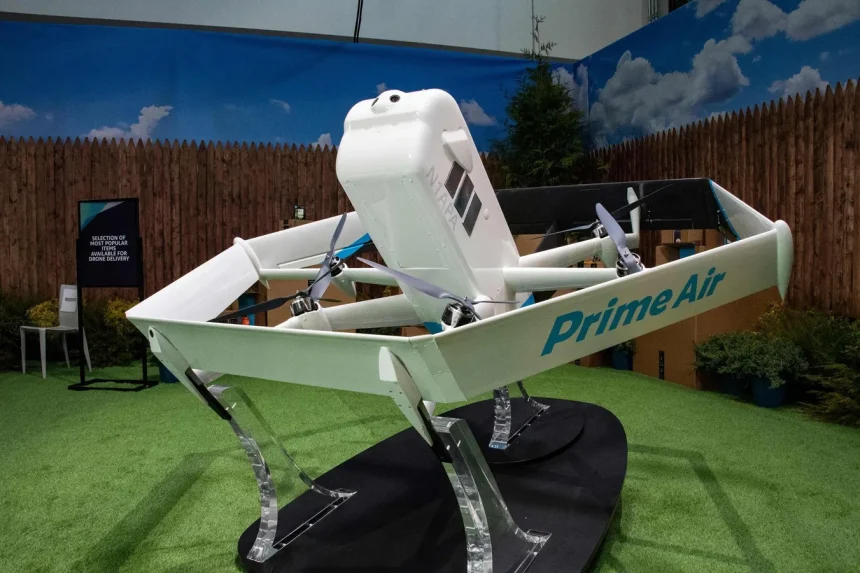
For over a decade, Amazon has painted a picture of a future where the sky hums with the quiet whir of delivery drones, a vision that often felt more at home in the pages of a science fiction novel than in the reality of suburban America. After years of promising this aerial revolution just over the horizon, the company’s long-held ambition is finally materializing in a tangible way. The dream, first unveiled by Jeff Bezos with characteristic fanfare, is shedding its futuristic sheen and becoming a practical, logistical reality. The journey has been fraught with regulatory hurdles, technical glitches, and public skepticism, but the promise of a package descending from the clouds is no longer a distant fantasy. It is a service that is about to become a part of everyday life for millions of people across the country, marking a significant and long-awaited turning point in the story of e-commerce and its relentless pursuit of speed.
The scale of this shift is dramatic. Amazon has announced its intention to expand its Prime Air drone delivery service to nearly 500 new cities and towns across the United States by the end of the year. This move represents a massive upward scaling of its operations, a six-fold increase from its current footprint. What was once a pilot program concentrated in a handful of metropolitan areas is set to become a widespread network, bringing millions of additional consumers within reach of Amazon’s small, autonomous aircraft. These drones, capable of ferrying everything from last-minute grocery items and vital prescriptions to the latest gadgets and household staples, are poised to become a familiar sight in the skies. This expansion is the culmination of one of the company’s most persistent and challenging projects, a testament to the unwavering belief that the speed of delivery is the ultimate frontier in customer satisfaction. The infrastructure, the regulatory approvals, and the technology have finally converged, creating a new commercial highway in the air that promises to redefine the final mile of delivery.
However, Amazon is not alone in this aerial race, and the competitive landscape has evolved significantly since Bezos first shared his vision. Other players have already charged ahead, proving the viability of drone delivery on a grand scale and setting a high bar for what is possible. Alphabet’s Wing, for instance, has surpassed a million commercial deliveries and is aggressively expanding its partnership with Walmart across the United States. Walmart itself, a behemoth of terrestrial retail, has already achieved over a million drone deliveries, boasting an average delivery time of just 23 minutes and a record-breaking trip of under five minutes. Meanwhile, Zipline has emerged as a global leader, carrying out more than two million deliveries across four continents and securing a valuation in the billions. The recent partnership between Uber and Zipline signals an even more ambitious future, with plans to facilitate up to a million drone deliveries a day by 2029. This is no longer a solitary experiment; it is a full-blown industry race where being first is less important than being the most reliable, efficient, and widespread.
Despite this intense competition, Amazon’s expansion is a defining moment, but it’s one that has been hard-won. The company’s internal communications show a relentless focus on speed, with executives emphasizing that the limits of customer demand for faster delivery have yet to be reached. To achieve this, the Federal Aviation Administration has granted Amazon approval for longer-range operations, allowing drones to fly beyond the pilot’s line of sight, a crucial milestone for scaling up beyond a small, geographically-contained test area. Amazon envisions its drones eventually handling a staggering 500 million packages a year, yet the path has been littered with obstacles that have grounded the fleet and threatened its progress. High-profile incidents, including drones colliding with infrastructure like cranes and internet cables, have attracted the scrutiny of federal safety boards and the FAA. These technical failures highlight the immense difficulty of operating thousands of autonomous machines in complex, shared airspace, where a small error can have significant consequences, undermining public confidence just as the company works to build it.
Beyond the engineering challenges, Amazon faces the equally difficult task of winning over the public, as resistance from communities concerned about noise, privacy, and the perceived threat to their neighborhoods and property values remains a potent force. The company has had to address these anxieties while also grappling with the limitations of its own technology. For instance, current drone models hover overhead and drop packages from a height of thirteen feet, a method that is both noisy and restricts the types of goods that can be delivered. In response, Amazon is testing a new, gentler system involving a retractable tether to lower packages safely to the ground, acknowledging that the “drop-and-go” method is a temporary compromise. This is an area where competitors have already established a lead, with Wing’s tethering system being a standard feature. As Amazon expands into new territories, it must convince skeptical residents that its drones are quiet, safe, and a valuable service, not an intrusion, a challenge that is as much about public relations as it is about technological prowess.
In conclusion, the aerial future of shopping that Jeff Bezos envisioned in 2013 is no longer a distant dream but an imminent reality, though its arrival is far different than initially imagined. Amazon’s ambitious plan to bring drone delivery to hundreds of new cities is a clear signal that this once-futuristic concept has become a core element of commercial logistics. The irony is that this vision is finally coming to fruition not in a vacuum, but in a fiercely competitive arena where companies like Walmart and Alphabet have already laid considerable groundwork. Amazon is entering a mature market, not pioneering an uncharted one, and must now prove it can deliver on its promises at scale, doing so safely, quietly, and efficiently. The drone war for the skies is not just about technology per se, but about winning the trust of consumers and communities alike. It is a race to build the future of delivery, and it is now officially underway in earnest, with the stakes being nothing less than the very definition of convenience in the digital age. For the consumer, the sky is no longer the limit, but the new frontier of instant gratification.