1. The Shock of the War Game
Colleen Golja had always believed that when the fate of the planet was on the line, science and reason would be given a seat at the table. She had spent years as a climate researcher, studying the physics of the atmosphere, the delicate balances that keep our world livable, and the terrifying ways human activity is tipping those balances. She knew that the decisions ahead would be difficult, but she assumed that if the stakes were high enough, people would listen to the evidence. That assumption shattered one morning last September in London. Golja walked into a meeting room at Queen Mary University of London, where a couple dozen foreign-relations experts, scientists, military personnel, and former government officials had gathered from across the world. They had come together for the first in a series of war games, simulations designed to test how the international community might respond to a profound and dangerous challenge: the emergence of technologies that could cool the planet by reflecting sunlight back into space. The official title of the exercise was Exploring Geopolitical Tipping Points and Climate Cooling Strategies. But the real question was simpler and more frightening: could the world prevent an uncontrolled global race to develop a technology that carries vast, unknown risks, risks that could reshape life on Earth? Over coffee and little yogurts, the participants made polite introductions. Then they took their seats at tables arranged in a square, each place marked with the name of a country or organization they would be playing. There were national governments, climate NGOs, indigenous groups, and tech companies. Golja’s role was to provide technical advice, to help the players make scientifically literate decisions. She thought the exercise would be easy. “I thought that would be such an easy thing. Like, we can all agree to do ethical research and make sure it’s for the better of all humans,” she told WIRED. “And boy, was I wrong.” What she witnessed over the course of the simulation was not a meeting of rational minds committed to the common good. It was a raw, uncomfortable display of human nature: suspicion, rivalry, short-term self-interest, and the desperate urge to control the thermostat of the entire planet.
2. The Seductive and Terrifying Promise of Solar Geoengineering
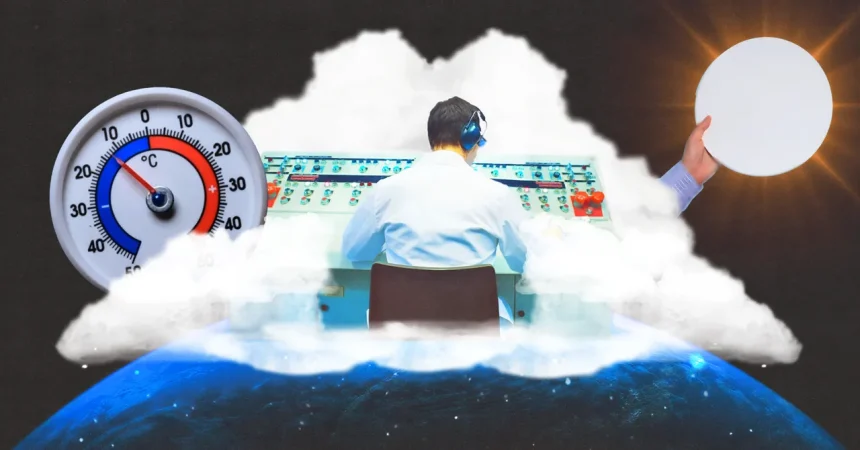
The technologies at the center of the war game are known collectively as solar radiation modification. The idea is seductive in its simplicity: if the Earth is warming because too much sunlight is being trapped by greenhouse gases, why not reflect a little of that sunlight away before it reaches the surface? One proposed method involves spraying particles of sulphur dioxide or other manufactured substances into the stratosphere, creating a kind of artificial haze that would bounce a small percentage of incoming solar radiation back into space. The cooling effect of this approach is not speculative; it is well understood. Large volcanic eruptions have done exactly this by accident. When Mount Pinatubo erupted in 1991, it ejected millions of tons of sulphur dioxide into the atmosphere, and the planet cooled by about half a degree for more than a year. Solar geoengineering would essentially mimic that effect, deliberately and continuously. But the fallout is far less certain, and far less equal. The models that predict a cooler planet also predict winners and losers. Some regions would suffer badly: sub-Saharan Africa could see prolonged droughts, and the Atlantic could see more intense tropical storms. The cooling would not restore the climate of the pre-industrial era; it would create a new, strange, and uneven climate, one that some people would experience as relief and others as catastrophe. And there is another terrifying possibility. The cooling effect of solar radiation modification would last only as long as the spraying continued. If the system were ever stopped—because of a war, a financial crisis, a change in political leadership, or a technical failure—the accumulated greenhouse gases would suddenly reassert themselves. The global temperature could shoot back up with shocking speed, perhaps by several degrees in a single decade. That kind of rapid warming would be catastrophic for agriculture, ecosystems, and human civilization. It would be a planetary whiplash, a fever that returns with a vengeance the moment the medicine is withdrawn. This is not a laboratory experiment. It is a gamble with the only home we have.
3. The Messy, Human Reality of the Simulation
Inside the war game, the abstract dangers of solar geoengineering became immediate and personal. The participants were not playing themselves; they were playing roles. Some represented national governments, worried about their own security and economic interests. Others represented climate NGOs and nonprofits, desperate to protect the most vulnerable people on Earth. Still others played indigenous groups, communities that have done the least to cause climate change but are often the first to feel its effects, and who fear that a technological fix imposed by the wealthy would violate their lands, their rights, and their ways of life. And then there were the tech companies, eager to develop and deploy the technology, seeing in it not just a way to save the planet but a commercial opportunity. Golja sat at the center of this storm, offering technical advice. She tried to explain what the models showed, what the risks were, what the uncertainties meant. But she quickly learned that in the game, science was just another card to be played. A country might demand that geoengineering begin immediately, citing the latest climate disaster. Another might threaten to shoot down any aircraft or satellite attempting to deploy particles. A tech company might argue that private innovation should not be strangled by government regulation. An indigenous representative might point out that the people who would suffer most had not been consulted at all. The conversations were polite, but the undercurrent was sharp. Everyone wanted to be in control. No one wanted to be left behind. And no one could agree on the most basic question: who gets to decide the temperature of the Earth? The simulation was designed to stress-test the world’s response, and it succeeded. It revealed that the global community is nowhere near ready to govern solar geoengineering. The technical challenges are enormous, but the political and social challenges are even greater. Golja had expected that ethical research and a shared commitment to humanity would guide the conversation. Instead, she watched the same dynamics that plague every other global crisis: power, mistrust, and the refusal to sacrifice short-term advantage for long-term survival.
4. The Future Arrives Before We Are Ready
Until recently, solar radiation modification was a speculative niche of climate science, a topic discussed in academic papers and at small conferences, but far from the mainstream. That has changed with alarming speed. Private firms are now exploring solar geoengineering as a commercial opportunity, and they are not waiting for international agreements or ethical guidelines. Last year, a US-Israeli startup called Stardust Solutions raised $60 million. In May, the company released details of a suite of new inventions that, it claims, would give humans the ability to dial down the global temperature as desired. The language is telling: not “perhaps” or “maybe,” but “dial down.” The promise is control, precision, mastery. In August, Elon Musk, whose company SpaceX might be a candidate for delivering geoengineering interventions, threw his voice behind the idea. Writing on X, he declared: “Space satellites to control temperature and massive geo-engineering will be needed or it will be game over.” That phrase, “game over,” captures both the urgency and the recklessness of the moment. Musk is not a climate scientist, but he is one of the most powerful people on Earth, and his companies have the rockets, the money, and the appetite for grand projects. When a billionaire with a Twitter following of hundreds of millions starts talking about controlling the planet’s temperature, the world is no longer in the realm of academic speculation. The future has arrived, and it is arriving faster than the institutions we have built to manage it. There is no international treaty governing solar radiation modification. There is no agreed-upon framework for who can deploy it, under what conditions, or with what oversight. There is no mechanism to compensate the countries and communities that would be harmed by its side effects. The war game was designed to explore exactly this scenario: a world in which the technology is possible, the incentives are strong, and the rules are absent. It did not take much imagination to see how quickly that world could spiral out of control.
5. The Governance Gap and the Coming Decade
Cynthia Scharf, a former UN advisor, has spent years thinking about the intersection of climate change, technology, and global security. She told WIRED that the world is going to have to make decisions about how to govern solar geoengineering much sooner than most policymakers imagine. “It’s not 15 years from now; it’s in the next decade, easily,” she said. That is a terrifying timeline. International negotiations are slow, cumbersome, and often paralyzed by disagreement. The Paris Agreement took years to negotiate and still falls short of what science demands. A treaty on solar geoengineering would be even more difficult, because the stakes are higher and the uncertainties are deeper. Who would be allowed to research the technology? Who would be allowed to deploy it? What temperature target would be used? What would happen if one country decided to go it alone, spraying particles into the stratosphere without the consent of others? What would happen if a country that felt threatened by the side effects decided to take military action to stop it? These are not hypothetical questions. They are the questions that the war game was designed to explore, and they are questions that policymakers are only beginning to ask. The danger is that by the time they are ready to act, the technology will already be in the hands of private companies and powerful nations, and the world will be forced to react to a fait accompli. The war games are a way to rehearse the impossible, to simulate the chaos before it happens, in the hope that we can build some kind of governance framework in advance. But the clock is ticking. The next decade will be decisive. If we wait for consensus, the technology will be deployed unilaterally, by a country, a company, or a coalition of the willing, and the rest of the world will have to live with the consequences.
6. The Lesson of the Game
Golja left the meeting room in London changed. She had gone in believing that science and reason would naturally guide humanity toward the right choice. She came out understanding that reason is not enough. Science did have a seat at the table, but so did fear, ambition, and distrust. The war game revealed that the fate of the planet will not be decided by a perfect formula or a compelling PowerPoint presentation. It will be decided by messy, fallible, complicated humans, each with their own interests, their own histories, their own fears. That is not a reason to give up. It is a reason to work harder. If solar geoengineering is to be governed wisely, it will require more than research; it will require the slow, difficult work of building trust across borders, cultures, and ideologies. It will require including the people who have the most to lose, not as an afterthought but as equals. It will require creating institutions that can say no to the powerful and yes to the vulnerable. And it will require recognizing that the technology itself is not a solution, but a symptom of our collective failure to deal with the root cause of climate change: the burning of fossil fuels. The war games are a beginning, not an end. They are a way of asking the hard questions before the real crisis is upon us. The question now is whether we will learn from them, whether we will build the governance, the ethics, and the trust we need before the real game begins. Colleen Golja still believes in science. But she now knows that science alone will not save us. We will have to save ourselves, and we will have to do it together.