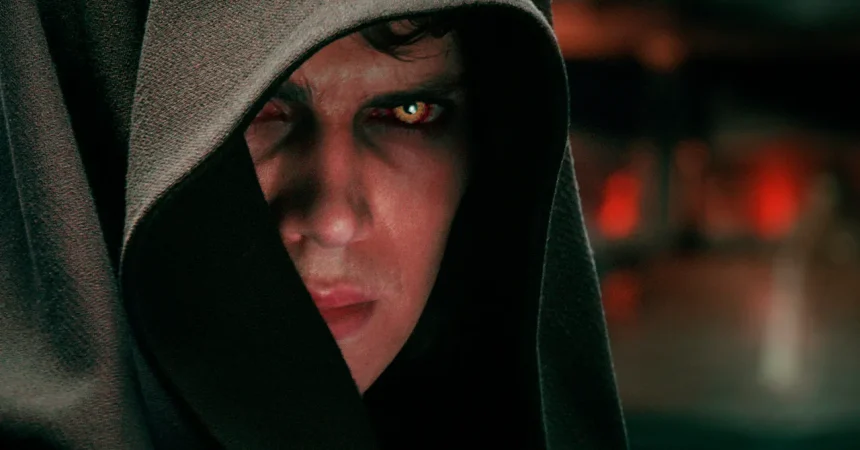
There is a strange comfort in finding a story that seems to understand your anger. In the weeks leading up to another turbulent election, a certain corner of the internet has turned Anakin Skywalker into an unlikely martyr, a symbol for everyone who feels betrayed by the world. Christian streamer Kangmin Lee put it plainly: Anakin is the “archetypal disenfranchised chud,” a man radicalized when he finally sees that the political order he once believed in is deeply corrupt, hypocritical, and wicked. That interpretation has real emotional appeal. Most of us have known what it is like to look at institutions and feel that they were never designed to help us, only to manage us. We have all felt powerless at some point, and we have all, perhaps, fantasized about what it would feel like to simply stop playing by the rules. Anakin’s tragedy—a gifted child taken from his mother, trained by an ancient and dishonest institution, manipulated by a sinister mentor, and ultimately crushed by his own fear—is genuinely moving. But the meme version of Anakin is not interested in his tragedy. It is interested in his rage, his power, his willingness to burn everything down. It strips away the moral complexity and leaves only a fantasy of justified violence, draped in the language of awakening and resistance. That transformation matters, because when we flatten a character into a symbol, we flatten ourselves too. We begin to believe that our own pain is proof of our righteousness, and that anyone who stands in our way is part of the corrupt order. It is a seductive story, and it is spreading.
The vagueness of the meme is part of its power. When Elon Musk, after donating hundreds of millions of dollars to Republican candidates this cycle, shared an AI-generated image of Anakin sitting on a throne with Padmé Amidala beside him, their children Luke and Leia nearby, and imperial guards and stormtroopers standing in silent loyalty, the caption said everything and nothing at once: “This is what they stole from us.” Who is “they”? It is deliberately unclear. They could be Democrats, elites, immigrants, the deep state, the media, the vague apparatus of progressive culture. “This” is equally slippery—a family, an empire, a golden age of tradition and order, a future that was rightfully theirs but somehow taken away. For the MAGA faithful staring down inflation, a wearying war, and a president with historic unpopularity, the details hardly matter. The image itself is the argument. It says that the world has been stolen from you by invisible enemies, and that the only proper response is to take it back with overwhelming force. The Anakin memes are not political theory; they are advertisements for a worldview in which the system is so rotten that the only meaningful choice is destruction. That is why the fact that Anakin was groomed into becoming an evil enforcer, that he slaughtered children on the orders of a decrepit old wizard, that he helped destroy the democracy he once served—none of that bothers his new fans. In their reading, those are not moral failures but necessary sacrifices. When you believe the current order is beyond redemption, even a monster can look like a liberator. This is an old human temptation, but the internet has made it dangerously easy to dress it up in cosplay and mistake it for wisdom.
This enthusiasm did not begin with Anakin. In the weeks before, the same online spaces were obsessed with something called “Malfoid” content—a fan-fiction twist on Harry Potter that introduced a gender-swapped, female version of Draco Malfoy, recast as a romantic interest for Harry. On its face, it was absurd. But to the people who pushed it, it was an anti-progressive memetic weapon, a way to smuggle traditional gender roles and reactionary values into the hearts of young fans. Right-wing Substack writer Max Mersault called such content “culturally significant” and claimed that you could not engineer a better anti-progressive virus in a lab if you tried. The U.S. Department of Education, of all places, eventually joined in, updating the trend with Anakin imagery. Katie Miller, a podcaster and the wife of top Trump adviser Stephen Miller, posted that she had “zero unregretted user seconds” spent on Anakin postings. It is tempting to laugh at the sight of political elites and government agencies acting like participants in a particularly obsessive fandom. There is something almost childlike about it—powerful people using Star Wars and Harry Potter lore to process their feelings about a changing country. But the laughter sticks in the throat. When the people who make policy spend their time feeding on memes that romanticize authoritarian power, the line between fantasy and reality becomes dangerously blurred. They are not just playing with action figures; they are also telling a story about who deserves to rule and what must be broken to make that happen. And because they are the ones with access, money, and influence, their play has consequences far beyond their own timelines.
The most puzzling part of the entire phenomenon is the belief that these memes are winning over ordinary voters. Some conservative influencers insist that the Anakin trend is “not a meme anymore” but a “monumental zeitgeist victory,” claiming it has reversed “a decade of cultural rot and damage in less than a week.” This is a delusion. In the real world, most people are not parsing the politics of Star Wars while they worry about the price of groceries, the difficulty of paying rent, the health care system that keeps failing them, or the future they are leaving to their children. The Anakin posts are, for the vast majority of Americans, background noise at best and incomprehensible nonsense at worst. The people celebrating them are talking mainly to themselves, in a closed loop where every like feels like confirmation and every retweet feels like a recruiting success. There is a human longing beneath this, though. We all want to believe that our struggles are part of a larger story, that our enemies have a face, that victory is just around the corner. That longing is real and deserves compassion. But when it is channeled into a myth about a man who becomes a monster, it does not lead to liberation; it leads to ruination. Hayden Christensen, the actor who played Anakin in the prequels, told Variety in 2023 that portraying the character’s journey to the dark side humanized him, but also revealed that he was ultimately a “pathetic person,” trapped in a life he perhaps never really wanted. That is the Anakin the memes leave out. He is not a winner. He is a warning. Mistaking him for an ideal is not a sign of cultural victory; it is a sign of emotional surrender.
It is worth stopping, for a moment, to think about what this says about the people who cling to these images. If we can set aside the mockery and the outrage, there is a real sadness in the spectacle of grown men—rich, influential, often surprisingly powerful—mapping their own anxieties onto a fictional character who burns the galaxy down because he cannot cope with grief and rejection. Perhaps they, too, feel trapped in lives they did not want. Perhaps the endless performance of strength is a way of hiding a quiet desperation. Perhaps they have convinced themselves that the only way to be respected is to become feared, and Anakin is the perfect avatar for that fear—a man so afraid of losing everything that he destroys everything to keep it. As the political fortunes of their favorite candidates waver, as the dream of a heroic restoration fades into the mundane reality of coalition-building and compromise, the need for a more aggressive and tragic hero grows. Anakin offers a template: when the world disappoints you, you have every right to break it. But the people promoting these memes are unlikely to ever acknowledge that their beloved mask is a mirror. They will not call it cringeworthy coping, and they will not reflect on the irony that their anti-establishment posturing is amplified by billionaires and entrenched networks. They will ride the wave as long as it lasts, and then they will move on to the next antihero who promises to make them feel powerful again. There is something almost poignant about that—a desperate search for dignity in a world that no longer seems to offer it. But that search goes nowhere unless it is grounded in honesty, and honesty would require them to see that their hero is a cautionary tale, not a savior.
In the end, the Anakin meme is a story about a story. It tells us less about Star Wars than about a certain kind of modern political psyche—angry, wounded, hungry for meaning, and dangerously susceptible to images of destructive power. That is not a new condition. Human beings have always been drawn to tragic villains when the world feels too complicated and too unfair. The internet, however, accelerates the process. It takes a private fantasy and turns it into a shared delusion, complete with its own prophets, rituals, and sacred texts. The best response to that delusion is not simply to laugh at it, although there is plenty to laugh at. It is also not to dismiss it entirely, because the people who believe these things are not aliens or monsters; they are neighbors, coworkers, family members. They want the same things we all want—to matter, to be seen, to believe that someone understands their pain and shares their outrage. The question is whether they will choose stories that lead to healing or stories that lead to ruin. Anakin Skywalker chose ruin. His fans do not have to follow him there. But that choice requires a kind of humility that memes rarely allow—the humility to admit that your side is not always right, that your enemies are not always evil, and that the empire you dream of building might look a little too much like the one you claim to hate. Maybe, after the election dust settles, some of them will realize that no image can fill the emptiness inside them. Maybe they will find a different kind of hero, one who fights for justice without becoming what he despises. For now, they will keep posting, keep retweeting, keep insisting that their very important stories matter. And the rest of us, with a mixture of sadness and exasperation, will keep watching, hoping that someday the fantasy loosens its grip and the human being underneath finds a better way.