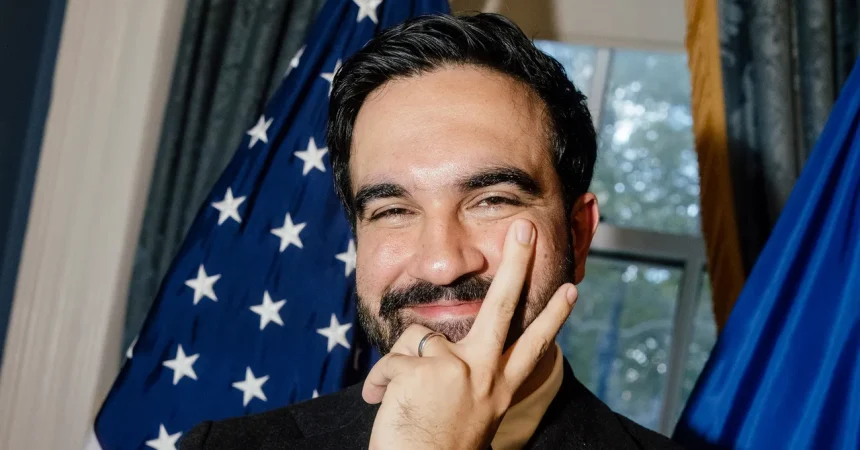
If you think you had a wild year, just imagine what it must feel like to be Zohran Mamdani. In October 2025, just weeks before his historic election as mayor of New York City, I sat down with him in his campaign office for an interview. I remember vividly the energy he carried into the room. It wasn’t just confidence or enthusiasm; it was something closer to a supernatural electricity. This was a man who had pulled off one of the most stunning political feats in recent memory, rising from relative obscurity to become the front-runner in the city’s mayoral race in a matter of months. His message had a lot to do with it. He spoke constantly and convincingly about affordability, about the working class, about the daily struggle of ordinary New Yorkers to keep their heads above water in a city that feels increasingly designed for the wealthy. But message alone doesn’t explain what happened. What truly set Mamdani apart was how that message traveled. He had mastered social media in a way that made nearly every other American politician look like they were still fumbling to open Instagram. His campaign felt less like a traditional political operation and more like a cultural movement, driven by memes, viral moments, and a direct, unfiltered connection with voters who had long stopped paying attention to politics. When he walked into the room that day, about to turn 34, he radiated a kind of hopeful, almost rebellious joy. It lit up the room. It was impossible not to feel it.
That electricity followed him everywhere. After the interview, we stepped out onto a bustling Manhattan street for a photo shoot, and something remarkable happened. Passersby stopped in their tracks. They hooted and hollered at the candidate who, seemingly overnight, had made the mundanity of local politics feel like a cultural revolution. It wasn’t just recognition; it was affection, excitement, a sense of shared ownership in this unlikely political story. New Yorkers who had never cared about City Hall suddenly cared about this young man with the radiant smile and the unmistakable air of change. He seemed to represent something larger than a campaign, a possibility that government could be responsive, that it could belong to regular people again. The scene on that street was a small taste of the phenomenon Mamdani had become. People didn’t just want to see him; they wanted to touch the moment, to be part of it. And he, for his part, seemed to thrive on it. He was not a politician performing for cameras; he was a person genuinely energized by the people around him, drawing strength from their enthusiasm. It was hard to imagine then that anyone could sustain that level of intensity. But as I would learn a year later, sustaining it was never the goal. The goal was something else entirely: transforming that energy into governance, into policy, into the slow and unglamorous work of running the largest city in America.
Fast-forward one year, and the Mamdani electricity is still there. It’s just a little bit more tired. The daily grind of governing does not offer the same thrill as a rocket-ship campaign. Campaigns are about promise and momentum; governing is about meetings, budgets, crises, and compromise. Mamdani, it turns out, is not immune to the weight of that transition. When we met again, this time at New York’s City Hall, he divulged, hoarsely, that it had been “a long day.” His voice was worn, his energy slightly more measured, but the spark was still visible beneath the exhaustion. And how could it not be? He has become one of the most influential figures on the American left, a national symbol of a new kind of politics. His approval rating among Big Apple voters sits at a stunning 69 percent, a number most elected officials can only dream of. But with that popularity comes an enormous target on his back. His harshest critics describe him as a dangerous radical, a man whose politics threaten the very city he was elected to lead. From his positions on Israel to his affiliation with the Democratic Socialists of America, he has become a lightning rod for polarizing conversations. He is both a beacon of hope for millions across the country and around the world, and a villain to those who fear what he represents. No pressure, indeed.
During our sit-down at City Hall, I wanted to understand what he had learned in his ten months on the job. What had changed since the campaign? How did it feel to move from the outside to the inside, from protest to power? Mamdani’s answers were thoughtful, sometimes guarded, but always sincere. He talked about the difference between winning and governing, between promising and delivering. He acknowledged that the work is harder, slower, and more complicated than he might have imagined, but he didn’t sound discouraged. He sounded, if anything, more grounded. One of the most striking parts of our conversation was about how he uses social media now that he is mayor. During the campaign, social media was his megaphone, his way of bypassing traditional media and speaking directly to voters. As mayor, he has turned it into a tool of governance. He uses it to explain policy decisions, to hold himself accountable, to show the human side of the office, and to put pressure on those who resist change. It’s a fascinating reversal: the same platforms that helped him get elected are now helping him govern. But it’s more than that. He seems to understand that trust is built through transparency, and that the public’s attention span is short. If you can’t explain why you did something, you haven’t done your job. Mamdani’s online presence is not just about promotion; it’s about participation. He is trying to make government feel accessible, even intimate, in an age when most people feel completely disconnected from those who make decisions on their behalf.
We also spoke about the political moment beyond New York. The midterm elections were on everyone’s mind, and Mamdani has become a sought-after voice for candidates across the country who see him as proof that a bold, progressive message can win in unexpected places. He is no longer just the mayor of New York; he is a symbol of what the left could be. That comes with a certain responsibility, and also a certain danger. He could easily become the face of a national movement, but his focus remains on the city that elected him. Still, he is not shy about speaking his mind on national issues. He is unapologetic about his values, about his belief in economic justice, in Palestinian rights, in a foreign policy that centers human dignity rather than military power. These positions have made him enemies, but they have also made him something rarer in American politics: a leader who says what he means and means what he says. There is a new sense of liberation about him, the liberation that comes from having won. During the campaign, he had to prove he was viable, that he could win. Now that he has won, he seems determined to use that mandate to push the boundaries of what is considered politically possible. He is not asking permission. He is not waiting for approval. He is governing.
In the end, our conversation left me with a powerful impression. Winning power and wielding power are two very different things, and Mamdani appears to understand that better than most. He has traded the adrenaline of the campaign trail for the slow, grinding work of governance, but he has not traded his vision. He is tired, yes. He is hoarse, yes. He is carrying the weight of a city, a movement, and a moment on his shoulders. But he is also newly empowered, more willing to speak his mind, more confident in his ability to shape the world around him. The internet’s Mayor has become something more: a real mayor, with real power, facing real consequences. And right now, that power is squarely in Zohran Mamdani’s corner. What he does with it will shape not only New York City but also the broader possibilities of American politics. If his first year is any indication, he will not play it safe. He will not slow down. He will not let the weight of the office crush the electricity that brought him there. He will, instead, try to channel that electricity into the machinery of government, hoping to light up a city and perhaps a country. And if the 69 percent approval rating tells us anything, it’s that New Yorkers are willing to follow him, tired or not, into the unknown.