Paragraph 1: A New Sound in the Room
There is a moment that Chuck Hoskin Jr., the principal chief of the Cherokee Nation, still carries with him. He remembers watching a group of Cherokee immersion students crowd around a screen, completely absorbed in How to Train Your Dragon. But something remarkable was happening in that room: the familiar story of Hiccup and Astrid was not unfolding in English. It was unfolding in Cherokee, with voices recorded by people from the local community. For Hoskin Jr., that image was not just a cute classroom moment. It was a quiet revolution. “They’re hearing it in our mother tongue—that didn’t happen a generation ago,” he says. He reflects on how far his people have come from the old days of rote classroom instruction and memorized phrases, when Cherokee was taught as a lifeless subject rather than a living, breathing language of imagination and storytelling. Now, the language can carry dragons, heroes, laughter, and children who speak it naturally. The memory is a small glimpse into a much larger struggle, one that is being fought not with weapons or treaties but with keyboards, audio files, immersion classrooms, and perhaps most importantly, the willingness to meet young people where they live. That place, more than ever, is on a glowing smartphone screen. But behind that screen is a complex partnership between a sovereign nation and one of the most valuable technology companies on Earth. And at the heart of it all is a ticking clock, because the Cherokee Nation currently has only around 1,500 active speakers left, and the vast majority of those speakers are over 70 years old. The generation that holds the language in their memories is slipping away, and the community knows it cannot wait another decade to act.
Paragraph 2: The Long Shadow of History and the Urgency of Now
To understand why Hoskin Jr. feels such urgency, you have to understand the forces that tried to erase Cherokee in the first place. The so-called Age of Discovery, colonization, forced displacement, and the deliberate destruction of Indigenous economies and social structures all dealt devastating blows. Then came the boarding schools, where Native children were taken from their families and punished for speaking their own languages. These were attempts, as Hoskin Jr. puts it, to strip Cherokee identity down to nothing. But while those historical enemies were brutal, they were also slow-moving. The enemy now is basic arithmetic. Every year, more elders pass away, and with each one, a piece of the language’s depth, nuance, and memory disappears. “It’s nothing compared to the mathematics we’re up against now,” he says. The Cherokee Nation is not waiting helplessly. It has built immersion programs, trained second-language learners, and even created a baby immersion program designed to make Cherokee the first words some infants hear and speak. The hope is that language becomes part of life from the very beginning, not something acquired later with effort. But the scales are still tilted, which is why the tribe is searching for partners who can help accelerate their work. They know that time is not a luxury. Every day matters. The community’s leadership is filled with a sense of purpose that borders on urgency, because they understand that language is not just a collection of words. It is the vessel for values, humor, ceremony, and a worldview that cannot be translated fully into English. If it disappears, something irreplaceable goes with it. That is why the tribe looks outside itself for help, and why the partnership with Apple is so much more than a corporate sponsorship or a box to check on a diversity report. It is an act of shared cultural responsibility, and for the Cherokee, it may be one of the most important tools they have in their fight for survival.
Paragraph 3: The Tech Giant That Listens
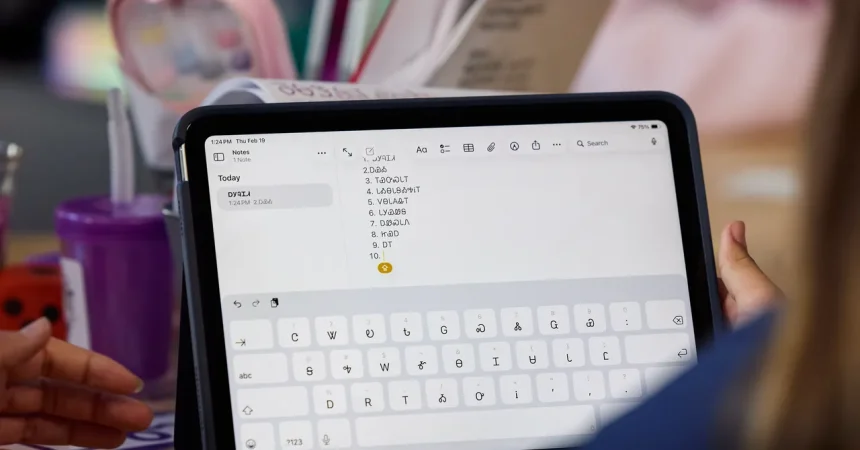
Apple’s involvement in Cherokee language preservation is not new. In fact, Cherokee made history in 2010 as the first Native American language to be included in iOS, allowing Cherokee speakers to type and read the language on their iPhones. At the time, it was a breakthrough, a signal that Indigenous languages deserved a place in the modern digital world. Since then, Apple has expanded its keyboard support to more than 200 languages and language variants, adding Haitian Creole and Nez Perce in iOS 26, and most recently welcoming Blackfoot, Comanche, and Northern East Cree in iOS 27. These are not merely technical additions; they are powerful symbols of acknowledgement. For a young Cherokee person trying to text a friend in their native language, or for an elder wanting to write an email to a grandchild, the keyboard is a bridge. Hoskin Jr. says that to revitalize and save a language, it has to become accessible. It cannot be locked away in an archive or only taught in a classroom. It has to live where people live, and people—especially young people—spend a significant part of their waking hours on their phones. By meeting them there, Apple and the Cherokee Nation are making the language feel modern, relevant, and alive. But the work is not easy. Apple says developing keyboard support for a language is a multi-year endeavor that requires deep research, not just into the characters themselves but into how the language is used, including regional dialects, spelling conventions, and the emotional and cultural weight of certain words. The company leans heavily on community members, linguists, and elders for their expertise, because no algorithm can replace the insight of someone who has grown up speaking the language. It is a partnership built on listening, and that makes all the difference.
Paragraph 4: The Secret Hero Called Unicode
Most people never think about Unicode, but it is the quiet foundation upon which digital language use is built. You might know Unicode as the organization that approves and standardizes the new emoji that appear on your smartphone every year. But its work is far more expansive. Unicode also handles time zone localization, currency names, and the difference between imperial and metric measurements. More importantly, it is the system that assigns a unique number to every character used in written languages around the world. Before a person can type a single word on a smartphone screen, each and every character in that word must first exist as a recognized character in the Unicode Standard. “Everything does start with Unicode in terms of a language, but it actually starts with characters and scripts,” says Unicode CEO Toral Cowieson. The organization now includes more than 157,000 characters, covering scripts and languages from every corner of the globe. Without Unicode, a Cherokee syllabary character would appear as a blank square or a meaningless jumble of signs, and the language would be effectively invisible in the digital world. Unicode is not just a technical bureaucracy; it is a kind of global linguistic library, and whether or not a language is included there can determine whether it survives in the twenty-first century. For Indigenous languages that have historically been marginalized, being accepted into Unicode is a major victory. It means the language has been officially recognized as part of the world’s digital infrastructure, no less important than English or Mandarin or Spanish. It also means that a Cherokee child, sitting in a classroom or at home, can see their language appear on the same screen that shows the rest of the world’s information. That is no small thing. It is, in a very real sense, the difference between a language living only in memory and a language living in the future.
Paragraph 5: More Than Just Words on a Keyboard
The collaboration between Apple and the Cherokee Nation is often framed in terms of technology, but the deeper meaning is human. Language is how we tell our children who they are. It carries the stories, values, and emotions that bind a community together. When a Cherokee child hears their language in a popular movie, it tells them that their culture is not stuck in the past but is part of the vibrant, creative present. When they can type in Cherokee on their phone, it tells them that their identity matters in the modern world. Hoskin Jr. often thinks about how different the possibilities are compared to when he was growing up. The rote lessons and memorized phrases of his youth were well-intentioned but insufficient. They did not allow for the imagination, joy, and spontaneity that come from living in a language. Now, he sees a generation of Cherokee children who can laugh at a dragon movie in their mother tongue, who can express their own creativity through the language, and who, ideally, will become more articulate and literate because they have had the chance to experience Cherokee in rich, varied, and engaging ways. This is not just about preserving a language; it is about giving future generations the tools to build on the past and create their own futures. The partnership with Apple is a model for how technology companies can work with Indigenous communities, not by imposing solutions from the outside but by listening to what the community says it needs. For the Cherokee Nation, the goal is not just to have Cherokee present on iPhones but to have it present in every aspect of life, from movie theaters to living rooms, from classrooms to dinner tables. Technology cannot do that work alone, but it can help open doors that were previously closed. And when those doors open, what walks through is hope.
Paragraph 6: A Future Written in Cherokee
The road ahead is still long, and Hoskin Jr. does not pretend otherwise. The Cherokee Nation is racing against a devastating reality: the number of fluent speakers is shrinking, and the elder generation cannot be replaced without deliberate, sustained effort. But there is a new energy in the community, a determination to win the battle with mathematics through innovation, partnership, and love. The baby immersion program, the teacher training, the digital keyboards, and the dubbed movies are all pieces of a larger strategy to create a future in which Cherokee is not an endangered language but a thriving one. Hoskin Jr. says the historical foes of his people—colonization, displacement, boarding schools—are not gone, but they are no longer the primary obstacle. The primary obstacle is time, and the only way to beat time is to act with urgency and use every resource available. That is why the partnership with Apple matters. It is why Unicode matters. It is why every new speaker, whether they are an infant learning their first words or an adult studying the syllabary for the first time, matters. Language is the living memory of the Cherokee people, and it deserves a place in the digital age. Thanks to the efforts of the community and the willingness of technology companies to lend their resources, Cherokee is not just surviving; it is finding new ways to thrive. The dragons of How to Train Your Dragon may be fictional, but the Cherokee voices that bring them to life are real, and they are helping to carry an ancient language into a future that is still being written—one keystroke, one word, one child’s laugh at a time.