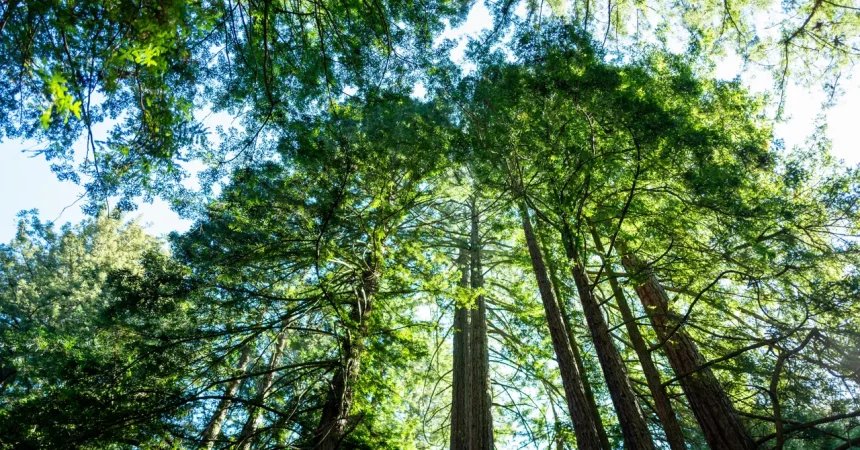
Along the fog-swept coast of California, where the continent meets the Pacific in a soft, gray embrace, the coast redwoods rise like ancient cathedrals of bark and green. For thousands of years, these trees have endured storms, droughts, and the slow drift of climate, but now they are facing something that even their deep roots and towering heights cannot easily escape: a brutal combination of heat and thirst. Todd Dawson, a plant ecophysiologist at the University of California, Berkeley, calls it a “double whammy.” The redwoods, he explains, are not just running out of water; they are also being hit by relentless heat at the same time. This is especially troubling because redwoods are used to a remarkably narrow temperature range, roughly eight to twenty-seven degrees Celsius, which is about forty-six to eighty degrees Fahrenheit. For most of their long lives, the cool, wet breath of the ocean fog has acted like a natural air conditioner, softening summer extremes and keeping their needles from drying out. But that fog has declined by thirty to forty percent in recent decades, and California, like the rest of the world, is seeing longer stretches of far hotter days than ever before. The result is a tree species that is, in a sense, living on the edge of its own comfort zone, wrapped in a blanket of warmth it never evolved to handle. You can almost feel it when you stand among them: the quiet rustle of leaves, the dry creak of limbs, the sense that something profound is shifting in the air.
It is not only the trees themselves that are struggling. High above the forest floor, in the canopy of these ancient giants, there is an entire hidden world of life—mats of soil, delicate ferns, salamanders, seabirds, and countless tiny creatures that make their homes among the branches. These organisms depend on the cool, damp conditions that the redwoods and the fog create together. As the heat waves roll through the summer, those little ecosystems are threatened too. Amber Ambrose, a researcher involved in the work, paints a worrying picture: if the trees experience excessive heat all summer long, the soil mats and ferns will dry out much faster than they used to. And when those foundational pieces dry out, the animals that live among them—the salamanders, the birds, the insects—may no longer be able to survive there. This is what ecologists call a cascading effect, a chain reaction that starts with a few stressful days and ends with the unraveling of an entire community. The redwoods are not just lonely towers of life; they are apartment buildings, watersheds, and microclimates all at once. The creatures that live in their canopies are not random visitors; they are tenants in a complex, interconnected habitat. When the trees suffer, the whole neighborhood suffers. And because we are still just beginning to understand the full web of relationships that makes a redwood forest function, we cannot say with confidence how many of these species will adapt—or disappear—as the climate keeps changing.
Yet there is a small, cautious note of hope buried in the new research. Kellie Klinek, who led the study, spent two years observing how redwood leaves respond to extreme heat. Her team expected that the leaves might acclimate, meaning they would gradually adjust their physiology to tolerate hotter conditions, much as people who move to a desert eventually learn to live with the sun. But that is not what happened. The leaves did not acclimate to the heat. They did, however, survive the heat waves without losing their ability to photosynthesize afterward. In other words, the redwoods were not thriving in the heat, and they were not adapting to it, but they were tough enough to hold on and keep functioning once the worst of the heat had passed. That is both reassuring and fragile. It means these trees have some resilience, some ability to absorb the shock of a hot summer and return to a normal rhythm in the fall. But it also means that their resilience has limits. They are not becoming heat-loving trees. They are simply enduring. And enduring is not the same as adapting. Klinek’s finding is a reminder that nature often works in strange ways: a tree can be permanently weakened by stress even while it stands tall and green. The fact that the leaves still photosynthesize is good news, but it does not change the urgent need to understand exactly how much more heat these forests can take, nor does it reduce the responsibility we all share to slow the warming that threatens them.
The seasonal rhythm of the California coast has always been a story of contrasts: cool, foggy summers giving way to rainy winters, with the redwoods drinking deep and recovering from the stresses of the dry season. That rhythm is still there, but it is becoming less reliable. Right now, Klinek says, temperatures are returning to normal in the fall and winter, and that gives the trees a chance to recover. The cold rains and long nights allow them to replenish, to shrug off the strain of the summer’s heat and prepare for the next year. But the question that haunts this study is the future. “In five or ten years,” Klinek asks, “if temperatures are even hotter and heat waves are even more frequent, we don’t really know if there would be a recovery.” That uncertainty is at the heart of the climate crisis. We are no longer asking whether nature can survive the way things are; we are asking how much more it can take before it breaks. The redwoods have lived for centuries precisely because their environment was so stable. They found a place where the temperature stayed within their narrow comfort range, where the fog came in off the ocean like clockwork, where the rain arrived in the winter and the sun arrived in the summer in just the right proportions. That stability is gone. Every year now, the clockwork is a little more out of tune. And while the trees are still standing, it is impossible to know when one hot, dry summer will be the one that pushes them past the point of no return.
The story of the coast redwoods is not just a story about a tree. It is a story about all of us, whether we live near the California coast or a thousand miles away. Redwoods, like all trees, are keepers of the planet’s atmosphere. They absorb carbon dioxide, release oxygen, cool the air, hold soil in place, and provide habitat for countless species. To lose them would be more than a tragedy for California; it would be a wound to the whole Earth. And yet, for now, the salamanders and seabirds still have their homes high in the redwood canopy. The forest is still there, magnificent and mysterious, waiting to be seen. But we are part of this ecosystem too, even if our connection is easy to forget. Every time we drive a car, switch on a light, or heat our homes, we are adding a little more warmth to the world that the redwoods and their fragile canopy creatures must endure. The trees cannot speak, and they cannot move. They can only stand there, century after century, absorbing the changes we have set in motion. That puts a heavy weight on us. We have inherited a relationship with these forests that stretches back through human history, and we are now deciding, through our actions and inactions, whether that relationship will continue.
The redwoods that Klinek and her colleagues studied have the potential to live for more than a thousand years. Some of them were already standing in the time of the Roman Empire. They have survived fires, droughts, and storms; they have watched entire civilizations rise and fall. But they have never faced anything quite like the world we are creating for them now. The heat is more intense, the fog is thinner, the drought is deeper, and the rhythm of the seasons is shifting in ways that even scientists are still struggling to predict. These trees are not just beautiful; they are reservoirs of history, living libraries of the climate and the land. To lose them would be to erase a future that could have been, to close the door on a thousand years of possibility. But the question of whether they survive is not really about the trees. It is about us. Do we have the will to reduce the warming, to protect the places that matter, to make the difficult choices that a changing climate demands? The redwoods cannot adapt their way out of this crisis. They can only endure, as they have always endured, and hope that we find the wisdom to act before their quiet strength runs out. The trees are waiting. The question is whether we will let them live.