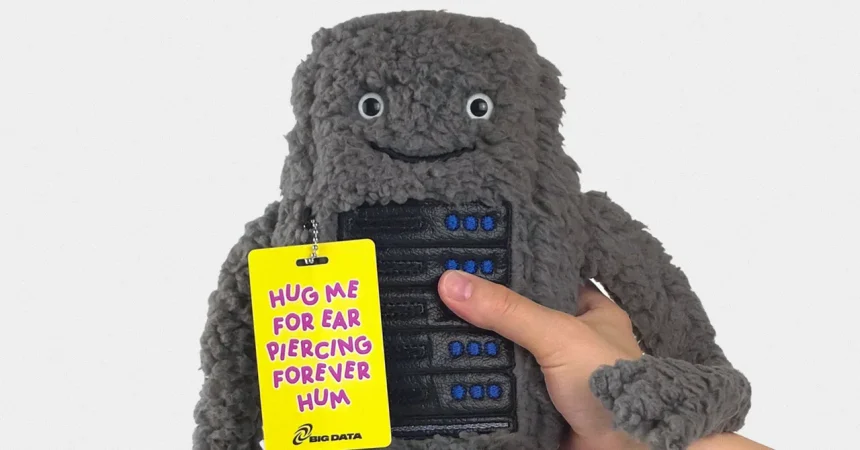
Here is the story of a small, strange plush toy that has somehow become a tiny ambassador for one of the biggest, loudest, and most complicated issues of our time. Her name is Bezzy, and she is genuinely adorable in the way that only well-designed stuffed animals can be. She has a soft, huggable body, long, friendly arms and legs, and the kind of big, expressive googly eyes that seem to invite you into a warm, comforting embrace. She looks like a cuddly cartoon character, the sort of thing you might want to snuggle on a difficult day. But there is a twist. Hidden inside her plush chest is a tiny speaker, and when you squeeze her torso, she does not giggle, purr, or play a lullaby. Instead, she lets out a piercing, grinding, almost agonizing screech of ambient noise. It is a sound that would make anyone wince and cover their ears. It is not a synthesized effect designed to be funny; it is a real, unedited audio recording taken by a frustrated neighbor of a massive data center in Virginia. The sound is the actual, operating hum of the servers, cooling systems, and electrical infrastructure that power the cloud. In other words, this cute little doll is a portable reminder that our favorite streaming services, AI chatbots, and endless online conveniences are powered by enormous physical structures that are not always pleasant to live next to.
This bizarre creation is the satirical centerpiece of a new project called Adopt a Data Center, a collaboration between Basura, a New York–based creative studio, and Big Data, the musical project of producer Alan Wilkis—the same person best known for the 2013 hit song “Dangerous,” made with the band Joywave. Basura has a history of playful, slightly absurd projects, like making luxury clothing for dogs and creating shoes made of dirt that fall apart as you walk, scattering wildflower seeds in your footsteps. But Adopt a Data Center is perhaps their most pointed work yet. The goal, as the project states, is to give people a “cuddly introduction to life with a real data center.” It is a strange phrase, and deliberately so. The idea is to place something intangible, emotional, and silly into the same conversation as something immense, industrial, and deeply controversial. In doing so, the project tries to force a reaction, a moment of cognitive dissonance. You want to love Bezzy because she is a stuffed animal, but her voice is a sonic representation of everything that is problematic about the infrastructure of the modern internet. It is exactly the kind of weird, uncomfortable, and oddly thoughtful joke that makes you pause, laugh, and then actually think deeply about the world you live in.
To understand why Bezzy exists, you have to understand the strange moment data centers are having right now. They are absolutely essential to modern life, but they are also, as the project points out, very un-vogue. These enormous facilities have proliferated across the United States, driven by the massive expansion of AI tools, cloud computing, and data-hungry services. They now cover thousands of acres of land, often appearing on the edges of small towns, agricultural communities, and quiet suburban areas. They bring with them the promise of jobs and economic growth, but also a long list of serious problems. Local residents have raised understandable and urgent concerns about their enormous energy consumption, their contribution to climate change, and the way they have encouraged the expansion of gas power plants to keep up with relentless demand. The electrical grid is being transformed by these facilities, and the costs, both environmental and financial, are often shared by the public. But beyond the broader environmental issue, there is something more personal that inspired the Adopt a Data Center project: the sound. Data centers are not quiet. They hum, they whine, they sometimes emit a high-pitched, relentless drone that can be heard for miles. People who live near them describe the noise as an inescapable presence, a constant companion that seeps into every moment of their day, making it impossible to truly relax, sleep well, or enjoy their own backyards.
The creators of this project clearly did their homework. Rajeev Basu, the founder of Basura, explained in an email that the recording used for Bezzy was selected because it was “the clearest and most suitably irritating” of all the audio clips they had gathered. It was recorded by an actual person who lives near a data center in Virginia, a state that has become something of an epicenter for these facilities. Basu and his team interviewed dozens of people living near data centers across the United States for the project, collecting stories and experiences. The person who captured the recording described the sound in a vividly relatable way: “like a car alarm going off nonstop. It’s high-pitched, and it’s all you can focus on.” That description is haunting because it captures the emotional toll of living with this kind of industrial noise. A car alarm is designed to be temporary, urgent, and annoying so that someone eventually silences it. But the data center noise never stops. It becomes a part of your environment, an ambient nightmare that you cannot tune out, no matter how hard you try. It is the kind of sound that stays with you, that finds its way into your dreams, that makes you feel powerless and slightly edgy all the time. By putting this noise inside a soft, cute plushie, the artists are not mocking the residents; they are giving people a taste of what it feels like to be in their shoes.
The details of the doll and the surrounding project are full of interesting, difficult layers. The tag on Bezzy’s body reads, “Hug me for ear-piercing forever hum.” That word, “forever,” is the true horror. The sound is not a temporary inconvenience; it is part of a new, permanent reality for many communities. Alongside the plushie, the project includes a collection of stickers with messages that are equal parts satirical and sincere. They say things like “Every data center deserves a forever home” and “Open your heart. And your power grid.” These phrases are darkly funny, but they also contain a pointed critique. Asking people to “adopt” a data center, as if it were a sad puppy in a shelter, plays on the language of empathy and care while exposing the absurdity of a system that asks us to accept unacceptable trade-offs. The website for the project expands on this idea, presenting the whole initiative as a cheerful, quasi-charitable campaign. It is satire in the tradition of Don’t Hug Me I’m Scared, which uses the aesthetics of childhood innocence to explore deeply unsettling adult themes. Bezzy is cute, but her cuteness is a trap. She is a gentle object that carries a harsh, uncomfortable truth. When you squeeze her and hear that grinding wail, you are not just hearing noise. You are hearing the frustration of real people, the hidden costs of digital convenience, and the increasingly complex relationship between the things we love and the way they are physically produced.
What makes this project so human, and so effective, is the way it turns an abstract, almost incomprehensible issue into something you can hold in your hands. It is very easy to talk about data centers in terms of megawatts, carbon emissions, and zoning laws. It is much harder to talk about the feeling of standing in your kitchen and hearing that high-pitched whine creep through your open window at dusk, knowing it will still be there at 3 a.m. Bezzy makes that feeling tangible. She gives people who have never lived near a data center a small, momentary connection to that experience. The project does not offer easy answers or pretend that there is a solution. It does not say that we should tear down all the data centers and go back to a pre-digital world, which would be both unrealistic and hypocritical, since the project itself relies on the internet and electronics to reach people. Instead, it asks a simpler, more provocative question: Are you ready to honestly acknowledge the true cost of the things you use every day? It asks us to be more aware, to look past the seamless interface of an app and see the physical world behind it. The creators are not anti-technology; they are anti-blindness. They want us to open our eyes, and our ears, to the world we are building. It is a strange form of activism, one that uses humor, absurdity, and a plush toy to cut through the noise and make us feel something real. And maybe that is the best we can do. The data centers are not going away, and our dependence on them is only growing. But by allowing us to laugh at the absurdity, to hold it in our hands and squeeze it, maybe we can start to truly understand the choices we are making and the environments we are creating. Bezzy is not a solution, but she is a wake-up call, wrapped in soft fabric, smiling all the while.