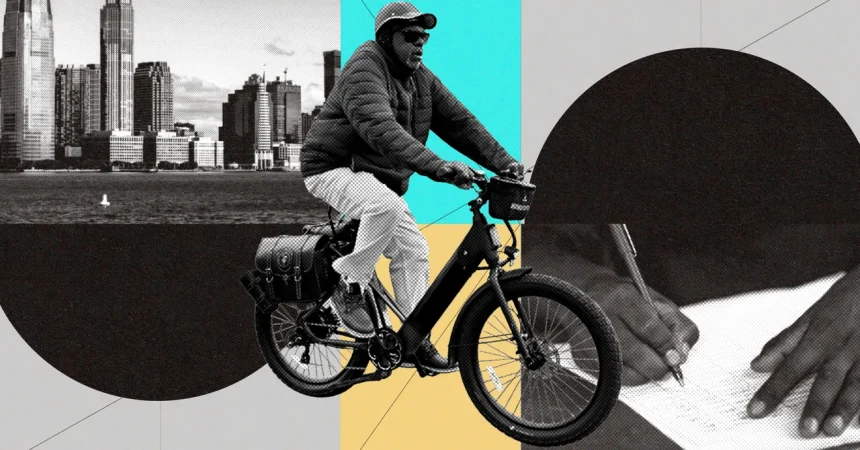
In a pioneering move that captured national attention, the state of New Jersey found itself at the forefront of a contentious new chapter in transportation policy. As the clock wound down on his tenure in January, outgoing Governor Pat Murphy signed into law a first-of-its-kind bill aimed at taming the perceived chaos of the electric bicycle boom. The legislation, designated S-4834, was the brainchild of state Senate President Nick Scutari and sailed through the legislature with a surprisingly wide bipartisan margin. Scutari’s motivation was rooted in a grave concern over what he described as a “dramatic increase” in e-bike usage, which he argued had created elevated dangers not only for the riders themselves but for pedestrians and motorists sharing the roads. The law was a direct response to a string of tragedies, including the death of a 13-year-old boy who collided with a landscaping truck the previous fall, a tragedy that echoed across several districts and underscored the urgent, and often heartbreaking, need for regulation.
The new regulations represented a sweeping overhaul of how the state treated these increasingly popular machines. Under the law, anyone seeking to own or operate a pedal-assist or throttle-equipped bicycle must be at least 15 years old and possess a valid license—either a standard driver’s license or a newly established motorized bicycle license, which itself requires passing a road test. Further complicating matters, all e-bikes must be registered with the state’s Motor Vehicle Commission (MVC), and riders of models capable of exceeding 20 mph are mandated to carry insurance. The intent was clear: to integrate e-bikes into the existing framework of motor vehicle law, treating them less like bicycles and more like lightweight motorcycles, with all the attendant bureaucratic requirements.
However, the ambitious legislation has quickly devolved into what advocates describe as a slow-moving administrative nightmare. Almost immediately, a wave of confusion washed over the state’s local MVC branches, where frontline workers appeared startlingly uninformed about the new rules they were meant to enforce. Reports surfaced of offices running out of the required registration stickers, leaving riders with paperwork but no tangible proof of compliance. For owners of older e-bikes who had long since discarded their receipts, the process became a punitive exercise in redundancy, with officials demanding they pay sales tax a second time just to secure a registration. The logistical hurdles seemed almost designed to deter participation: MVC buildings, typically built for car-centric access, lack basic bike parking and are frequently unreachable by public transit. This combination of bureaucratic incompetence, contradictory instructions, and prohibitive logistics has resulted in a law that is enforced sporadically and inconsistently at best, leaving both riders and police in a state of perpetual uncertainty.
The human and economic toll of this legislative experiment has been swift and severe, hitting local businesses with the force of a Category 5 hurricane. Scott Chambers, the owner of Zippy’s Bikes in the shore town of Wildwood, has become an unwilling canary in the coal mine. He reports a catastrophic 90 percent decline in e-bike sales year-over-year, with overall store sales down by half. With inventory from the previous season still gathering dust on his showroom floor, Chambers describes the shop’s future as “bleak,” struggling to pivot in a market that has evaporated overnight. His story is not an isolated one; the New Jersey E-Bike Coalition, a grassroots organization formed specifically in opposition to the law, claims that a staggering 37 bike shops have shuttered their doors across the state. Even the tourism industry felt the shockwaves, with e-bike-loving vacationers reportedly choosing to bypass New Jersey entirely for destinations with more welcoming policies, further draining revenue from coastal and resort communities.
New Jersey’s struggle is a microcosm of a much larger, nationwide debate about the place of e-bikes in the modern transportation ecosystem. From coast to coast, a surge in reported incidents of reckless riding, speeding, and serious collisions—frequently involving teenagers—has prompted lawmakers to scramble for new enforcement mechanisms. California, Illinois, and New York have all seen legislative proposals for their own e-bike licensing schemes, though, as of yet, none have successfully passed. Even New York City’s Council, a body often eager to regulate, retreated from a licensing proposal over the summer, perhaps wary of the fierce backlash witnessed in New Jersey. This legislative push-and-pull highlights a fundamental societal tension: the desire for safety and order versus the need to accommodate a rapidly growing, environmentally friendly, and cost-effective mode of transport that millions have come to rely on for their daily lives.
For many, the e-bike is not a toy but a lifeline. Working riders depend on them for deliveries and commutes, leisure riders use them to explore their communities, and everyday errand-runners use them to navigate steep hills and haul groceries, all without the exorbitant costs of car ownership. Karin Vanoppen, a Jersey City resident, embodies this dependency. She has not ridden her pedal-assist bike since the enforcement began in July, left in a state of “limbo” by the new regulations. Vanoppen has never held a driver’s license—she has simply never needed one—and now finds herself in a Kafkaesque predicament. The state’s designated testing locations are all situated more than an hour’s ride away, along roadways where e-bikes are legally prohibited, creating an impossible Catch-22. At a legislative hearing addressing the law’s fallout, one lawmaker callously suggested that non-drivers could simply ask their parents for a ride to the test site—a remark that rings painfully hollow for Vanoppen, whose 85-year-old mother is her only family member with a car. “I guess my 85-year-old mother has to come,” she said, her resignation a poignant indictment of a policy that seems to have forgotten the very people it was meant to serve.
In the end, the New Jersey law stands as a cautionary tale about the complexities of regulating emerging technologies. What was intended as a safety measure has morphed into a bureaucratic quagmire, pitting safety advocates against a growing legion of e-bike enthusiasts and small business owners. The law has successfully vilified e-bikes, as Zippy’s Scott Chambers lamented, but it has done so without successfully addressing the root causes of the accidents it sought to prevent—namely, a lack of rider education and infrastructure that separates vulnerable road users from heavy traffic. As the state grapples with the fallout of its well-intentioned but poorly executed experiment, the rest of the nation watches closely. The core question remains unresolved: how can we regulate e-bikes to ensure safety without strangling the very innovation and accessibility that have made them so popular? The answer, it seems, will require far more nuance than a simple licensing mandate, and the human stories emerging from New Jersey—of stranded riders, shuttered shops, and frustrated citizens—serve as a powerful reminder that the impact of any policy is ultimately measured not in its intentions, but in its real-world consequences for the people it touches.