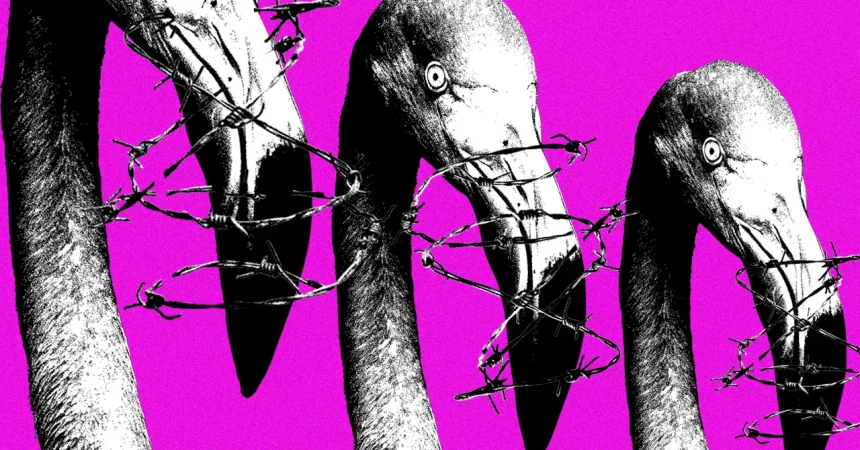
On a warm evening in Tirana, the streets are filled with the sounds of a movement that refuses to go away. For more than three months, protesters have gathered daily under the banner of what they call the Flamingo Revolution, waving flags, carrying signs, and demanding real change in a country that many of them no longer trust. But in recent weeks, a quieter, more insidious battle has been taking place, not in the streets, but on the phones and computer screens of the people documenting them. Activists, citizen journalists, and ordinary protesters have watched with confusion and alarm as their Instagram and Facebook accounts were suddenly suspended, restricted, or deleted, often with no clear explanation. The only explanation they could find was copyright complaints filed against their posts, sometimes dozens in a single day. Now European lawmakers are stepping in. More than thirty Members of the European Parliament have signed a letter calling on the European Commission to investigate whether Meta, the company behind Instagram and Facebook, has violated the European Union’s Digital Services Act by allowing what appears to be a coordinated attack on Albanian protest accounts. “What happened in Albania is tantamount to censorship,” said Alexandra Geese, a German MEP who helped lead the campaign. She did not mince words about who she believes is responsible. “Mark Zuckerberg’s understanding of ‘freedom of speech’ only seems to cover opinions that align with the political agenda of the Trump administration,” Geese said. “This is precisely why we have European rules.” For the protesters, this is not a distant legal debate. It is the difference between being seen and being erased.
To understand why this matters, you have to understand what the Flamingo Revolution represents and why social media became its nervous system. The protests began over a luxury resort project linked to Ivanka Trump and her husband, Jared Kushner, a development that seemed to embody everything protesters considered wrong about Albania’s political culture. The project was planned on protected land, and the law rose like a wall to defend it, because the law allowed development on protected land, and the political establishment, from the prime minister on down, seemed unwilling to change that. For many Albanians, the resort became more than a construction site. It became a symbol of a system built on privilege, secrecy, and environmental destruction, a system that favors the influential and connected while ordinary people are left with nothing but the rubble. The protests are calling for two clear changes: the law must be amended to protect public land from private development, and the prime minister must resign. Every day, residents of the capital gather in the heat and the rain, carrying Albanian flags and placards, chanting slogans that have now been repeated for months. But the movement does not only live in the streets. It lives in Instagram stories, Facebook live streams, drone videos, and comment threads, where hundreds of thousands of people watch, share, and organize. Social media is where the Flamingo Revolution has taken on a life of its own. Without those platforms, the protests would be almost invisible to the outside world. And so, when Meta began suspending the accounts of activists in late August, almost all of them based on copyright complaints, the strategy was not hard to read. It was an attempt to disconnect the movement from its own voice.
The evidence of coordination, according to the investigators who have spent weeks studying the case, is difficult to ignore. Repro Uncensored, a nonprofit organization that tracks digital censorship, has documented the suspensions in detail. Its founder, Martha Dimitratou, says the group has evidence that “strongly indicates coordinated activity” led to the flood of complaints. “What quickly distinguished this from ordinary content moderation was the concentration of cases around the same political and civic movement,” Dimitratou told WIRED. She and her team have verified around one hundred cases of account restrictions directly connected to the Albanian protests, but they believe this is only the tip of the iceberg. “We continue to receive additional reports and, based on the volume and patterns we are seeing, estimate that the true number could be several hundred,” she said. The patterns are strikingly organized. Accounts would receive not one or two copyright claims, but five, ten, sometimes more in a short period, with automated enforcement escalating at every step. A post would be removed, then another, then the account would be restricted, and eventually the entire account would be disabled. Even replacement accounts set up by protesters were targeted again, in what looks like an active effort to suppress repeat offenders. In one case, the person who filed the complaint admitted that they had been paid to do so. Paid reporting, repeated strikes, the targeting of the same political movement, and the relentless pursuit of new accounts all point to one conclusion in Dimitratou’s mind: this was not a glitch. It was an attack. “Taken together, the alleged paid reporting, the repeated sequence of copyright complaints followed by account enforcement, the concentration of targets around the same movement, and the repeated targeting of replacement accounts strongly indicate coordinated activity,” she said.
The consequences of this attack are more than a matter of lost likes or follower counts. Repro Uncensored confirmed at least seventy cases in which posts and videos about the protests were removed, accounts restricted, or collaboration features disabled. But those are merely the cases that could be verified. The real number, the group believes, is much larger. And the reach of the targeted accounts is enormous. “Collectively, the targeted accounts reach millions of people,” Dimitratou said. “Meaning that when they are restricted or removed, millions can lose access to news, political information, protest documentation, and civic voices they rely on.” Imagine waking up one morning and discovering that the pages you follow, the people you trust, the ones who risk their safety to document the truth, have all gone silent overnight. Imagine scrolling through Instagram and finding that your favorite stream of the protest has disappeared, not because of a mistake, but because unknown actors somewhere filed a cascade of copyright claims against it. Copyright law is a dangerous weapon in the hands of bad actors, because it does not require the platform to determine the truth of the claim before punishing the accused. Meta’s system is built to act first and ask questions later. For politically active users, that can be fatal. A single wave of coordinated complaints can destroy an account that took years to build and days to rebuild, and once an account is gone, its followers are scattered, its content is inaccessible, and its owner is left alone in the silence. This is the quiet censoriousness of automation, and it is devastating because it is invisible. The public sees the streets of Tirana full of protesters, but they no longer get to hear from the people who are trying to tell them why they are there.
The story of Arjan Koçi brings all of this into focus. Koçi is a British-Albanian citizen journalist who had been documenting the protests since June, using his Instagram account to share aerial drone footage that captured the magnitude of the demonstrations. His videos were watched by millions of people around the world. They showed a city transformed by civic rage, a nation at a crossroads, a movement too big to ignore. Then, on August 20, the emails started arriving. Messages poured in from Meta, each one informing him that a copyright claim had been filed against his account. “Someone was claiming that I had taken their work and published it as mine. But it was my video, my voice, my picture,” Koçi told WIRED. The accusation was absurd, and yet the system did not care. Meta’s automated process treated the false claim as if it were real and began penalizing his account. Koçi knew what was coming next. “If you receive too many of these reports, Meta will restrict your account,” he said. Around him, other activists began receiving the same notices. Then came the night that made it impossible to doubt what was happening. “It was about 1 o’clock in the morning, and I know at least 20 accounts that were closed at the same time,” he said. Twenty political accounts, all silenced at the same moment. It was not a coincidence. It was a coordinated strike. Another protester told WIRED that the person who reported his account had admitted that they had been paid to do it. For Koçi, losing his account meant losing more than a platform. It meant losing access to a global audience that had come to rely on him for an independent view of the protests. It meant losing the ability to likely counter the lies and omissions and official spin that dominate public discourse. It meant being erased at a moment when visibility was the movement’s greatest resource.
This is exactly why the European Parliament is getting involved. The Digital Services Act was designed to prevent this kind of abuse by holding platforms like Meta accountable for their content moderation systems and the ways they can be weaponized. The law requires transparency, fairness, and diligence, and it gives the European Commission the power to investigate systemic risks and impose consequences. The letter signed by over thirty MEPs is not just a complaint; it is a demand that the Commission wake up and look at what happened in Albania as a potential violation of a European standard. At the heart of the issue is a profound disagreement about what free speech means. For Geese and her colleagues, speech cannot be free if it is only protected when it agrees with the political agenda of powerful figures. They see in Meta’s actions a dangerous willingness to let a platform become an instrument of political suppression, either through negligence or design, and they believe Europe’s rules are meant to stop that from happening. The situation in Albania is a test of whether those rules have any real power. It is also a warning to the rest of the world. If a coordinated copyright-complaint campaign can wipe out the accounts of an entire protest movement in a European country, it can happen anywhere. It can happen to environmental activists, to independent journalists, to political minorities, to anyone whose voice threatens the interests of those who want to silence them. The investigators are still waiting for Meta to offer a satisfactory explanation. The protesters are still waiting for their voices to be restored. And the European Commission is being asked to decide whether the world’s largest social media platform will be held to the same rules as everyone else. What happened in Albania, the MEPs insist, is not just an Albanian story. It is a digital-age story about power, corporate greed, and the precious, fragile nature of the right to speak.