It was a warm September evening in New York, and the digital air was already thick with talk of doom. Two days earlier, Jacob Coxon, a young researcher who had recently quit his job at the San Francisco AI company Anthropic, had gone public with a dire warning: the industry he had left behind might be steering humanity toward extinction. It was the kind of story that usually dominates the internet for a week: a brilliant insider, a mysterious lab, a future too terrifying to ignore. But on September 10, the New York City chapter of the Democratic Socialists of America offered a different kind of message, one designed to cut through the apocalyptic fog. On Instagram, the chapter’s Tech Action Working Group posted a carousel of images. The first slide was simple and striking: a drawing of an ouroboros—a dragon eating its own tail—set against a hot pink background. Over the image, the text read: “AI alarmism and AI hype are the same story: both keep your attention on a science-fiction future to distract you from the real harms experienced in the present.” The post went on to accuse tech leaders of encouraging both hysteria and excitement about artificial intelligence, all while enjoying the benefits of public fear and private profit. Within days, the post had collected more than 25,000 likes on Instagram, making it one of the chapter’s most visible pieces of political messaging. But it did not go unanswered. “Horrible and dangerous take,” one commenter wrote. “Sometimes sounding the alarm is justified.”
That comment captured something important about the strange moment the American left now finds itself in. As politicians scramble to understand AI safety, an ideological split is opening up between people who are normally on the same side. The question at the center of the debate is deceptively simple: should the left believe the warnings coming from some of the world’s most powerful technology companies? These are companies that have spent the past few years claiming their own products are so powerful, so advanced, and so poorly understood that they could end the world. Some on the left hear those warnings and see a trap. They argue that by elevating theoretical dangers over actual, measurable harms, the left is doing the bidding of the very corporations it should be regulating. They believe that when a CEO testifies before Congress about the existential risks of AI, he is not showing humility; he is performing it. The story of a superintelligent machine that might someday destroy us all is far more interesting than the story of a gig worker being paid starvation wages to label data for that machine, or a tenant being denied housing because of an automated screening algorithm. The ouroboros image was designed to make that point: hype and alarm are two sides of the same serpent, each feeding on the other, each drawing attention away from the messy, concrete, and all-too-human ways artificial intelligence is already reshaping lives.
The group behind the Instagram post, the Tech Action Working Group, is part of the largest Democratic Socialists of America chapter in the country, and its members spend their time thinking about how technology is governed. They are not Luddites, and they are not naive. Their critique is careful and political. “AI has become the latest tool of capitalist exploitation,” Alan Dang, a member of the group, told WIRED. “The damage that unregulated and misused AI is already causing is clear across the country. As socialists, we don’t trust these corporations to craft their own regulations.” His point is that when tech companies like OpenAI, Google, and Anthropic say the government should regulate AI because otherwise humanity might be destroyed, they are positioning themselves as wise and responsible stewards of a civilization-threatening power. They are simultaneously asking for legitimacy and for permission to continue scaling their technologies, arguing that only they truly understand the risks. To Dang and others in his camp, this is a dangerous inversion of democratic governance. Instead of starting with the present—the workers being monitored, the communities being misled, the biases being baked into decisions about health care, credit, and criminal justice—the conversation starts with a hypothetical future that no one can prove and no one can regulate meaningfully. The companies get to shape the terms of the debate, the media gets a sensational story, and ordinary people are left passive spectators to their own fate.
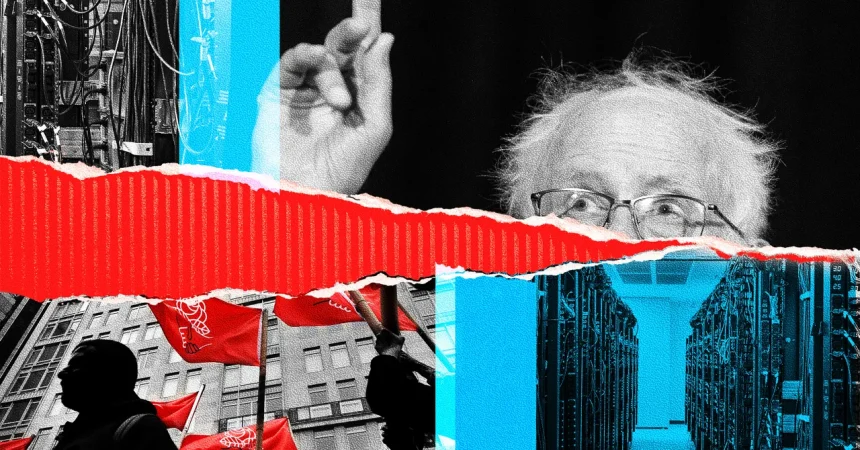
But not everyone on the left sees it that way. Senator Bernie Sanders, the godfather of progressive politics in the United States, has enthusiastically embraced AI safety as one of his defining issues. The 85-year-old independent from Vermont, who has spent his entire career fighting against concentrated corporate power, has begun speaking about artificial intelligence in terms that sound closer to a science fiction novel than a policy memo. He has warned that AI could eliminate humanity, and he has argued that the government must step in before it is too late. In March, Sanders released a bill calling for a moratorium on the construction of new data centers—the massive, energy-hungry facilities that power artificial intelligence. The bill explicitly linked the pause to the need for federal regulation to protect “the future of humanity.” That framing was a deliberate choice, and it has allowed Sanders to connect two seemingly separate battles: the grassroots backlash against data centers that have been raising electricity bills and straining local infrastructure, and the global existential threat posed by ever-smarter machines. Sanders’s position has put him in some unusual alliances. Perhaps most surprisingly, he has found common ground with Steve Bannon, the right-wing populist and former adviser to President Donald Trump, who has also been sounding the alarm about the dangers of unchecked AI. The fact that Sanders and Bannon, two figures who represent opposite poles of American political life, can agree that AI poses an existential threat shows just how strange and significant the moment has become. It also shows how much room there is for cooperation across ideological lines, even if the underlying motivations are very different.
Sanders’s embrace of AI safety has not stayed in Washington. It has rippled through left-wing political campaigns across the country. On September 9, one day before the New York DSA posted its ouroboros image, six candidates affiliated with the Working Families Party—including four who had been endorsed by Sanders—issued statements calling on Washington to regulate AI to prevent existential threats to humanity. These candidates are running for local and federal offices, and they are bringing the language of apocalypse to town halls and campaign websites. They talk about the need to protect jobs, but they also talk about the need to protect existence itself. For many of them, the two ideas are not opposed. They see AI as a genuine threat to human civilization, and they believe the left has a responsibility to confront it with the same urgency it brings to climate change. Alexander McCoy, a Democratic strategist focused on AI issues, put it this way: “The same people concerned about frontier governance and the development of superintelligence are also addressing those current harms. We should address all these other important factors. Those frontier AI abilities are true and increasing in power. They are not fake or hype.” In other words, you can care about both the worker being surveilled today and the possibility of a machine that decides, tomorrow, that human beings are an obstacle. You do not have to choose between a present-tense politics of suffering and a future-tense politics of survival.
And that is really what the left is arguing about. It is not a disagreement about whether capitalism is bad, or whether workers deserve better, or whether AI companies should be held accountable. On all of those points, there is broad agreement. The real disagreement is about what kind of story to tell. Do you tell the story that AI is a product like any other, designed by people who are making money, making mistakes, and making decisions that are hurting people right now? Or do you tell the story that AI is something radically new, a force that could escape human control and bring about the end of our species? The first story is more grounded, more verifiable, and more immediately useful for activists trying to pass laws against algorithmic discrimination or workplace surveillance. The second story is more emotionally powerful, more attention-grabbing, and more likely to put AI on the front page. But it also hands enormous power to the companies that are already the center of the story. When an Anthropic researcher quits and warns that the company’s own technology could be catastrophic, the company’s response is not to deny the risk; it is to say, “We always said that.” That is the snare the DSA post was pointing to. The alarm and the hype feed each other. The more terrifying the future seems, the more important the tech companies become, because they are the ones who claim to be building it and to be protecting us from it. The left is now caught between those two narratives, trying to find a way to talk about AI that does not give the industry a free pass and does not ignore the very real possibility that some of the industry’s warnings are true.
The stakes of this debate go far beyond Instagram posts and campaign statements. As artificial intelligence becomes more deeply embedded in every corner of American life, the left will have to decide not just what it thinks about the technology, but what kind of politics it wants to build around it. If the left focuses only on present harms, it risks being blindsided by a genuinely transformative force that could upend the economy, the labor market, and the global balance of power. If it focuses only on existential risk, it risks abandoning the people who are already being harmed, and it risks playing into the hands of corporations that are more than happy to distract from their own misconduct with talk of superintelligence. The path forward is not easy. It requires holding contradictory ideas in the mind at once: the understanding that AI is just another tool of power and profit, and the acknowledgment that it might also be something much more dangerous than anything humanity has ever built. The ouroboros on that hot pink slide was a warning against circular thinking, but perhaps it was also a reminder that the left has always been good at holding multiple truths at the same time—that it can be skeptical of power and open to the unknown, that it can fight for the worker in the warehouse and against the machine that might someday replace all of us. The dragon may be eating its tail, but a snake who sheds its skin is also a symbol of renewal. The left is not yet sure which story it wants to tell about artificial intelligence. But the very fact that it is asking the question, loudly and publicly, is a sign that this is no longer just a Silicon Valley argument. It has become a fight about democracy, about who gets to decide what the future looks like, and about whether ordinary people will have any say in the machines being built to shape their lives.