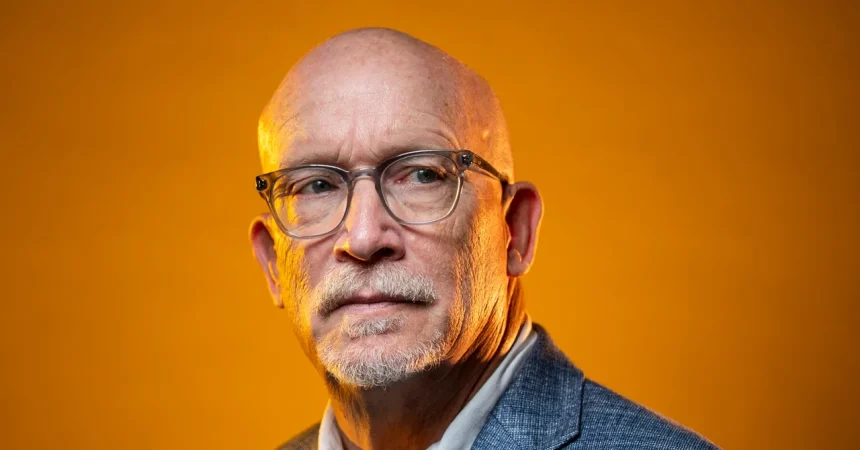
Election nights have a way of sharpening questions that, on ordinary days, we manage to push aside. At the WIRED World Fair, just before the big races were called, a roomful of people sat in the half-lit glow of a documentary screen and watched a story unfold about the most powerful, most unpredictable, and most investigated businessman on earth. The film was Musk, directed by Alex Gibney, the kind of documentarian who doesn’t just tell you what happened but forces you to ask what it means. When the lights came up, there was a nervous energy in the room, not just because the film was unsettling, but because the election returns were starting to roll in. The U.S. Congress was preparing to welcome a Democratic majority, and Gibney, standing in front of the audience with WIRED contributing editor Zoë Schiffer, wanted to know whether that majority would actually do anything. Would Democrats, with the power to hold hearings and launch investigations, finally confront Elon Musk? Or would they flinch in the face of his enormous wealth, his legal threats, and his ability to turn the machinery of government into a personal grievance? Gibney put it plainly: “Is our political system capable—assuming the Democrats win the House and the Senate—of ignoring the power of money … to hold really tough investigations?” The question hung in the air, not because it was abstract, but because everyone in that room understood how much is at stake when money and power collide with accountability.
Gibney’s documentary is not a simple biography. It is a sweeping, unflinching look at the many ways Musk’s companies have come under scrutiny from U.S. government agencies over the years. Tesla, SpaceX, Neuralink, X—each one has been touched by investigations, safety questions, labor complaints, or accusations that the billionaire has played fast and loose with rules that apply to everyone else. What makes the film so provocative is its central argument: that all that scrutiny was not just a nuisance to Musk. It was, in Gibney’s telling, a driving force behind his political transformation. The Musk who once seemed to float above partisan politics became a man who openly embraced Republican candidates and poured hundreds of millions of dollars into helping them win. Gibney suggests that this wasn’t simply a natural evolution of a libertarian tech bro. It was a reaction—a calculated response to a government that, in Musk’s view, kept coming after him. The investigations weren’t just legal headaches; they were personal betrayals. And so Musk turned his fortune into a political weapon. This election cycle, the numbers were staggering: more than $474 million donated to Republican political groups. That is not the kind of money people spend because they believe in a candidate’s vision. It is the kind of money people spend because they want to protect themselves, to install friends in power, to make sure that the people investigating you suddenly have bigger problems to worry about.
The Texas connection made the point even sharper. Gibney, looking at the early returns, smiled wryly and said, “last I looked things weren’t going Elon’s way, particularly in Texas.” Not long after, the results confirmed his hunch. James Talrico was declared the winner of his Senate race, and Gina Hinojosa was elected the state’s governor—some of the first Democrats to win a Texas statewide election in more than three decades. For years, Musk had enjoyed close relationships with Texas power brokers. He moved Tesla’s headquarters to Austin. He seemed to have carved out a comfortable place for himself in the state’s political landscape. But this cycle, he had bet heavily on the other side, donating at least $158 million to super PACs supporting Talrico’s opponent, Texas attorney general Ken Paxton. To lose that bet was more than a political embarrassment. It was a sign that even the richest man in the world cannot always buy the outcome he wants. Gibney, watching this unfold, seemed almost relieved. But he also sounded a warning. Musk, he reminded the audience, has so much money that “dropping $500 million on an election means nothing to him.” The real vulnerability, Gibney suggested, is not his bank account but his stock. So much of Musk’s wealth is tied up in the value of his companies. The question is: what happens if that stock begins to fall? If the market turns, if investors get nervous, if the public grows tired of the chaos, then the whole empire could start to wobble. And a man who feels cornered is not always a man who makes wise decisions.
The human side of the story is what makes Musk feel less like a policy briefing and more like a tragedy. Gibney spoke with tech entrepreneurs who watched Musk rise, former employees who felt the sting of his unpredictability, and, in two particularly damning interviews, women who knew him intimately: his first wife, Justine Wilson, and his ex-girlfriend, Ashley St. Clair. Those interviews give the film a kind of texture that balance sheets and court filings never could. They remind us that behind the rocket launches and the electric cars and the endless tweets, there is a person who has left a trail of broken relationships and bruised loyalties. Wilson and St. Clair don’t just talk about Musk the celebrity or Musk the visionary. They talk about Musk the man—his obsessions, his cruelties, his need for control. It is not a flattering portrait. But it is a human one. The documentary also includes conversations with Schiffer and WIRED global editorial director Katie Drummond, adding a layer of journalism that keeps the film grounded in reporting rather than rumor. Musk, predictably, declined to be interviewed. He didn’t want to sit for a documentary that might challenge his own version of his story. So Gibney’s team did something strange and striking: they created a simulated version of Musk using his own past public comments, placing them into the mouth of a tanned, chiseled avatar wearing a leather jacket. The effect is eerie, almost uncanny. It makes you feel like you are watching a ghost of Musk, a performance of the man built from his own words. It is a creative decision that says something profound about the subject. In a world where so much of what Musk says is already a kind of performance, the avatar is not entirely a parody. It is a mirror.
The rollout of the film has been almost as complicated as the man it depicts. Musk, never shy about defending himself, took to X to call the documentary a “hit piece.” In September, his attorney, Alex Spiro, sent Gibney’s Jigsaw Productions a letter threatening to file a defamation lawsuit before the film even came out. Legal threats like that have a chilling effect. They make distributors nervous. They make advertisers think twice. And they make audiences wonder whether there is something truly damaging in the film or just another billionaire trying to silence criticism. The early festival reviews, though, were strong enough that independent distributor Bleecker Street moved the release date up by a week. Yet the advertising side was messy. According to The Hollywood Reporter, YouTube, TikTok, and Meta all initially declined to run ads for the trailer. X did not advertise it at all. You don’t have to be a cynic to see the pattern. A platform that depends on the goodwill of powerful men, or that simply doesn’t want to anger them, can make a film vanish before anyone has a chance to see it. But Musk is not vanishing. It will be available to rent or buy starting November 6, at which point it will no longer play in theaters. That makes it a strange kind of event: a film with theatrical release, a streaming drop, and a documentary life that will likely be debated for years to come.
In the end, Musk is not just about one man. It is about the rest of us—our willingness to be dazzled, our tendency to confuse wealth with wisdom, and our slow, difficult realization that power, left unchecked, will always try to rewrite its own story. Gibney’s question to the audience was really a question to the entire country. Can our political system hold someone like Elon Musk accountable? Not through tweets or online outrage, but through actual investigations, actual hearings, actual consequences? The election results in Texas offered a glimmer of hope, a reminder that voters can sometimes surprise us. But the documentary itself offers a darker lesson: money doesn’t just buy ads. It buys access. It buys silence. It buys lawyers who send threatening letters. It buys platforms that decide not to run your trailer. And it buys a kind of influence that makes people in power look away when they should be looking closer. The film ends with no tidy conclusion, because there isn’t one. Musk remains a force of nature, a man of immense talent and immense appetite, surrounded by people who either adore him or fear him. Whether the new Democratic majority will have the courage to investigate him is still an open question. But Gibney has done his part. He has made the film, put the facts on the table, and asked the question out loud. Now it is up to us—the voters, the viewers, the citizens—to decide whether we want answers.