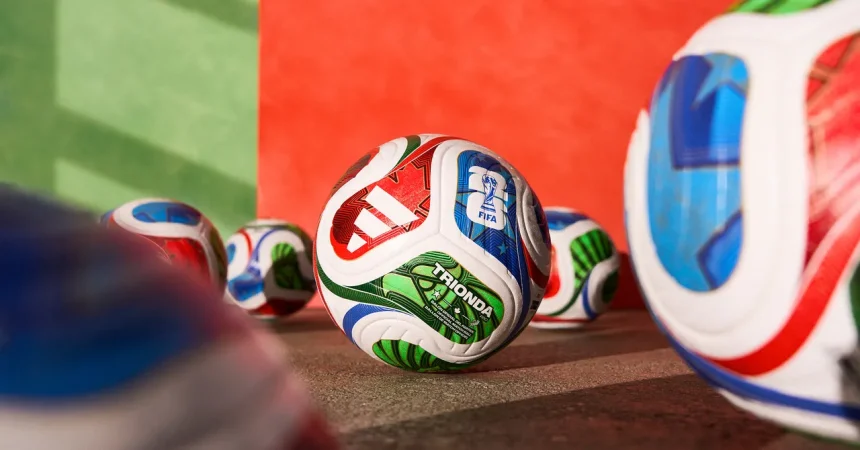
The 2026 World Cup is shaping up to be a historic spectacle, not just for the spectacle on the pitch, but for the silent protagonist that will dictate the flow of every match: the ball itself. This year, the official match ball, dubbed the “Trionda,” marks a radical departure in engineering. For the first time in the history of the men’s tournament, the ball is constructed from only four thermally bonded panels. While this design offers a striking aesthetic that blends the colors of the three host nations—the United States, Mexico, and Canada—it has sparked intense debate among sports scientists and players alike. In the high-stakes world of international football, a ball’s surface structure isn’t just a design choice; it is a fundamental factor that alters acceleration, trajectory, and range, potentially shifting the outcome of all 104 matches.
To understand why this four-panel design is so controversial, one must look at the physics of flight. John Eric Goff, a physics professor at the University of Puget Sound, points out that the fewer the panels, the shorter the seam length, leading to a much smoother surface. In the world of aerodynamics, surface smoothness is everything. The thin layer of air that hugs the ball as it flies determines how the air separates, the size of the wake left behind, and how much drag the ball experiences. A ball that is too smooth can become unpredictable, a lesson learned the hard way in the 2010 World Cup with the notorious “Jabulani,” which gained infamy for its erratic flight and sudden, ghostly decelerations that left goalkeepers flummoxed.
The memory of the Jabulani’s unpredictable behavior has loomed large over the development of the Trionda. To compensate for the reduced number of panels and the potential for aerodynamic instability, Adidas incorporated deep structural stitching, pronounced grooves, and a textured surface. The goal was to reclaim the stability lost by removing the traditional multi-panel pattern. However, the question remained: would these cosmetic and structural tweaks be enough to tame the physics of a four-panel sphere? To find the answer, researchers like Goff turned to the controlled environment of wind tunnels, measuring the balls against the unpredictable nature of physics to see if the Trionda would fly true or wander like its predecessors.
The testing process involved rigorous analysis of aerodynamic force coefficients, which essentially map out how air resistance pushes and pulls on the ball during flight. Perhaps most importantly, the researchers looked for the “aerodynamic drag crisis”—the precise moment when air resistance shifts abruptly as the ball changes speed. When a ball hits this “crisis” point, the air flow around it changes, often leading to that dreaded fluttering motion that makes a strike nearly impossible to track. By comparing the Trionda’s performance to previous tournament balls like the Al Rihla, the Telstar 18, and the Brazuca, the team aimed to see if they had finally cracked the code of stability.
The findings were revealing. The data showed that the Trionda hits its critical drag crisis point at roughly 43 kilometers per hour. To put that in perspective, this is significantly lower than the speed ranges recorded for recent, more stable balls like the Al Rihla (50–65 km/h) and a far cry from the troubled Jabulani, which peaked at nearly 97 km/h. By reaching this critical threshold at a lower speed, the Trionda behaves in a very specific way: it essentially “settles” into a predictable flight path sooner than its predecessors. While this might seem like a disadvantage, it actually suggests a more consistent, albeit different, flight profile that players will have to adapt to.
As the tournament approaches, the Trionda stands at the intersection of beautiful design and cold, hard physics. It represents a bold gamble by Adidas to redefine the standard of a match ball. Whether it will be remembered as the ball that allowed for spectacular, long-range goals or the one that made the tournament feel like a game of chance remains to be seen. What is certain is that the players who take the field in 2026 will be playing a game that is as much about mastering the air as it is about mastering the opponent. The Trionda is a masterwork of engineering, and it promises to make the 2026 World Cup an unpredictable, high-stakes, and scientifically fascinating display of human skill.