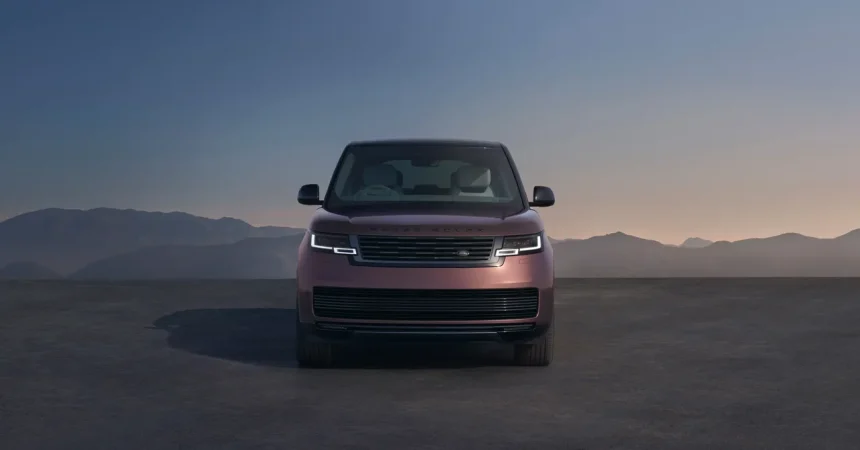
The automotive world has a curious relationship with anticipation, a slow-burning tension that usually fizzles out into cynical shrugs. But the wait for the Range Rover Electric was different—it was a conscious, almost monastic pause that transformed desire into a national obsession. Announced back in December 2023, JLR promised the inevitable: the world’s most luxurious SUV was going fully electric. But then came the silence. The missed 2024 deadline wasn’t met with excuses; it was met with a quiet, stubborn commitment to extended development testing. Unlike lesser brands rushing to market to grab the EV tax credit, JLR seemingly vanished into the Arctic tundra and the scorching Moroccan desert, torturing prototypes to ensure nothing short of perfection. The wait felt like watching a fine Swiss watchmaker slowly polish a single gear. And now, finally, the revelatory moment has arrived. The veil has been lifted, and despite the agonizing postponement, the SUV that many of us have quietly doodled on napkins for years is not just real—it’s one of WIRED’s most anticipated rides of the decade. It is a testament to the idea that patience, in the automotive realm, is rarely rewarded with mediocrity, but rather with a vehicle that feels like it was worth every sleepless night we spent refreshing the news feeds.
When you finally grasp the machinery behind this elegant facade, the first reaction is sheer disbelief at the numbers. Under the sculpted hood lies a powertrain that doesn’t merely match traditional combustion engines; it obliterates them with an almost arrogant ease. Dual 260-kilowatt motors spin up a combined 542 horsepower and a monumental 850 newton-meters of torque—figures that JLR proudly claims are 20 percent more potent than any other motor of comparable size currently on the market. Humanizing this means translating it from textbook physics to pure sensation. Imagine the immediate, violent yet eerily silent shove you feel in your lower back when you floor the accelerator. There is no screaming exhaust, no guttural downshift, just the deeply satisfying, instantaneous surge of an electron avalanche. The official 0 to 60 mph sprint takes just 4.3 seconds. Let that sink in. This is a vehicle that weighs well over 2.5 tons—a rolling fortress built for diplomatic security and muddy estates—yet it launches with the ferocity of a Porsche 911. The fact that it achieves this while maintaining that commanding, elevated driving posture is nothing short of engineering alchemy. It’s the kind of velocity that makes your passenger grip the door handle, your coffee stay perfectly flat in the cupholder due to active damping, and your expression turn into a delighted, baffled grin. This isn’t just a fast SUV; it’s a physics-defying ride that feels like being on a gravity-defying magic carpet, one that whispers “effortless” while delivering a punch that would have made a 1960s muscle car weep.
Of course, all that fury needs a heart of lithium, and the Range Rover Electric doesn’t disappoint. Nestled discreetly within the chassis is a monumental, double-stacked 118.5-kWh battery pack. The genius here isn’t just the capacity; it’s the architectural integration. Mounting it low and central does wonders for handling, giving the leviathan a surprisingly nimble footprint on winding roads. But the true genius of the engineering lies in the 800-volt electrical architecture, a system that directly attacks the human anxiety of being stranded. We’ve all felt that sinking panic when the battery icon blinks red. The Range Rover Electric attacks this with a vengeance. Plugged into a high-capacity DC fast charger, it can recharge from 10 percent to 80 percent in just 22 minutes—barely enough time to finish a bad fast-food meal. Even more compelling, it recovers a staggering 137 miles of range in a mere 10 minutes, which is roughly the time it takes to stretch your legs and check the tire pressure. As for range itself, JLR quotes a WLTP-certified 372 miles, which translates to a far more realistic and honest 333 miles on the road. This is psychologically perfect. It tells you that a weekend escape from London to the Scottish Highlands is entirely within reach without a single frantic stop for a charge. The days of range anxiety are over; this vehicle offers the same unshakable confidence that made the diesel-engine Range Rover the untamable king of the trans-European commute. It’s the freedom to drive the long way home, safe in the knowledge that the charging network, combined with this rapid technology, will always have your back.
Stepping inside this behemoth is an exercise in sensory incision from the outside world. Humanizing the interior of the Range Rover Electric means understanding that JLR has essentially built a spa with wheels. The acoustic isolation is almost supernatural. Because there is no internal combustion engine to muffle, the engineers have had to address the whine of the electric motors and the roar of the tires at speed. The result is a hushed, library-like silence that isolates occupants from the chaotic world. This quiet is paired with a double-stacked battery that lowers the center of gravity, making the ride feel more like a luxurious yacht gliding over gentle swells than a heavy truck pushing through potholes. Inside, the materials are a tactile feast: sumptuous semi-aniline leather, sustainably sourced wool blends, and chilly, precision-milled aluminum. The twin 13.1-inch touchscreens curve neatly around the driver, displaying a crisp, intuitive interface. But the magic happens when you stop looking at the screens. You notice the knurled texture of the volume dial, the soft-close doors that gently suction shut, and the sight lines that make you feel like you are gazing over the horizon from a top-floor penthouse. It’s a cabin meant for deep conversations, quiet contemplation, or simply enjoying the booming Meridian surround sound system. Whether you’re in the chauffeured rear seats folding down the picnic tables or driving through a monsoon, the Range Rover Electric envelops you in a feeling of absolute, unassailable sanctuary—a fortress of calm that happens to be capable of fording 33.6 inches of water without flinching.
Now, let’s talk about the elephant in the room: the price. Because with great engineering comes a truly terrifying cost of admission. The Range Rover Electric is, and always has been, a symbol of stratospheric wealth, and the EV iteration doubles down on this. For UK customers, the entry-level Autobiography model opens at a breathtaking £154,070, which translates to roughly $208,000 in American currency. However, if you want the highest-spec baller status, you will opt for the SV Black long-wheelbase model, which will drain your bank account to the tune of £225,240—or a mind-blowing $304,000. And should you feel that’s not enough of a flex, JLR still offers the “Ultra” models, listed merely as “Price on Application.” This is the automotive equivalent of the phrase, “If you have to ask, you can’t afford it.” It’s a deliberate, haughty exclusivity that feels almost liberating in its honesty. To humanize this price tag is to admit that we, the 99 percent, are utterly priced out of this fantasy. It makes us feel a pang of envy, but also deep admiration. This is not a car for mass adoption; it is a hand-built talisman for billionaires, tech moguls, and heads of state. The staggering cost buys you the right to own the pinnacle of human automotive engineering—a machine that can out-drag a sports car while carrying your Louis Vuitton luggage to a ski chalet. It’s a status symbol that screams “I won at capitalism” while silently gliding past the petrol stations where the mere millionaires are queuing up.
Adding a thin sliver of hope for the slightly-less-wealthy American consumer, JLR has introduced a lower SE-spec model specifically for US buyers. Priced from $138,000, before a $2,550 delivery and destination charge, this variant cuts some of the opulent excess but retains the core 542-horsepower magic and the 333-mile range. It becomes a direct heavyweight contender against the Cadillac Escalade IQ and the Mercedes EQS SUV. But in the end, what does all this mean for the human experience? It means that the wait wasn’t just about engineering; it was about creating a legend that bridges the gap between raw ecological future and old-world luxury. After all the delays, all the teasing, and all the astronomical price tags, driving the Range Rover Electric doesn’t feel like driving a compromised electric vehicle; it feels like driving the evolution of a throne. It’s the realization that you don’t need to hear an engine to feel power, and you don’t need to smell diesel exhaust to feel untamed capability. As you finally sit behind the wheel, the silent hum of the dual motors becomes a soundtrack to your own personal kingdom. The long wait, the frustrating delays, and the crushing price are all instantly forgiven the moment you press the pedal and the horizon rushes toward you with breathtaking, serene efficiency. This is not just the future of luxury SUVs; it is the triumphant, long-overdue coming-out party for the most anticipated vehicle of the decade.