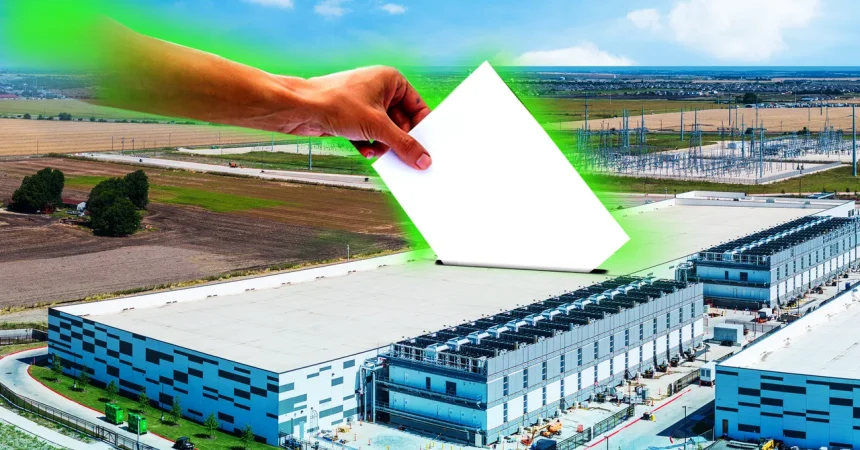
The Great Data Center Revolt: How 2026 Became the Year America Turned Against Big Tech’s Building Boom
It began like any other election night, with pundits predicting the usual political battles over the economy and immigration. But as the results trickled in across the Eastern time zone, a different story started to emerge—one that would fundamentally reshape American politics and send shockwaves through the technology industry. In Ohio, a state that had become synonymous with data center construction, voters made a powerful statement by sending Democrat Sherrod Brown to the Senate. Brown had spent months running advertisements that painted his opponent as the embodiment of the data center boom, repeatedly referring to him as “the face of data centers in Ohio.” The strategy worked, and the victory wasn’t even close. Meanwhile, in New Hampshire, Chris Pappas secured his own Senate seat, making history as the nation’s first openly gay male senator. But what was perhaps more telling than that historic milestone was the moment in his victory speech when he mentioned his opposition to data centers. The crowd erupted in thundering boos—not confusion, not indifference, but genuine, passionate anger. What made this particularly striking was that New Hampshire doesn’t even have any large-scale data centers under construction. The mere mention of the industry was enough to ignite fury in a crowd that had gathered to celebrate a historic political victory.
The wave of anti-data center sentiment rippled far beyond these high-profile Senate races, crashing into House contests across the Midwest with remarkable consistency. In Ohio and Wisconsin, two Republican candidates who shared almost identical names—one called Derek, the other Derrick—found themselves on the losing end of their respective races. Their Democratic opponents had brilliantly weaponized the data center issue, branding them with the memorable nicknames “Data Center Derek” and “DC Derrick.” The fact that both men lost, despite their different states and circumstances, pointed to something deeper than just local dissatisfaction. This wasn’t about individual candidates or specific projects. This was a genuine political movement taking shape, one that cut across traditional party lines and geographical boundaries. As part of what many are now calling the “blue tsunami” of 2026, voters across the country seemed to be making a coordinated statement about the direction they wanted their communities to take. They chose candidates who promised tough policies on data centers at every level of government, from local councils to state houses to Congress itself. The message was clear and unmistakable: the era of unchecked data center development was coming to an end.
The polling data from election night painted an even more dramatic picture of just how central this issue had become to the American voter. NBC News reported that nearly a quarter of all voters identified data centers as “crucial” to how they cast their ballots—a stunning figure for an issue that barely registered in political discourse just a few years ago. Even more significantly, almost two-thirds of voters said that data centers were either a major or minor factor in their decisions. These numbers suggest that what we’re witnessing isn’t just a transient political fad or a niche concern of environmental activists. This is a fundamental shift in how Americans view the technology industry’s physical footprint in their communities. The data center, once seen as a symbol of progress and economic vitality, has transformed into something far more complicated in the public imagination. It now represents concerns about energy consumption, environmental impact, rising electricity bills, and the displacement of traditional industries. Texas Democratic Congressman Greg Casar captured the moment perfectly when he declared that “the revolt against data centers was one of the top issues of the 2026 election.” His warning that we would look back on this as “just the early tremor of a much bigger AI earthquake upending American politics” suggests that this is only the beginning of a much larger societal reckoning with artificial intelligence and its infrastructure.
To understand why this issue has resonated so powerfully with voters, one must appreciate how deeply interconnected data centers and artificial intelligence have become in the public consciousness. Democratic strategist Alexander McCoy, who specializes in AI policy, explains that “data centers and AI as a technology are fundamentally linked in many voters’ minds.” This connection means that concerns about data centers extend far beyond their immediate physical impacts—the humming noise, the massive water consumption, the light pollution, the strain on local power grids. Even if all these tangible problems were magically solved tomorrow, McCoy argues, “there would still be significant concerns about what these projects are enabling.” Voters aren’t just worried about the server farms in their backyards; they’re worried about what those servers are being used for. They’re concerned about the effect of artificial intelligence on their job prospects, on the prices they pay for goods and services, on the very fabric of their communities and society itself. This deeper anxiety explains why the anti-data center movement has gained such traction across such a diverse range of constituencies. It’s not just rural communities dealing with massive power line installations or suburban areas concerned about property values. It’s a broad coalition of Americans who sense that something fundamental is changing about their country, and they see the data center as the most visible symbol of that transformation. The 2026 election represented their chance to push back against what they see as unchecked technological progress without democratic oversight.
Perhaps the most stunning shocks of the night came in the governor’s mansions, where voters delivered what can only be described as repudiation of the data center industry’s political influence. In Georgia, voters elected Democrat Keisha Lance Bottoms in a stunning upset, while Texas chose Democrat Gina Hinojosa—both candidates who had run explicitly on platforms that included not just increased regulations on the industry but outright data center moratoriums. In Kansas, Democrat Cindy Holscher appeared on the cusp of a potential victory, campaigning on a similar platform. The implications of these victories cannot be overstated. Texas and Georgia have served as two of the largest hubs for data center development in the entire country, with hundreds of projects planned for each state. A moratorium on new data centers in these states would represent an earthquake for the industry, potentially halting billions of dollars in planned investment and throwing the future of numerous tech companies’ expansion plans into question. The political calculus here reveals just how dramatically the landscape has shifted. Just a few years ago, politicians in these states were falling over themselves to woo data center developers with generous tax breaks and streamlined permitting processes. They saw these projects as job creators and tax revenue generators without fully considering their long-term costs. Now, voters have sent an unmistakable message that this era of pandering is over. The candidates who won did so not despite their anti-data center positions but because of them, proving that this issue has become a winning political strategy rather than a liability.
The path forward for the data center industry and its political allies looks increasingly difficult, with strategists and analysts already mapping out the implications of Tuesday’s results. Alexander McCoy predicts “the end to favorable tax breaks” for data center developers, pointing to figures like Texas Governor Greg Abbott, who may find themselves politically weakened by their historical support for providing financial incentives to AI companies and their infrastructure. The new political reality suggests that data center developers will face significantly more scrutiny from administrative and regulatory bodies at both the state and federal levels. Environmental protection regulations that were previously waived or relaxed to attract development will likely be enforced with renewed vigor. Permitting processes that were fast-tracked will slow down. Community engagement requirements will become more stringent. The industry is going to have to fundamentally change how it operates and how it interacts with the communities where it seeks to build. This doesn’t necessarily mean the end of data center construction in America, but it does mean a new era of accountability and democratic oversight. Companies that want to build these facilities will need to make real, substantive commitments to mitigating their environmental impact, to providing genuine economic benefits to local communities, and to being transparent about their operations and energy usage. The days of showing up, cutting a ribbon, and receiving decades of tax breaks while straining local infrastructure are over. The 2026 election marked a turning point in how Americans think about the relationship between technological progress and community well-being—and that shift in thinking is not going to reverse itself anytime soon.
As the dust settles on this historic election, it’s worth considering what this moment means for the broader trajectory of American society. The data center revolt represents something deeper than a single-issue political movement. It reflects a growing skepticism about the promises of technological progress that have dominated American culture for decades. For generations, we’ve been told that innovation would solve our problems, that bigger and faster always meant better, that the march of progress was inevitable and shouldn’t be questioned. But voters across the country have now said, in no uncertain terms, that they want a seat at the table when decisions are made about their communities’ futures. They want to weigh the costs of progress against its benefits, and they want their voices to matter in those calculations. The fact that this message was delivered through the data center issue—arguably the most mundane and unglamorous aspect of the AI revolution—makes it all the more powerful. It shows that voters are paying attention not just to flashy new technologies but to their practical implications. They understand that every new breakthrough comes with infrastructure requirements, and they’re no longer willing to absorb those costs without question or compensation. The AI earthquake that Greg Casar predicted is indeed coming, and it will reshape not just our politics but our fundamental relationship with technology. The 2026 election was just the first tremor, the first warning that the American people are no longer content to be passive observers of their own technological transformation. They want to be active participants, and any industry or political leader who fails to recognize this new reality does so at their own peril. The data center revolt has reminded us that in a democracy, the people ultimately hold the power—even over the mightiest forces of technological and economic change.