Paragraph 1: The Cosmic Speedster at the Heart of the Galaxy
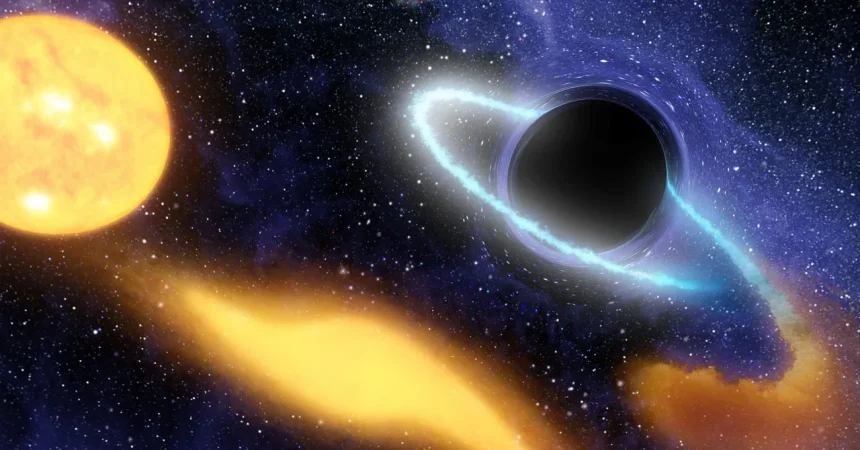
The center of our Milky Way is not a peaceful, silent void; it is a chaotic, violent maelstrom where the very fabric of space and time is put to the ultimate test. For decades, astronomers have peered into this dark heart, trying to understand the forces that govern the cosmic monsters lurking there. Now, a team of researchers has made a jaw-dropping discovery: they have found the fastest star ever detected in our entire galaxy. It’s not just a quick mover; it is a true cosmic speedster, a celestial bullet tearing through space at a rate that breaks all records and challenges our everyday understanding of motion. This star, designated S301, is not simply racing across the galaxy on some random trajectory. Instead, it is locked in a deadly, tight gravitational waltz with the most terrifying object known to science: Sagittarius A*, the supermassive black hole that sits at the exact gravitational center of the Milky Way. This black hole is an absolute behemoth, packing the equivalent mass of four million Suns into a region so compact that it warps the very space around it. To be caught in its orbit is to be subjected to the most extreme physics imaginable, and S301 is living—or at least moving—proof of that. Its speed is not a gentle push but a violent gravitational slingshot, a relentless acceleration fueled by the immense pull of a monster that devours light itself.
Paragraph 2: Putting the Speed of S301 into Human Perspective
To truly appreciate the insane velocity of S301, we need to scale it down to something our human brains can actually grasp. Let’s start with our own star, the Sun. The Sun is moving, and it’s moving fast by our standards, orbiting the center of the galaxy at about 230 kilometers per second. That translates to over 800,000 kilometers per hour. It sounds incredible, right? But compared to S301, it might as well be standing still. At its peak, S301 accelerates to a staggering 25,000 kilometers per second. That is over one hundred times faster than our Sun. To put that into a more tangible metric, S301 moves at approximately eight percent of the speed of light. Imagine taking a journey from New York to Los Angeles; S301 could do that in less than a tenth of a second. At that speed, you could travel around the entire Earth in under two seconds. It takes S301 just 8.7 years to complete one full lap around the black hole, which sounds fast, but its speed isn’t constant. It varies wildly depending on where it is on its path. The reason for this extreme velocity is its orbital proximity. At its closest point to Sagittarius A*, S301 swings incredibly close, coming to within a distance comparable to that between Saturn and the Sun. For a star to get that close to a four-million-solar-mass black hole is like putting your hand right next to a jet engine at full thrust—the gravitational acceleration is simply overwhelming.
Paragraph 3: The Gravitational Slingshot and the Dance of the Ellipse
The physics behind S301’s extraordinary speed is a classic, yet extreme, demonstration of gravity and orbital mechanics. This isn’t a star spiraling directly into the black hole to be devoured. Instead, S301 follows a highly elongated, extremely elliptical orbit. Think of a stretched-out oval. As the star plunges towards the black hole, Sagittarius A*’s immense gravitational pull tugs at it relentlessly, converting gravitational potential energy into kinetic energy. This means that as the star gets closer, it accelerates, reaching its maximum velocity at the point of closest approach. This is the essence of a gravitational slingshot effect. It’s the exact same physics that NASA uses to send spacecraft like Voyager to the outer planets, except here, the gravity source is a supermassive black hole, and the spacecraft is a blazing ball of plasma. When S301 swings around the black hole and heads back out into the outer reaches of the galactic center, it slows down just as dramatically, shedding that speed as gravity pulls it back. The elliptical shape of its orbit explains the stark contrast in its velocity, much like how we see with comets in our own solar system. Take Halley’s Comet, for instance. When it nears the Sun, it shoots past at breakneck speeds, and then it slows down to a crawl in the frigid outskirts of the solar system. S301 is just a massive, stellar version of that same cosmic dance, except its “Sun” is an invisible, light-bending void at the center of our galaxy.
Paragraph 4: A Tragic Past – The Cosmic Breakup and the Lost Companion
But how did this star get into such a treacherous, high-speed orbit in the first place? The answer reveals a violent and slightly tragic history. Stars, as we understand them, cannot form from collapsing gas clouds in the direct vicinity of a supermassive black hole. The intense radiation, extreme heat, and brutal tidal forces—the gravitational gradient that stretches and squeezes objects—would make star formation impossible. So, S301 must have been born elsewhere, far away from this spooky neighborhood. Astronomers now believe that S301 didn’t arrive alone. It was likely part of a binary system, a pair of twin stars locked in a gravitational embrace, orbiting each other as they collectively journeyed around the galactic center. But their fate took a deadly turn when they wandered too close to Sagittarius A*. The black hole’s immense tidal forces acted like a cosmic butcher. As the binary pair approached, the difference in gravitational pull on the two stars became so extreme that it literally tore their mutual bond apart. This is akin to pulling on a rubber band until it snaps. In this violent cosmic breakup, one of the stars—S301—was immediately captured by the black hole’s gravity, swooping into the tight orbit we see today. The other star, its former companion, was violently ejected from the system at an astronomical speed, kicked out with such force that it was flung out into the galaxy. In fact, scientists calculate this ejected star is likely traveling so fast that it may have achieved escape velocity, doomed to drift aimlessly through intergalactic space, forever separated from its partner.
Paragraph 5: Unlocking the Secrets of the Invisible Monster
The discovery of S301 is more than just a cool record for the fastest star; it is a scientific goldmine that opens a unique window into the behavior of the hidden giant that rules our galaxy. By observing S301’s orbit with incredible precision over the coming years, astronomers can use it as a probe to measure the properties of Sagittarius A itself. Currently, researchers know the black hole’s mass, but its spin—its rotation—remains a mystery. Spin is a fundamental property of black holes alongside mass. Einstein’s General Theory of Relativity predicts that a rotating black hole drags space and time along with it, an effect known as frame-dragging. This warping of spacetime subtly alters the orbit of anything around it. By tracking S301’s exact path and looking for tell-tale signs of this precession—the slow rotation of the orbit itself—astronomers can deduce how fast the black hole is spinning and in which direction. The European Southern Observatory is confident that within the next decade, with the power of next-generation telescopes like the Extremely Large Telescope, they can measure the spin of Sagittarius A with high precision. This information is crucial to understanding how supermassive black holes are born and evolve in the universe, painting a clearer picture of the extreme, bizarre physics that hold galaxies together.
Paragraph 6: The Beauty and Violence of Our Cosmic Home
As we stand back and look at this discovery, it serves as a humbling and awe-inspiring reminder of the nature of our universe. The story of S301 is one of incredible speed, cosmic violence, and extreme physics, playing out right in the middle of our galactic hometown. It reminds us that the Milky Way is not a serene, static swirl of stars. It is a dynamic, dangerous, and breathtakingly beautiful place, governed by forces so extreme that they warp the very nature of reality. Yet, the most remarkable aspect of this story isn’t just the star or the black hole—it’s us. We are tiny, fragile beings living on a speck of rock orbiting a rather ordinary star in the galactic suburbs. And yet, we were able to detect this cosmic speedster, calculate its breakneck speed, dissect its history of a tragic binary breakup, and predict exactly how we can use it to measure the spin of a monster black hole. We are actively translating the language of the cosmos, peeling back the layers of reality to understand the rules of the grandest stage imaginable. The tale of S301 is a testament to human curiosity and intellectual determination. It shows that even the most violent, chaotic corner of our galaxy can be understood through science, and it underscores a fundamental truth: we are part of a universe that is infinitely more extraordinary, more violent, and more fascinating than we could ever have envisioned, and we have the capability to explore its deepest, darkest secrets, one stellar bullet at a time.