Paragraph 1: The Unthinkable Price Tag
Let’s be honest with ourselves for a moment: when you first hear that a preamplifier costs $240,000, your brain probably does a double-take. Not a power amplifier, not a pair of speakers, not a complete system—just the preamp. The component that, in many people’s minds, is simply that box with a volume knob and an input selector. Yet the Goldmund Mimesis Statement analog preamplifier exists precisely to shatter that notion. It is a statement in every sense of the word, not just about sound quality but about what high-end audio can be when cost is no object and engineering becomes a form of artistic expression. If you are not familiar with the chain of audio reproduction, a preamplifier is the quiet hero of the system. It receives the tiny electrical signals from your source components—your turntable, your network streamer, your CD player—and prepares them for the power amplifier, which in turn drives your loudspeakers. The preamp is what you use to choose your input, adjust your volume, and ideally do all of that without adding any unwanted color, noise, or distortion. In an ordinary system, this happens invisibly, quickly, and cheaply. In the Goldmund Mimesis Statement, it happens with such obsessive precision that the price seems almost incidental to the underlying ambition. This is not a component you purchase to simply make your music louder or your life more convenient. It is a component you purchase because you believe that every millivolt of musical signal deserves to be preserved, protected, and delivered with the same purity that the artist originally created.
Paragraph 2: A Sculptural Approach to Electronics
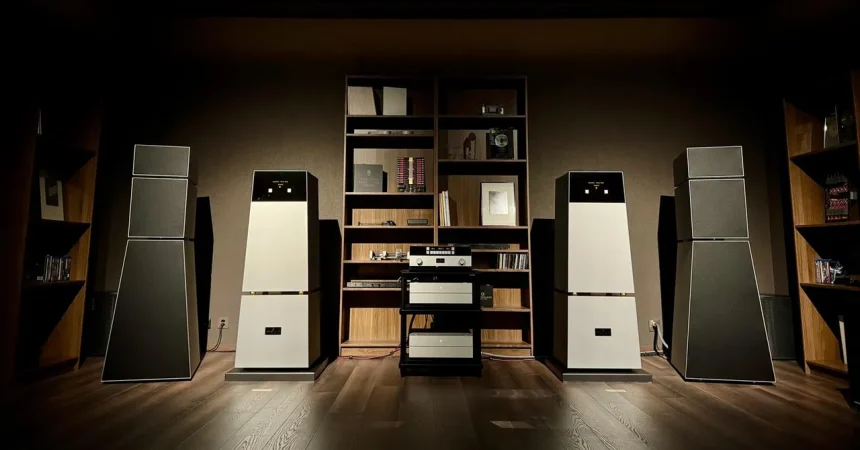
Before you even switch on the Mimesis Statement, its physical presence tells you that this is no ordinary piece of stereo equipment. The system is split across three chassis, which immediately sets it apart from virtually every other preamp you have ever seen. The main enclosure—the one with the buttons, dials, and display—houses the pre-amplification electronics. This is where your source equipment connects, using a generous array of balanced and unbalanced inputs that can accommodate just about any serious audio component you might own, from a high-end turntable to a state-of-the-art network streamer. The other two boxes are dedicated external power supplies, one for the left channel and one for the right channel. This kind of radical separation might seem excessive, even theatrical, but for Goldmund it is a serious technical decision. By moving the power supplies out of the main chassis, the designers isolate the sensitive audio circuits from electromagnetic interference and mechanical vibrations that inevitably intrude when everything shares a single box. The result is a preamplifier that feels less like a piece of consumer electronics and more like a carefully arranged sculpture for your listening room. And the styling matches the ambition: mirrored-glass displays, metal-coated controls, and Goldmund’s signature slender gold-line design flourish run across all three units, giving the system a visual identity that is simultaneously luxurious and understated. It is the kind of object that you want to touch, not because it feels expensive—although it certainly does—but because everything about its construction communicates intention. There is no wasted space, no cheap compromise, no part that was chosen simply because it was easier or cheaper than the alternative. Every knob, every button, every edge has been considered, as if the entire unit were an instrument rather than an appliance.
Paragraph 3: The Obsessive Pursuit of Purity
What justifies the existence of a preamplifier that costs more than many houses? Goldmund’s answer lies in the internal architecture, which is designed with painstaking attention to detail and an almost fanatical commitment to signal integrity. The company emphasizes complete symmetry, meaning that the left and right channels are treated as independent circuits with identical construction, avoiding any subtle imbalance that could affect stereo imaging. Each channel has its own voltage regulation stages, ensuring that the electronic current remains stable and clean no matter what the music demands. Heat dissipation is also carefully optimized, because heat is the enemy of precision: when components get hot, their behavior changes, and those small fluctuations can color the sound in ways that are difficult to measure but audible to keen ears. Goldmund claims that this radical separation—combined with the careful internal layout—guarantees absolutely consistent operating conditions in all circumstances. In other words, whether you are listening to a delicate piano passage or a thunderous orchestral crescendo, the preamp operates with the same calm, controlled precision. All of this effort results in a total harmonic distortion figure of 0.0002 percent. To put that number in perspective, it is so low that it is extremely difficult to measure in the first place. Laboratories need incredibly sensitive equipment and careful methodology just to detect it, let alone quantify it. And for most listeners, that level of distortion is entirely beyond audibility. But that is not the point. The point is that Goldmund has pushed the technology to its theoretical limit, not because you will consciously hear the difference, but because they believe that every removed imperfection—however tiny—brings you closer to the original performance. It is the same philosophy that drives a watchmaker to polish surfaces that will never be seen, or a car manufacturer to balance components at speeds you will never reach. The obsession is not about practicality; it is about perfection.
Paragraph 4: A Price That Demands Context
Now, let’s talk money, because $240,000 is a number that demands context. In the United States, that price places the Goldmund Mimesis Statement firmly in “fairly fancy European sports car” territory. You could, with that sum, buy a luxury sedan, a weekend convertible, or a very nice apartment—probably with a balcony. And yet, as remarkable as the preamp’s price tag is, you have to remember that a preamplifier by itself does not constitute an audio system. It cannot produce sound on its own. It needs an input signal from a source component, and it needs to send its output to a power amplifier, which in turn drives speakers. The Mimesis Statement is the centerpiece, the brain, the master controller—but a brain without a body cannot do anything. Fortunately, Goldmund offers plenty of options to flesh out the system, and they are by no means modest in price either. The company suggests pairing the preamp with its Eidos network streamer, a digital source that will set you back about $27,000. That streamer serves as the music source, delivering high-resolution digital audio from your streaming service, library, or network. In the context of the overall system, $27,000 almost seems like a bargain, the way a reasonable dinner seems inexpensive next to a wedding banquet. The preamp and streamer work together as a team, but they still need the next pieces of the puzzle: power amplifiers and speakers. And this is where the system really begins to reach for the stars.
Paragraph 5: The Complete Million-Dollar Orchestra
For the listening session, Goldmund connected the Mimesis Statement to a pair of Thelos 9800 power amplifiers. These are not subtle components. Each amplifier weighs nearly 800 pounds, which means that moving them into a listening room requires not just strong backs but probably logistics and planning, perhaps even specialized equipment. They deliver 1,560 watts per channel, so they have enough power to drive virtually any loudspeaker on the market to realistic—and beyond realistic—levels without breaking a sweat. Their aesthetic is imposing, to say the least: industrial, massive, muscular, and yet somehow elegant, like a weightlifter in a tailored suit. Each of these amplifiers costs $500,000. You read that correctly: half a million dollars apiece, which means a pair costs one million dollars before you even add in the preamp and streamer. From the amplifiers, the signal travels to a pair of Theia Passive four-way floor-standing loudspeakers, priced at $215,000 for the pair. These speakers are designed to be the final mouthpiece of the entire system, turning the amplified electrical signal into physical sound that fills the room. They are four-way designs, meaning they use multiple drive units to handle different frequency ranges, from the deepest bass to the highest treble, each driver carefully integrated to create a seamless sonic picture. When you add all of this together—the $240,000 preamp, the $27,000 streamer, the pair of $500,000 amplifiers, and the $215,000 speakers—you arrive at a total system price of $1,482,000. That is no longer “fancy European sports car” money. That is “very nice apartment, probably with a balcony” money. Actually, that is “very nice apartment in a major city, with parking, and maybe a second apartment for weekends” money. And we have not even added in the price of cables, which in the high-end audio world can easily add another significant sum if you choose exotic options.
Paragraph 6: What Does a Million-Dollar System Actually Buy?
So, what is it like to listen to a million-and-a-half-dollar system? At this level, you are not just buying sound quality. You are buying a kind of conviction—a belief that the original musical performance, in all its nuance and emotional weight, can be transported into your room with almost no loss. The low distortion figures, the separate power supplies, the enormous amplifiers, the carefully designed speakers—all of this exists to preserve something intangible that gets lost with lesser equipment. I would be lying if I said that the system did not sound remarkable. The sense of space, the texture of instruments, the sheer physical presence of the music—it all feels real in a way that ordinary systems rarely achieve. But I would also be lying if I said that the price justified itself in any rational, measurable way. Because you cannot quantify music, not really. You cannot put a dollar value on the feeling you get when your favorite song makes you stop what you are doing and just listen. What Goldmund sells, at this level, is the absence of compromise. They have built a preamplifier that they believe is as close to perfect as humanly possible, and then they have surrounded it with willing partners that match its ambition. The result is a system that asks all the right questions and tries to answer them with absolute confidence. Is it absurd? Of course it is, in the same way that a Bugatti Veyron or a dress made of gold thread is absurd. But it is also an expression of human creativity, engineering skill, and the simple, persistent hope that if we work hard enough, we might just catch a glimpse of the perfect moment hiding inside the music. For the very few people who can afford it, that glimpse might be worth every single dollar. And for the rest of us, it remains an extraordinary fantasy—a story about what happens when you refuse to accept anything less than the best, and then refuse to admit that enough is ever enough.