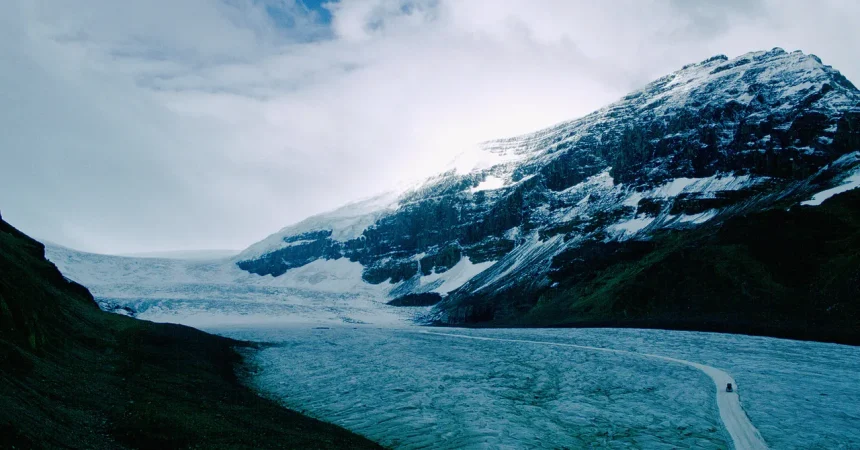
Imagine a small patch of moss, no bigger than your hand, clinging to rocky ground that has only recently been freed from the grip of ice. For decades, maybe even centuries, it lives quietly through wind, snow, and the short Arctic summer. It anchors itself in cracks, turns green, and becomes part of a fragile but real community. Then, slowly, the ice returns. It creeps forward, covering the moss, grinding over the land, and killing the tiny plants. But here is the remarkable thing: the moss is not entirely destroyed. It is frozen, compressed, and preserved beneath the glacier, waiting. Thousands of years later, as the ice melts away again, those ancient plants are exposed once more, offering scientists a kind of message from the past. This is not a metaphor. It is exactly what Nicolás Young, a paleoclimatologist at Columbia University’s Lamont-Doherty Earth Observatory, and his colleagues have found around the Barnes Ice Cap in the Canadian Arctic. “After the ice cap retreated, mosses eventually colonized this newly exposed land,” Young explains. “These mosses are living there, and things are normal—then, eventually, the ice cap starts to re-expand. The ice covers the moss, and kills it.” By studying those preserved traces, the team has been able to reconstruct a detailed timeline of how the ice cap has moved across the landscape, growing and shrinking in response to changes in the Earth’s climate. What makes this story so powerful is that the evidence is not hidden in complex data sets or abstract models. It is literally frozen in the remains of tiny, ordinary plants that lived and died on the edge of a massive ice field. These mosses become accidental historians, recording centuries of environmental change in their own silent way.
Thanks to these records, Young and his coauthors have been able to estimate that the Barnes Ice Cap began growing again around 2,000 years ago. For a long time, this expansion was likely part of the natural rhythm of the planet. The Earth was gradually cooling after a warmer period, and ice was beginning to advance in many parts of the Northern Hemisphere. This may have been the start of another glaciation period—a slow slide toward conditions that, over many thousands of years, could have produced much larger ice sheets. To scientists, this kind of long-term pattern is essential for understanding how the climate system works. It shows that glaciers are not static features; they are constantly responding to even subtle changes in temperature, sunlight, and ocean circulation. The mosses that were killed by the advancing ice mark a clear boundary: before that time, the ice cap was smaller than it is today; after that time, it expanded and remained large for roughly two millennia. That is an impressive stretch of history. It encompasses the rise and fall of empires, major shifts in human civilization, and countless generations of people living in the Arctic. Yet to the ice cap, it was just one long, cold chapter in its existence. The fact that scientists can now look back across those 2,000 years and read the story from preserved plant material is a testament to human curiosity and ingenuity. It also challenges us to think about what the ice cap has experienced during its long life and how quickly it is now changing. The study’s timeline gives us a baseline, a sense of what was “normal” for this glacier before the industrial age and the rapid warming that followed.
But starting in the 1960s, the ice cap began doing something that did not fit the pattern of an approaching ice age: it started shrinking. This reversal is striking, especially because it followed such a long period of expansion. The team used historic aerial photographs to document how the ice cap has changed over recent decades, and the images tell a clear and sobering story. Since the 1980s, the edges of the Barnes Ice Cap have retreated at an average rate of about four meters per year. That may not sound dramatic, but over the decades it adds up to a profound loss of ice. It also coincides precisely with a period of rapidly increasing carbon emissions and rising global temperatures, the same forces that have caused glaciers and ice caps to retreat all over the world. For Young, the contrast could not be more stark. “Modern retreat of this glacier has reversed 2,000 years of net expansion—that’s a pretty decent chunk of time,” he says. Think about what that means: in a few short decades, human activity has undone a natural process that took two millennia to build. The ice cap grew for centuries, slowly and steadily, carrying a record of the Earth’s cooling climate. Then, in the span of one human lifetime, it began to melt away. This is not a subtle signal. It is a dramatic, measurable change that can be seen from the air, mapped on the ground, and dated in the remains of ancient mosses. The ice cap is not just a passive victim of climate change; it is also a living archive that shows us how quickly things can shift when the balance of the climate system is disturbed. The fact that this retreat began in the 1960s and accelerated alongside rising greenhouse gas emissions makes the connection to human influence hard to ignore.
Meredith Kelly, a professor of earth sciences at Dartmouth, has praised the study, calling the data “awesome” and saying that it reveals a “clear pattern of what the ice cap was doing.” Her enthusiasm is understandable. It is not every day that a glacier gives up its secrets so completely, allowing scientists to trace its movements decade by decade, century by century, all the way back through the Holocene. But Kelly also offered a thoughtful caveat: she would like to see comparisons between these findings and data from other sites around the world. This is not a criticism of the research, but rather a recognition that no single glacier can tell the whole story of the Earth’s climate. To fully understand how the planet was moving toward glaciation before human-caused warming interrupted that process, scientists need to look at ice caps, glaciers, and other natural records across the globe. The exact mechanisms that initiate ice growth are still not completely understood. We know the broad strokes—changes in the Earth’s orbit, atmospheric circulation, ocean currents, and greenhouse gas levels all play a role—but the precise way these factors interact remains an active area of research. Studies like this one provide important clues, but they are also part of a larger puzzle. The more data scientists can gather from different regions, the better they can understand how the climate system responds to both natural and human-driven changes. Kelly’s point is a reminder that science is not about one dramatic discovery; it is about building a more complete picture over time, piece by piece, often through collaboration and healthy skepticism.
This new evidence may also help settle a long-standing controversy that has been used by climate deniers for decades. In the early 1970s, scientists gathered at a meeting at Brown University to discuss a pressing question: when might the next ice age begin? The group included two of Young’s coauthors, and their discussions were serious and data-driven. At the time, the Earth had experienced a period of cooling, and some scientists believed that a glaciation could be on the horizon. They concluded that a new glacial period was so imminent, at least in geological terms, that they sent a warning letter to President Richard Nixon. In the years that followed, media coverage of that meeting, combined with the cooler temperatures of the 1970s, was often twisted by climate deniers as “proof” that global warming was not real. The argument went something like this: scientists once warned about an ice age, and they were wrong, so why should we trust them now about global warming? It became a favorite talking point, repeated endlessly in public debates. But Young says his study actually helps show that the scientists at that Brown meeting were not wrong at all. They were right that the Earth was heading toward glacial conditions—conditions that would have continued the ice cap’s expansion. What they could not have predicted, because it had not yet fully unfolded, was the immense impact of human-caused greenhouse gas emissions. The natural cooling trend was overwhelmed by human-caused warming, and instead of sliding into a new ice age, the planet began to heat up. The Barnes Ice Cap, which had been growing for 2,000 years, reversed course and started to melt. In other words, the original scientists were looking at the right story; they just did not know that a new, human-driven plot twist was about to rewrite the ending.
Ultimately, this research does much more than provide a neat history of one glacier. It gives us a way to understand the present moment more clearly. The scientists who warned of a coming glaciation in the 1970s were not foolish or misguided. They were reading the natural rhythms of the Earth, and those rhythms were real. What has changed is that human activity has now become a force powerful enough to override those natural rhythms. The same ice cap that expanded for two millennia is now shrinking at a rate of four meters per year, and that retreat has been driven by rising temperatures linked to carbon emissions. This is not a contradiction of the early ice age warnings; it is a confirmation of a more urgent danger. The natural world will always move through cycles of warming and cooling, but when we pour enormous amounts of greenhouse gases into the atmosphere, we push the planet into new territory. The story of the mosses beneath the Barnes Ice Cap is a story about time, change, and the remarkable ability of living things to record what happens to them. It is also a story about human beings and the choices we make. We can read the signs in the landscape, in the ancient plants emerging from melting ice, and in the long lines of retreating glaciers. The question is whether we will act on that knowledge. For Young and his team, the mosses are not just evidence; they are witnesses. They have survived under ice for centuries, and now they are emerging to tell us something we need to hear. The ice cap grew for two thousand years, and then, in the blink of an eye in geological terms, it began to fall back. That is happening all over the world. It is not a hoax, not a misunderstanding, and not a question of distant future danger. It is happening now, and the evidence is literally frozen in the landscape.