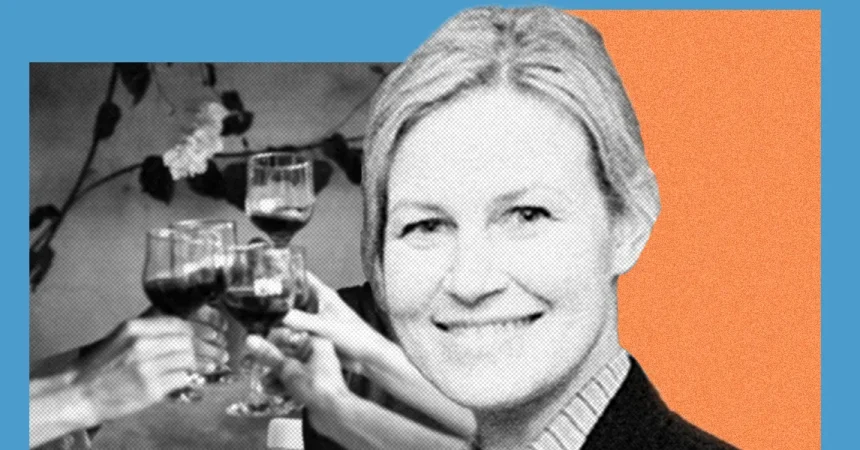
I’m not even going to pretend I don’t have a bit of a girl-crush on Shoshana Berger. She has that rare combination of being impossible smart and genuinely chic, the kind of woman who makes intelligence look like an accessory she wears effortlessly. A former WIRED editor who went on to lead editorial efforts for companies like Notion and IDEO, she has spent her career at the intersection of technology, design, and culture. But her latest project feels more personal than anything she has done before. Along with her cofounder and fellow “recovering magazine editor,” Nina Willdorf, she started the Aged Intelligence Society, a buzzy events startup that hosts invite-only dinner parties where women gather to solve midlife problems using frontier tools. The phrase “frontier tools” is their gently clever way of saying artificial intelligence, but there is nothing small or modest about what they are building. These are not networking receptions with bad wine and awkward name tags. They are intimate, thoughtful, highly anticipated evenings where accomplished women come together to learn, share, and actually use the most powerful new technologies in their lives. The events sound like something between a salón, a support group, and a masterclass, with the warmth of a great dinner party and the practical urgency of a life raft. And the whole thing seems to have tapped into something deep, something that women have been waiting for.
The origin story of the Aged Intelligence Society is almost too good to be true, except that it is so specific, so human, and so exactly right. Berger and Willdorf were at a friend’s birthday party, doing what two former magazine editors do best: obsessing over a subject that fascinated them and talking about it with total enthusiasm. The subject was Claude, the AI model that they affectionately referred to as their “new French lover.” They were not talking about Claude in some abstract, academic way; they were using it, testing it, playing with it, and discovering how it could make their lives easier. But as they talked, they looked around the room and saw that the other women at the party had glazed eyes. The conversation simply did not include them. Berger and Willdorf were speaking a language that felt exciting and obvious to them, but completely foreign to everyone else. And in that moment, with the gentle boredom of the room washing over them, Berger turned to Willdorf and said, “Nina, I think this might be a business, because all these women need to be doing what we’re doing.” It was the kind of spark that could easily have faded over the next day, forgotten like so many party ideas. But they acted on it. They were nervous before their first event, deeply, honestly nervous. Berger later admitted that they needed beta blockers and ashwagandha just to get through it. They were inviting baller women, truly smart, accomplished, impressive women, and the two of them were not AI experts. But they had done what good reporters do: they had tested the tools themselves, thoroughly, curious about what actually worked and what didn’t, and they had found that many women simply weren’t doing that. They weren’t bowing out because they weren’t capable. They were bowing out because no one had given them a compelling reason to stay.
At the heart of the Aged Intelligence Society is a refreshingly practical philosophy, one that cuts through all the techno-hype and all the doom-and-gloom fear. Willdorf puts it plainly: “This is the most formative technology of our generation, and it’s here. If you choose to sit it out, you are doing yourself a disservice.” That is the sentence that should be printed on invitations, read at dinner tables, maybe even whispered to every brilliant woman who has decided AI is simply not for her. Berger and Willdorf are not claiming that AI will solve every problem in the world, and they are not pretending it is perfect, but they are refusing to let women leave the table. They see AI as an assistant, a collaborator, a way to carry some of the exhausting mental weight that falls so heavily on midlife women. They are not asking anyone to become a programmer or a data scientist. They are asking women to become fluent. To be fluent means to understand enough to ask the right questions, to experiment, to be curious rather than intimidated. It means recognizing that this technology is not something happening to us from the outside; it is something already woven into our daily lives, whether we like it or not. The most formative technology of our generation is here. That is simply a fact. And the question they are asking is not whether we should love it or hate it, but whether we are going to be conscious participants or passive bystanders.
The response to this thesis has been nothing short of remarkable. From the very first event, the Aged Intelligence Society was oversubscribed. There was clearly a hunger for what they were offering, a deep and unspoken need for women to come together around this topic in a way that felt supportive and practical rather than competitive or intimidating. The second dinner party they hosted was covered by The New York Times, and suddenly the little dinner party had become a movement. Hundreds of women reached out asking to attend future events, eager to be part of something that felt both timely and urgent. Their Substack, where they share tools and tips, quickly gathered over a thousand subscribers, and not just the usual tech-savvy crowd. The list included a writer from The New Yorker and a small-town mayor, proof that the appeal of what they are building reaches far beyond the Bay Area bubble. More importantly, women outside California started hosting their own Aged Intelligence meetups, recreating the same spirit of curiosity and connection in their own communities. It is one thing to have a successful event startup. It is another thing entirely to watch your idea spark independent gatherings all over the country. That is not just a network; that is a cultural shift. Berger and Willdorf have managed to create something that feels exclusive enough to be desirable and generous enough to be replicable, and that is a very hard balance to strike.
They also practice what they preach, which is perhaps the most humanizing part of all. They are not detached futurists sitting in some beautiful studio, theorizing about how AI might help hypothetical women in the future. They are women in the middle of everything, juggling kids entering college, their own aging parents, and an increasingly in-demand business that requires their constant attention. The midlife cognitive and emotional labor is so heavy, so intense, that Berger describes it almost like a weight pressing down: “Actually, we need the National Guard, but AI will help in the interim.” It is a funny line, but it is also completely honest. This is what makes their approach so compelling. They are not telling women that AI is a magic wand that will fix everything. They are telling them that life is overwhelming, that the demands on their time and attention are unreasonable, and that any tool that can help carry even a small part of that weight deserves attention. The AI they talk about is not some far-off concept. It is something that can help draft a difficult email, organize a care plan for an aging parent, summarize a dense medical document, or brainstorm a convincing argument to have with a teenager. These are not abstract problems. These are the daily struggles of every woman who is trying to hold everything together. And that is the source of their credibility. They are not outside looking in. They are at the table, ordering the same meal as everyone else, and passing the bread.
What Berger and Willdorf have built is more than a dinner party. It is a quiet rebellion against irrelevance, a refusal to let an entire generation of women be left out of the most important conversation of our time. They have said, over and over, that there are a million reasons for women to bow out. There is fear, there is embarrassment, there is a lack of time, there is the feeling that this is for younger people, or for men in hoodies, or for people who speak in acronyms. But their response is an emphatic “no, no, no.” They insist that you cannot bow out of this conversation if you want to be relevant in the work world. You need to be fluent. It sounds like a demand, but it is actually an invitation. The door is open. The dinner table is set. And the message of the Aged Intelligence Society is ultimately a hopeful one: it is not too late to learn, and you do not have to learn alone. You do not need to be an expert to begin. You just need to be curious, and willing to show up, and ready to ask the questions that matter. This is what aged intelligence really means. It is not withered or static. It is wisdom in motion, always learning, always adapting. It is the knowledge that comes from lived experience, combined with the courage to try something new. And it is here, at tables all over the world, in small meetups and in big kitchens, with women passing their phones around and asking one another, “Have you tried this?” The future is not arriving in some grand, abstract way. It is already at the table, and thanks to Berger and Willdorf, more women are pulling up a chair.