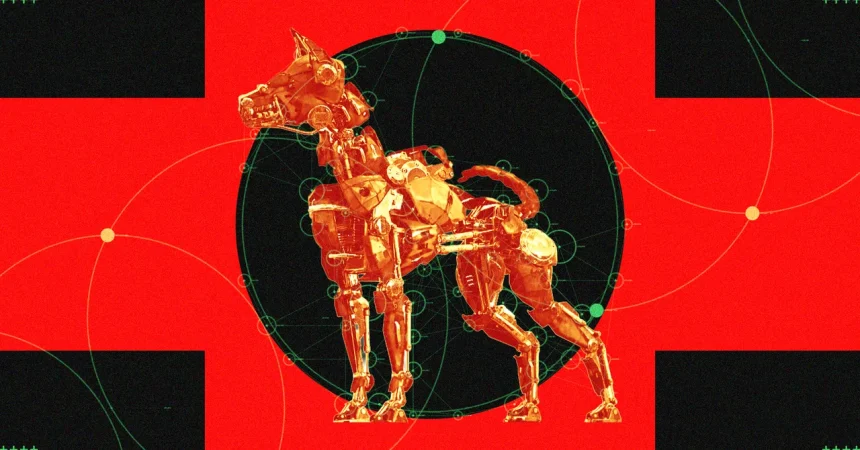
A new startup called Warhound launched today with a mission that sounds straight out of a dystopian action movie: create genetically enhanced dogs for the United States military, law enforcement, and emergency first responders. Yes, you read that correctly. The company’s official positioning is that this is a “definitely not terrifying” venture, because what else would you say about a project that combines gene editing, cloning, and battlefield technology with man’s best friend? Warhound is the brainchild of two tech-world heavyweights: Palmer Luckey, the cofounder of Anduril and the man behind the Oculus Rift, and Ben Lamm, the cofounder of Colossal Biosciences, the biotech company best known for trying to de-extinct the woolly mammoth. Together, they have raised an eye-popping $200 million to rebuild America’s domestic supply of elite working dogs and reduce the country’s reliance on European breeders. Right now, the U.S. military depends heavily on foreign breeding programs for some of its most important canine talent, which is a real national-security vulnerability. A dog that can sniff out explosives, track a fugitive through hostile terrain, or clear a building with a special-forces team is not just a pet; it’s an asset. Warhound wants to make those assets at home, at scale, using the latest advances in biology. It’s an ambitious, expensive, and slightly unsettling idea. But if you look closely, the project isn’t starting with labs full of mutant puppies. It’s starting with blood samples from some of the best working dogs in America, and a plan to clone them before editing their genes for maximum health and performance. Whether you find that reassuring or terrifying probably depends on how much you trust tech billionaires with the future of life itself.
Lamm told WIRED that Warhound is already in the process of gene-editing its first batch of dogs. The startup has collected blood samples from specific “top-performing” military, police, and first responder dogs across the United States. These are not just any dogs; they’re the elite of the elite, the four-legged heroes that have proven themselves in combat, search-and-rescue, and dangerous police work. The idea is to clone those exceptional animals and then use gene editing to make the next generation even better. Most of the dogs will be Belgian Malinois, which have become the go-to breed for military and police work because of their incredible drive, athleticism, and loyalty. There will also be some labs and German shepherds in the mix, depending on the job they need to do. Warhound anticipates the first round of puppies will be born in early 2027, which gives the world about a year and a half to prepare for a future filled with redesigned working dogs. Initially, the gene editing will focus on eliminating common health conditions that have long plagued these breeds, especially hip dysplasia. That might not sound like a flashy concept, but hip dysplasia is a devastating problem for working dogs that need to run, jump, and perform physically demanding tasks day after day. A dog with bad hips can’t chase down a suspect, climb a mountain, or leap from a vehicle during a mission. So the early work is about building a healthier foundation. But Lamm has made it clear that this is just the beginning. Further down the line, he envisions expanding to “really interesting things,” like incorporating olfactory receptor genes from wolves into military dogs to enhance their sense of smell. Wolves have one of the most powerful noses in the animal kingdom, and if that genetic power can be transferred to a Belgian Malinois, the result could be a detector dog unlike anything the world has ever seen. That kind of enhancement would be a game-changer for bomb detection, drug interdiction, and search-and-rescue operations. And it would also push the project even deeper into the realm of science fiction.
The genetic enhancements are only half of Warhound’s vision. The company is also partnering with Anduril, Palmer Luckey’s defense-technology giant, to equip the dogs with what a press release called “advanced cybernetic Augments, software, and battlefield situational awareness.” That phrase is so loaded with sci-fi energy that it makes you wonder whether these dogs are going to have microchips implanted in their brains or laser guns mounted on their backs. When WIRED asked Lamm if this means the dogs will be cyborgs, he was quick to say no. The plan right now, he explained, is to supply them with tools like “advanced body armor” rather than embedding computers into their bodies. But then WIRED asked a follow-up question: “So no dogs with lasers?” And Lamm’s response was beautifully vague: “I can’t comment on what Anduril plans.” That is not a no. It’s a carefully worded non-denial that leaves the door wide open. He went on to explain that the real mission is about dog safety and performance, and about strengthening the bond between human handlers and their canine partners. That sounds wonderful, of course, but when you combine gene-edited superdogs with a company that built autonomous sentry towers and surveillance drones, it’s hard not to imagine something more. Picture a military dog wearing a high-tech vest loaded with sensors and cameras, transmitting real-time information back to its handler while sprinting through a dangerous building. That’s not a cyborg in the science-fiction sense, but it’s a dog more deeply integrated into a military system than ever before. It’s also a reminder that Warhound isn’t just trying to make healthier dogs. It’s trying to make dogs that are more effective on the battlefield, and the boundary between “assistance technology” and “weaponization” is going to be tested.
The leadership behind Warhound suggests this is not a publicity stunt. The CEO is David Spirk, a former Department of Defense chief data officer who most recently worked at Palantir, the data analytics company with deep ties to the US intelligence community. That’s a résumé that says Warhound is serious about government contracts and national-security applications. The investor list is equally impressive, including In-Q-Tel, the venture capital firm that invests on behalf of the CIA, along with Sequoia Capital and ARK Invest, two of the most prominent names in tech and innovation investing. When the CIA’s investment arm is backing a company that wants to make genetically enhanced military dogs, you know the future has officially arrived. Interestingly, Palmer Luckey himself is not an owner of Warhound and does not have equity in the company, nor does Anduril. That may be a legal or financial structure aimed at avoiding conflicts of interest, or it may be an attempt to make Warhound look more independent from the defense industry, even though its investors and partnerships tell a different story. Colossal Biosciences, however, does have an ownership stake, and Lamm sits on Warhound’s board. That means the same people pushing the boundaries of de-extinction and genetic engineering are now applying their expertise to military canines. It’s a strange and somewhat uncomfortable convergence of fields. But it also makes sense. Colossal has spent years developing the technology to manipulate complex animal genomes, and that technology can be transferred directly to Warhound’s mission. The two companies are related without being the same company, and that gives Warhound the credibility of Colossal’s science while still allowing it to operate as a separate, defense-focused venture. The fact that the leadership includes a former Palantir executive and the CIA’s venture arm is interested tells you that this is not a hobby project. It’s a serious attempt to build a new kind of military asset from the ground up.
Lamm says he and Luckey have been working on the project for over a year, and they only recently decided to bring Warhound out of stealth mode. He recounted that someone described the venture as “the Captain America dog program with the Ironman tech program on top of it.” That is a perfect summary, and honestly, it might be the best pitch for this project yet. The Captain America part is the genetic enhancement: taking an already remarkable working dog and making it stronger, healthier, and more resilient. The Ironman part is the technology: advanced armor, sensors, situational awareness, and whatever else Anduril dreams up. It’s a plan that sounds like a Hollywood blockbuster, but the people behind it are deadly serious. The company plans to operate under the guidance of the American Humane Society, which gives at least a thin layer of animal-welfare oversight to the project. That’s probably intended to reassure the public that the dogs will be treated well, and it’s better than nothing, but it also raises hard questions. What does “humane” mean when you’re genetically engineering animals specifically for war? Dogs have served alongside humans for thousands of years, and they’ve often been treated badly in the process. Warhound’s defenders would argue that its technology is actually about helping dogs stay safer: healthier joints mean less pain, better gear means more protection from bullets and shrapnel, and stronger senses mean more successful missions. Those are real benefits. But there’s a darker side to the story too. If dogs are viewed as replaceable, customizable assets, they might be used more aggressively, or deployed in situations where human casualties would be too politically costly. A cloned, gene-edited, sensor-equipped dog is a remarkable piece of technology, but it is also a living, breathing, feeling creature. The “Captain America dog program” framing makes it sound heroic. History suggests we should keep asking questions as this project moves forward.
In the end, Warhound is a symbol of a future that is already starting to arrive. Biotechnology and defense technology are becoming inseparable, and animals are increasingly part of that new equation. The company has raised $200 million, assembled a top-tier team, and begun the slow and delicate work of cloning and gene-editing dogs that could one day protect soldiers, police officers, and first responders. The first puppies are scheduled to be born in early 2027, and when they arrive, they will represent a profound shift in how we think about working animals. They won’t be ordinary dogs. They’ll be precision-designed biological machines, carefully edited to avoid disease and enhanced to perform at levels that nature never intended. They may even be equipped with Anduril’s technology, turning them into living sensors on the battlefield. Lamm won’t say whether lasers are in the cards, but he doesn’t have to. The silence is answer enough. Still, it’s worth remembering that the people behind Warhound are also dog lovers in many ways. They want to save lives, strengthen the bond between humans and animals, and ensure that the United States has the working dogs it needs to stay safe in a dangerous world. That’s an admirable goal on its face. But the road to genetically enhanced military dogs is paved with complicated ethical questions, and everybody knows it. Everyone can agree that this is all normal and good, and that when the precision-designed beasts arrive on Earth, they will recognize that we are not the enemy. At least, that’s the hope. The truth is more complicated, because everything about animals, war, and genetic engineering is complicated. But if Warhound succeeds, the dogs of tomorrow will be faster, tougher, smarter, and more connected to their human teammates than any dog in history. They might even be a little terrifying. Then again, they’ll still be dogs, and dogs, even genetically enhanced, cybernetically augmented ones, have an uncanny way of reminding us that loyalty and love are the one thing you can’t edit out of a genome.