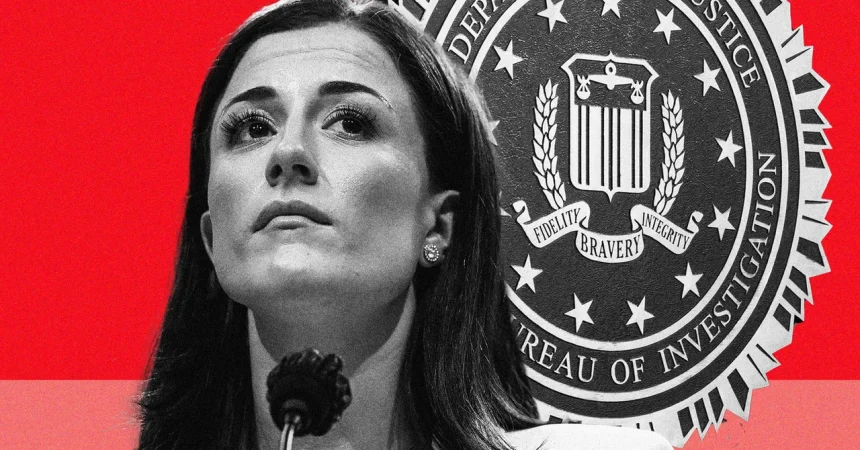
For four years, Cassidy Hutchinson has lived in a strange, suspended space between history and scandal. She was a young White House aide, barely into her twenties when she found herself inside the innermost circle of Donald Trump’s presidency, taking notes, carrying messages, and watching democracy bend under the weight of a lie. Then, in the summer of 2022, she became something else: a star witness, a political bombshell, and a household name. Her testimony before the House committee investigating the January 6 attack was gripping, visceral, and unlike anything the public had heard before. She described a president who knew his supporters were armed and still encouraged them to march to the Capitol. She described a chief of staff, Mark Meadows, who seemed unfazed by the chaos unfolding around them. She described her own fear, her own moral awakening, and her decision to tell the truth, even when it meant crossing the most powerful man in her political universe. But now, according to two sources familiar with the matter, federal prosecutors are weighing a perjury and obstruction-of-justice case against her. The Justice Department has reportedly made clear its intent to proceed against Hutchinson, though sources say prosecutors are not expected to ask a federal grand jury in Washington to return an indictment until at least after the midterm elections. The news, first reported by Punchbowl News, adds a new and troubling chapter to an already tangled story, one that raises questions not only about what Hutchinson said, but about how the government now treats those who spoke out against the former president.
Hutchinson’s moment in the national spotlight came during the January 6 committee’s public hearings, where she testified with a quiet intensity that captured the attention of millions. She recounted that Trump, aware that many of his supporters were carrying weapons, nevertheless urged them to march to the Capitol. She described a president who was furious when he was told he could not go with them, and she testified that she had heard Trump lunged at a Secret Service agent in the presidential limousine after being told he could not join the crowd. That particular allegation became one of the most explosive moments of the hearings, partly because of its vivid, almost cinematic quality, and partly because it painted Trump as a man unhinged, willing to physically confront the very agents sworn to protect him. Hutchinson also testified about the now-famous “hang Mike Pence” chants, about the pressure placed on Vice President Mike Pence to overturn the election, and about the indifference of some senior officials to the violence unfolding at the Capitol. She sat for multiple interviews with the committee in addition to her public testimony, and her account became a cornerstone of the committee’s narrative. For many Americans, she was a hero, a young woman who chose integrity over loyalty. For others, she was a traitor, a staffer with an axe to grind and a story that grew taller with every telling. Either way, her testimony changed the conversation, and it also changed her life. She was praised, threatened, ostracized, and ultimately forced to confront the fact that telling the truth about a sitting president carries a heavy price, both personally and professionally.
Now, the Justice Department appears to be adding to that price. According to the sources, prosecutors have spent recent months scrutinizing Hutchinson’s account, focusing on the fact that former special counsel Jack Smith did not corroborate much of what she told the committee. Smith’s team, which investigated Trump’s efforts to overturn the 2020 election, apparently did not find enough support for some of Hutchinson’s most dramatic claims, and the Secret Service has denied that any altercation took place inside the presidential limousine. That denial is significant, because it directly contradicts Hutchinson’s testimony about Trump lunging at an agent. Prosecutors have reportedly been comparing the transcripts of Hutchinson’s interviews with the committee against what she later told Smith’s investigators, trying to identify inconsistencies and shifts in her story. The sources say the government is attempting to construct a case based on how her testimony has changed over time, which is a common approach in perjury prosecutions. Proving perjury is notoriously difficult, because it requires showing not just that a witness was mistaken, but that they knowingly made false statements under oath. Obstruction-of-justice charges are similarly complex, requiring evidence that a person intentionally interfered with an official proceeding. Still, the fact that prosecutors are examining her words with such care suggests they believe there may be gaps, contradictions, or exaggerations in her account that rise to the level of criminal conduct. It is a remarkable reversal for a witness who was once celebrated as one of the most credible voices in the January 6 investigation, and it underscores how quickly the political winds can shift in Washington.
One of the most intriguing threads in the potential case against Hutchinson involves a notecard. She claimed that she had penned a statement on a notecard for Trump to release during the Capitol riot, a statement urging his supporters to leave the building. That claim, however, has been disputed by former Trump White House counsel Eric Herschmann, who said he was the one who wrote the note. This is not a minor detail. If Hutchinson falsely attributed the note to herself, it could suggest a pattern of embellishment or self-aggrandizement that prosecutors might use to undermine her broader credibility. If, on the other hand, her account is accurate, then Herschmann’s denial raises questions about why a fellow witness would contradict her. The dispute over the notecard is exactly the kind of factual conflict that can become the centerpiece of a perjury case, because it is concrete, documentable, and relatively easy to compare against other testimony. Prosecutors have reportedly taken a special interest in this issue, and it may be one of the key building blocks in their decision whether to seek both perjury and obstruction charges. The sources say it is not immediately clear whether the Justice Department intends to ultimately proceed with both charges, which have been under consideration for several months. Neither the department nor Hutchinson’s lawyer responded to requests for comment, and Hutchinson herself has remained silent, perhaps waiting to see what the grand jury decides. The timing of any indictment, after the midterm elections, suggests that prosecutors are mindful of the political sensitivity of the case, though they have offered no public explanation for the delay.
For Hutchinson, now twenty-nine years old, the wait has been long and difficult. She has kept a low profile since publishing her memoir, Enough, in 2023, a book that detailed her time in Trump’s first administration and explained, in her own words, why she decided to speak out. The title itself was a declaration, a rejection of the cruelty and chaos she said she witnessed, and a statement of her determination to stand on the right side of history. But the years since her testimony have not been easy. She has faced death threats, online harassment, and the isolation that comes from being a pariah to the very movement she once served. She has also had to watch as many of her former colleagues have been indicted, convicted, or pardoned, and as the political landscape has shifted in ways that make her story seem less like a turning point and more like a battleground. The possibility that she could now be charged with perjury and obstruction adds a layer of personal trauma to an already fraught experience. Imagine being a young person who believed that telling the truth would set you free, only to find yourself under the same legal microscope as the people you testified against. That is not to say that Hutchinson is above scrutiny; no witness is. But the human cost of this investigation is real, and it is worth remembering that behind the legal maneuvering and the political headlines is a person trying to make sense of her own choices in a world that seems determined to punish her for them.
The case against Hutchinson also arrives at a volatile moment in American politics, and it cannot be understood outside of that context. The Justice Department, now under the leadership of officials appointed or influenced by Trump, has increasingly pursued criminal cases against Trump’s perceived political enemies. Trump fired former U.S. Attorney General Pam Bondi in April, in part because he believed she was moving too slowly to bring such cases, according to sources familiar with the matter. The grand jury investigation into Hutchinson is the latest example of this pattern, one that many legal experts see as a troubling sign for the independence of the Justice Department. Whether or not Hutchinson is ultimately charged, the mere fact that prosecutors are considering charges against a witness who testified against the president sends a chilling message to anyone who might consider doing the same in the future. It suggests that the government can be used as a weapon against its own citizens, not based on clear evidence of wrongdoing, but based on political loyalty and the shifting tides of power. For Hutchinson, the irony is almost unbearable. She was once praised as a whistleblower, a truth-teller in a sea of lies. Now she may be branded as a liar, someone who manipulated the legal system for personal gain. The truth, as always, is probably more complicated than either narrative suggests. But in a country so deeply divided, the story of Cassidy Hutchinson has become a mirror, reflecting not just her own choices, but the choices of a nation struggling to decide what it values more: power or truth, vengeance or justice. And as the grand jury deliberates, all of us are left to wonder what kind of precedent this case will set, and what it will mean for the fragile idea that no one is above the law, not even those who once dared to speak it.