There is something almost poetic about a data release that arrives not as a sterile spreadsheet, but as a time capsule of human curiosity. That is exactly what NASA has just handed to the world: roughly 800 gigabytes of scientific material from the Artemis II mission, a treasure trove that includes 11,000 full-resolution images and videos, eight and a half hours of spoken observations, handwritten notes from the astronauts themselves, officially transcribed conversations, and photographs captured by cameras mounted aboard the Orion capsule. It is a staggering amount of information, but the numbers alone do not capture what makes it special. These are not just measurements gathered by robotic sensors; they are records of a human journey, a return to lunar space that no one had made in more than half a century. NASA describes this collection as the first set of planetary science data obtained beyond Earth orbit and, for the most part, directly by human eyesand voices in over fifty years. The closest ancestor to this archive is not some recent orbiter mission, but the Apollo era, with astronauts walking on the Moon and scientists back home hanging on every word they said. In that sense, this release feels less like a filing cabinet being opened and more like a handwritten letter from an old friend who has just returned from a place we thought we would never see again.
.
For scientists, the release is a landmark moment, not least because NASA has paired the raw data with three carefully prepared reports that distill some of the initial lessons from the mission: the Artemis II Preliminary Lunar Science Report, the Artemis II Lunar Science Operations Report, and the Artemis II Lunar Science Data User Guide. These documents are essentially keys to the archive, explaining what was collected, how it was collected, and how it can best be used. They transform what might otherwise be a chaotic flood of pixels and audio files into something navigable, something that researchers can actually hope to mine for insights. The intended audience is primarily the scientific community—planetary geologists who want to trace the Moon’s battered history, flight engineers curious about how spacecraft behave aroundour companion world, heliophysicists studying the Sun’s influence on deep space, specialists in telecommunications and remote sensing, and researchers focused on the small meteoroids that continuously pepper the lunar surface. But to say that scientists alone will benefit would be far too narrow. The archive is public, open to anyone with an internet connection anda sense of wonder. For space enthusiasts, some of the most immediately accessible treasures include mission transcripts and lunar photographs annotated by the astronauts themselves, offering a glimpse not just of what they saw, but of what they noticed, what surprised them, what they thought was worth pointing out to the rest of humankind. There is a particular intimacy in reading words scribbled by a person millions of miles from home, circling another world, knowing that those words might end up shaping the next generation of exploration.
.
For anyone wondering how to dive into this ocean of data, NASA has made the path surprisingly welcoming, and there are essentially two doorways into the archive. The more technical route leads through the Planetary Data System, NASA’s vast and meticulously organized public repository for data from its planetary missions. In the section dedicated to the Moon, users can now browse Artemis II entries, explore the various available collections, documents, and files, and download individual items for direct analysis. This is where the raw scientific files and their metadata live, carefully formatted so that researchers can feed them into analytical tools and produce peer-reviewed results. The less technical route, meanwhile, is an Artemis II science page that NASA has set up for those who prefer a curated experience: from there, visitors can download the three official reports, browse a selection of the most striking photographs, and listen to the mission’s audio library. This page feels almost like a museum exhibition drawn from the archive, a way for the general public to engage with what happened without needing to understand the intricacies of data formats orbital mechanics. Both routes matter, because they reflect a philosophy that this information should not be locked away in a vault; it should be available to everyone from professional researchers to curious students sitting in a classroom, wondering what it would feel like to look back at Earth from the far side of the Moon. The sheer openness of the release is a quiet reminder that space exploration, at its best, is not a spectacle to be watched from a distance, but a shared human project that belongs to all of us.
.
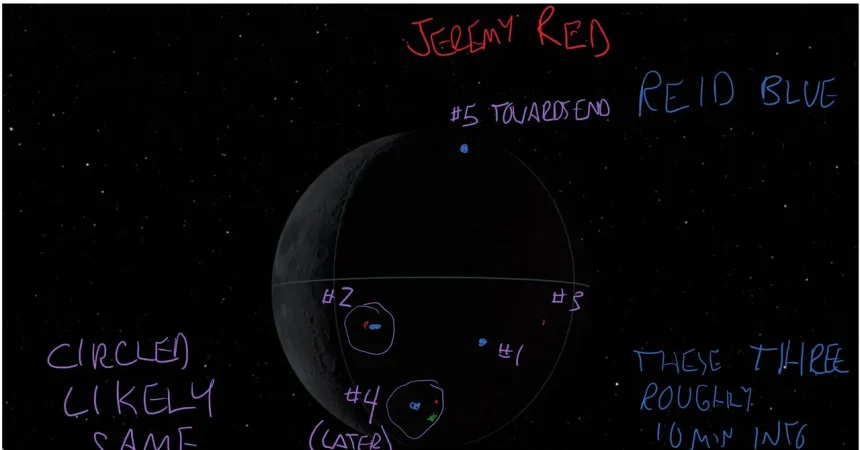
Beneath the impressive statistics and carefully organized files, the release already contains genuine scientific discoveries, and the first clear result is as elegant as it is useful. During a 54-minute eclipse observed by the Orion crew, astronomers detected five small meteoroid impacts on the lunar surface, each one visible as a tiny flash of light against the darkened, otherwise quiet landscape. These impacts are not enormous; the fragments involved appeared to be just a few centimeters in size, more like small pebbles than giant boulders. Yet their importance should not be underestimated. For years, scientists have struggled to estimate exactly how often objects of this size strike the Moon, because they are too small and too faint to be easily spotted by Earth-based telescopes, especially during normal daylight conditions. An eclipse, however, offers a perfect dark screen, and the astronauts aboard Orion happened to be in exactly the right position, with the right eyes, to catch these fleeting sparks. By recording these flashes, the Artemis II crew has handed modelers a rare piece of empirical evidence with which to sharpen their predictions about the frequency of small impacts. That might sound like a modest result, but fall those individual stones tells a larger story. Knowing how often centimetre-scale fragments hit the lunar surface is essential for calculating the risks that future lunar bases, landed spacecraft, and astronauts on extravehicular activities will face. Even a tiny meteoroid, travelling at tremendous speed, can damage a habitat, puncture a spacesuit,or disable a piece of equipment. Five small flashes,during a single hour-long observation, are not just curiosities; they are safety data that could one day help determine how thick a shelter wall needs to be, or how carefully a rover should be parked, or where it is wise to build a permanent human outpost. In that way, this finding links the grandeur of human exploration to the very practical, unglamorous work of keeping people alive in an unforgiving environment.
.
If we step back from the technical details, what NASA has actually done here is something deeply human: it has slowed down, shared its treasures, and invited the world to ask its own questions. The Apollo program returned rocks and photographs and hours of astronaut commentary, but in many ways those early missions were overhead, controlled, and rationed to the public. Artemis II, by contrast, arrives in the age of open data, and the agency seems determined to let this story unfold in public, with the archive acting not as a final product, but as a starting point. The astronauts captured the data, but they did not (and could not) analyze all of it; many discoveries will be made years from now, by researchers who were still in school when this mission planted its first seeds. Some of those future findings might come from unexpected places: from the way a rock glowed in a high-resolution image, from a half-remembered comment in an audio recording, from a pattern that only becomes visible when thousands of images are compared side by side. This is what makes the release so exciting: it is not a closed book, but a living library, waiting for curious minds to open it from a thousand different angle. For ordinary people, meanwhile, the archive offers something a little more personal. Hearing an astronaut’s voice crackle through the audio files, seeing their handwriting on an annotated photograph, reading their offhand remarks about the landscape below—these experiences remind us that exploration is not done by soulless machines, but by human beings with the samecapacity for awe and uncertainty that the rest of us feel when we look up at the night sky. The data may be scientific, but the sensations it stirs are the same ones that have driven explorers for centuries: the desire to see what lies beyond the horizon, and the urge to bring back evidence of that journey for everyone else.
.
Ultimately, this release is both a closing and a beginning: a closing of one chapter, in which a small crew of humans made the long journey to the Moon and came home with their spacecraft’s memory full of sights and sounds, and a beginning of another chapter, in which thousands of scientists and hobbyists alike get to work piecing together what that journey actually meant. NASA has often been accused of looking too far forward, dreaming of Mars and beyond, while neglecting to fully share the wonders it has already found. This time, it has done something different: it has opened the vault and said, essentially, “here is what we saw, now you tell us what it means.” The near-terabyte isn’t an inert pile of files; it is a conversation starter, a bridge between the astronauts who lived the experience and the rest of us who can now relive it, examine it, question it, and build upon it. For planetary geologists, it may hold the key to understanding the Moon’s long and violent history. For engineers, it offers valuable lessons about how real spacecraft behave in real lunar space. For meteoroid specialists, it provides the exact kind of observational data that models have been missing. And for everyone else, it offers something rarer than gold: handed access to a moment in human history when we finally went back, after decades of absence, and made sure to bring everyone along for the trip. The numbers—800 gigabytes, 11,000 images, 8.5 hours of voices—may grow dim with time, but the feelings behind them will not. In five decades, some future historian or space traveler might look back at this release as the moment when the Moon stopped being a distant, abstract destination and became a place where ordinary people could, in their own way, explore too. That is no small achievementand. It may even be as meaningful as the mission itself.