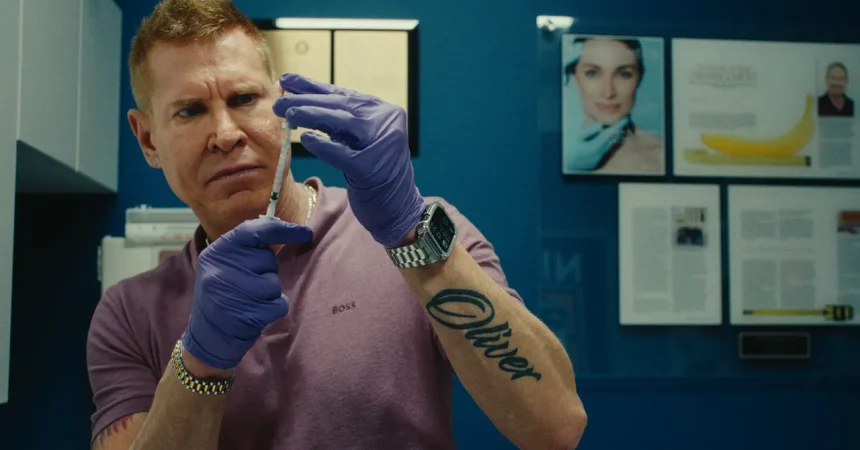
1. Bill Moore with the Patter of a Preacher
Bill Moore is what you might call a televangelist for big dicks—though he lacks the flock, the choir, and the holy book, he has all the fervor. At AdvancedYou, an anti-aging aesthetic clinic that specializes in the kind of “biohacking and wellness treatments” that sound more at home in a Silicon Valley startup than a Dallas strip mall, Moore presides over a congregation of men in quiet crisis. The gospel he preaches goes by the name PhalloFill, a penis enlargement procedure that has become his signature offering to a world of men who feel they have come up short. It is not a miracle for length; Moore is careful and honest on that point. The procedure adds no inches, no promise of sudden magnitude. Instead, it injects hyaluronic acid dermal filler directly into the shaft to increase girth, a physical change that many men believe will translate into something less visible: confidence. Moore sees himself as a cosmetic revolutionary. He was among the first wellness professionals in Dallas to use platelet-rich plasma for hair replacement, and with PhalloFill, his aspirations are not modest. He wants this procedure to become as routine as Botox, a lunchtime tweak, a small invasion with an outsized psychological return. But standing in the waiting room of his clinic, surrounded by men who have traveled to talk about the most private part of their bodies with a stranger, you sense something more than vanity at play. These men are confessing. They are seeking absolution. Moore, with his soft-spoken certainty and clinical vocabulary, offers them not just a needle but a narrative: that their inadequacy is fixable, that their manhood can be thickened, that the problem is physical, not spiritual, and therefore solvable. It is a seductive message. And if he preaches it with the rhythm of an evangelical, perhaps that is because the need is almost religious.
2. The Filmmaker Who Turned Toward the Body
Daniel Lombroso did not set out to make a film about penises. A former editorial producer at The Atlantic and The New Yorker, Lombroso had spent years in the trenches of American extremism. His first documentary, White Noise, followed white nationalist groups from Donald Trump’s 2016 victory through the end of his first term, a harrowing immersion into the minds of men and women convinced that their America was being stolen. After that, he wanted something different—but not necessarily softer. The headlines about the male loneliness epidemic had been making their rounds, and while Lombroso found them intellectually interesting, he also found them “sort of thin and maybe navel-gazy.” The coverage described a crisis of connection among men, but it rarely went deeper than statistics and think-pieces. It stayed in the abstract. It never entered the body. Around that time, Lombroso began hearing about penile enhancement, a shadowy corner of the aesthetic world where men were paying significant sums to alter their own anatomy in pursuit of an ideal that few could articulate. He picked up the thread, talking to practitioners and patients, and eventually connected with Bill Moore, who invited him to Dallas. What Lombroso found surprised him: not a circus of desperate weirdos, but a waiting room full of ordinary men—fathers, workers, believers—eager to tell both Moore and the camera why they were there. “This is fucking crazy that these guys are really eager to tell Bill,” Lombroso recalls, “and were really eager to tell me, what was going on in their life.” That openness, that strange and sudden permission to speak, became the heart of Manhood, the documentary that opens in theaters this week. It is not a film that mocks its subjects. It is a film that sits down beside them, that asks questions and then listens, that understands that a man who is willing to have his penis injected with filler is perhaps also a man who has been waiting a long time to be asked what he is afraid of.
3. The Men in the Waiting Room
The men who come to Moore’s clinic defy easy categorization. There is a megachurch pastor, a man who has spent his life standing before a congregation and preaching certainty, yet who cannot find within himself the same conviction when the lights are low and the sermon is over. There are border patrol agents, men who symbolize a rugged, unyielding version of American masculinity, who nevertheless find themselves in a strip mall, whispering about the one part of their bodies that has never felt adequate. There is a man suffering from brain cancer, navigating the prognosis of his own deterioration, and for whom this procedure is not about vanity but about seizing control before the body slips further away. They come from different states, different political worlds, different stages of desperation, and yet they are bound by a single conviction: that the penis is not merely an organ, but a verdict. In a culture that teaches men that dominance is a birthright and that performance is the price of love, the idea that one’s size might be insufficient becomes a moral failing, a personal flaw that cannot be addressed by talking, only by acting. Lombroso captures these men without irony. He lets them be awkward and earnest and sometimes heartbreakingly sincere. The film does not deny the absurdity of the situation—a grown man lying on a table while filler is pushed into his penis for the sake of self-esteem—but it refuses to let absurdity be the final word. Instead, it dwells in the sadness before the procedure, the quiet moments where the jokes falter and the truth comes out. These are men who have been told all their lives that they should be able to handle their problems alone, that vulnerability is weakness, that asking for help is a sign of failure. And so they solve their deepest anxieties with a syringe, convinced that the answer to loneliness, shame, and inadequacy is girth.
4. The Two Faces of the Same Wound
At the center of Manhood are two men who could not be more different on the surface, and could not be more similar beneath it. Ruben is an out-of-work father of five who moonlights as a stand-up comedian and listens to the Joe Rogan podcast. He is a man steeped in the language of internet masculinity, the self-help of podcasts and red-pilled rants, a man who has been told that strength means self-reliance and that any admission of weakness is a betrayal of the species. Yet here he is, cracking jokes in a clinic, deflecting the gravity of the moment with a routines. He is not looking for easy answers; he is looking for the foundation he feels he never had. For Ruben, being a man has always meant providing, performing, keeping the family afloat, and when that fails—when the work disappears and the money runs short—the body becomes the only remaining place to locate the problem. Then there is David, a 24-year-old gay OnlyFans star who has already endured a botched procedure elsewhere and is now visiting Moore’s clinic for repair. David’s body is his livelihood, his brand, his constant companion and betrayer. He was shunned by his religious mother for being gay, and he has spent his life since then trying to be seen, to be valued, to be enough. For him, the penis is not just a source of pleasure but an instrument of validation—a way to be desired, to be paid, to be held. A botched procedure is not merely a medical mishap; it is a personal catastrophe, one more piece of evidence that his body has failed him. Together, Ruben and David reveal the astonishing breadth of the masculine crisis. One is a straight father, the other a gay performer. One listens to podcasters who rail against the feminization of American culture; the other has built a business from his own face and flesh. But both are looking for the same thing: a stable, acceptable, lovable self. And both have decided, perhaps unconsciously, that this self can only be found below the belt.
5. The Confessor and the Salesman
Bill Moore is impossible to categorize neatly as a charlatan or a savior, and that ambiguity is what makes him such a compelling figure. He seems genuinely convinced of the value of what he does. His clinic is clean, calm, unconventionally intimate. He speaks of biohacking and optimization, of taking control of one’s biology, of not settling for the hand that nature dealt you. The language is borrowed from the wellness industry, but in his hands it acquires an almost pastoral quality. He does not ridicule his patients or their fears. He validates them. He looks them in the eye and tells them that their desire for more is understandable, that their dissatisfaction is real, that the procedure before them is a form of self-care rather than vanity. The televangelist comparison is inevitable—the man who offers salvation through a tangible transaction, who claims access to a better life while standing at the edge of a collection plate. But Moore’s salvation is not deferred to an afterlife. It is immediate, measurable, if only in millimeters. He wants PhalloFill to be as normal as Botox, a standard offering in the modern man’s arsenal of self-improvement. And in the film, you can feel the pull of that vision. A man walks into the clinic feeling wrong, feeling small, feeling like a failure in the most primal terms. He leaves with an altered body and a new story about himself: that he did something, that he took action, that he refused to accept the hand he was dealt. The fact that this action requires a needle and a few tubes of filler does not diminish the feeling of relief. Moore may be selling a dream, but he is also providing something real. He is listening. He is taking men seriously. And in a world that has spent decades ignoring their pain, that might be the most seductive part of the package.
6. The Real Crisis Beneath the Skin
Perhaps the most revealing revelation in Manhood is the statistic that surprised even the filmmaker: roughly seventy-five percent of the men undergoing penile enhancement are straight, and many are conservative-leaning. The obvious assumption might be that gay men—who are often perceived as more appearance-obsessed—would dominate the market, but the film flips that expectation. It is straight men, many of the same men who project dominance, who police the boundaries of masculinity, who speak loudly about strength and self-reliance, who are privately booking appointments for girth injections. They are not necessarily doing it for a partner. They are doing it for their own internal judge, the voice that has never been satisfied, that whispers that they are not enough no matter how much they achieve. This is the quiet tragedy at the heart of modern masculinity. Men are raised to be independent, stoic, and uncomplaining. They are not given language for their pain. They cannot say, “I am lonely,” without feeling like a failure. They cannot say, “I am afraid,” without losing their claim to manhood. So the discomfort converts, like energy finding a new path, into the body—and particularly into the penis, the most vulnerable and symbolic part of male identity. A man can work harder, make more money, lift more weight, climb more ladders. But he cannot will himself to be bigger. That one stubborn fact, that immovable obstacle, becomes the last frontier. If he can conquer that, perhaps he can conquer the rest. Perhaps he can finally feel real. Lombroso’s documentary does not pretend to solve this crisis. It offers no tidy political conclusion, no reassuring moral. What it offers is a mirror. The men in the film are not alien; they are familiar. They are our fathers, brothers, friends, ourselves. And the desire beneath the absurdity—the desire to be enough, to be loved, to be held—is not grotesque. It is profoundly human. Manhood is a film about penises, yes, but it is really a film about the weight of being a man in a world that gives him no way to carry it. And if that weight sometimes ends up in a Dallas strip mall, in a chair next to a man with a syringe, then perhaps we should not laugh. Perhaps we should look closer.