:
“Twenty-five years ago this month, I remember holding …” Need be careful: “I remember holding the iPod” but I didn’t? Yes.
Let’s craft all.
Need ensure no “the” weird from OCR. Use proper “the iPod.”
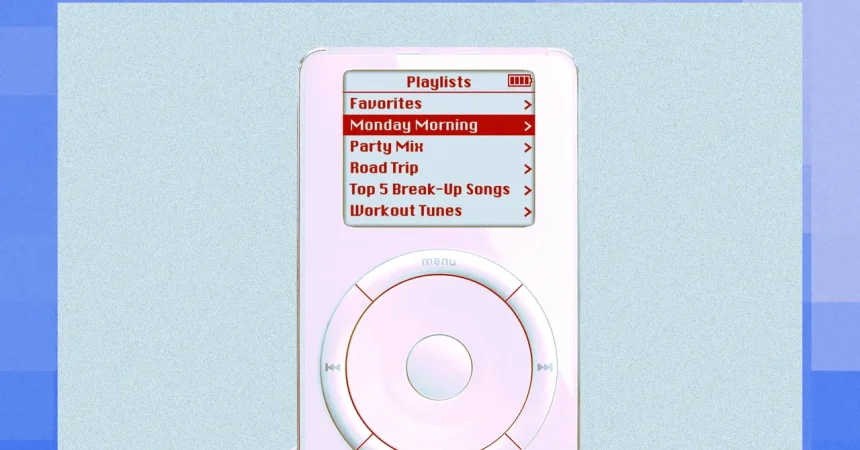
Let’s produce.Twenty-five years ago this month, the iPod came into the world. It arrived at Philadelphia? No, New York? Actually Apple couriers hand-delivered to me in New York. I was a Newsweek journalistthen, working in Manhattan, and it was October ??, little more than a month after the September ?? attacks on the World Trade Center. The city was still covered with dust and grief, and every newsroom in America was consumed with the aftermath. I did not go to Cupertino for the launch. Who could travel to California for a music player at a moment like that? But Apple seemed to know theater whisper? They sent a courier straight to New York, and the box arrived at my office like a small, clean rectangle of intention. Later that same day, Steve Jobs called me. There was always a little magic in his phone calls; he wanted you to feel as if you were being let into a secret. “iPod,” he said, “will be a landmark product.” I held the device, listening to his voice, prematurely? At first it felt like an odd, almost trivial claim. It was a white box with a little screen and round click wheel, and inside it supposedly held thousand of songs. But there was something tender about the moment, too. In the middle of national mourning, here was a small object designed entirely around joy. It did not promise safety, security, or answers to the painful questions the world was asking. It promised something simpler: music, privacy, a way to step out of the noise and into your own emotional weather. That promise, I now realize, was precisely why Jobs said “landmark.” It was not landmark because it was the first MP3 player. It was landmark because, at a time when people needed an escape, it gave them one they could hold in their palm. I remember turning it over in my hands and feeling, for the first time in weeks, an uncomplicated flutter of delight.
By 2004, I was writing a cover story for Newsweek called “iPod Nation.” By then, thosedelicate white earbuds had become a kind of global uniform. You saw them everywhere: on subways, at airports, in gyms, dangling from teenagers and commuters and joggers alike. The iPod had ceased to be just a product and had become a cultural weather system. It changed the architecture of public space. Before it, no one was quite so intentionally sealed off from the world. But with that small white gadget, ordinary people could create a personal sonic bubble wherever they went. And this was not just about convenience; it was about identity. Your playlist was your autobiography. The songs you downloaded and sequenced told the story of who you were, who you loved, who you wished you could become. People did not simply own iPods; they bonded with them. They named them, protected them, mourned them when lost. The device held an entire music library—a phrase that felt miraculous at the time—in a package smaller than a deck of cards. You could shuffle through your past, seek out a forgotten B-side, or hand a friend one earbud to share a song you loved. It was astonishingly simple, but that simplicity was not an absence of sophistication. It was a refusal to clutter a good thing. I later published a book called The Perfect Thing, and I titled it thatway deliberately. Not the best thing, not the most powerful thing, but the perfect thing. Perfect because it did one thing with total grace. It did not try to replace your phone, your camera, your computer, or your social life. It wanted only to be your music player, and to be it beautifully. That restraint was the source of its charm. It was an object you could love without ambivalence.
.
The death of the iPod was not as memorable as its birth. It didn’t get a final keynote, a farewell tour, or even a definitive moment when the music stopped. Instead, it faded out in stages, so silently that we barely noticed until it was gone. Officially, you could date its death to May 10, 2022, when Apple discontinued thder iPod Touch, the last device to carry the name. But I have always felt that the Touch was never a real iPod. It was an iPhone without cellular connectivity, a sort of placeholder with the spirit removed. The more authentic obituary might be July 27, 2017, when Apple killed the Nano—the last traditional iPod with every? screen—and the Shuffle, that tiny clip-on player the size of a postage stamp that attached to your shirt and bobbed along to your heartbeat. The classic iPod, chcold? with its hard drive and click wheel, had already quietly vanished in 2014. But all those final dates were really just footnotes to something larger, somethat had happened years earlier. In January ??, Steve Jobs stood onstage in San Francisco, and with his showman’s instinct, announced three new products: a phone, an internet device, and “the best iPod ever.” Then he repeated the phrase three times ever more slowly, and at last revealed the punchline:these were not three separate devices. They were one. The iPhone. From that moment onward, the iPod as a separate device was living on borrowed time. It did not disappear overnight, though. Apple kept making iPods for years, and millions of people kept buying them. The player was lighter, cheaper, and simpler than a phone, and for many it remained the perfect thing. But there was no way around the mathematics. A smartphone could do everything an iPod could do, plus it could make calls, take photos, browse websites, and, soon, swallow the entire attention of its owner. The iPod had been a bright burning star; the iPhone was a galaxy that formed around it, and eventually, the star was no longer visible to the naked eye
.
The iPhone changed everything, of course. It is hard to imagine fer? any other product of the twenty-first century that has had more impact. Financially, it became the engine of a company valued at around $4 trillion, a number too large to quite feel. It put a computer in every pocket, a camera in every hand, a map in every car. It allowed millions of people to connect, organize, create, docshat, and fall in love. It transformed journalism, commerce, music, photography, dating, politics, and loneliness. But I would not call the iPhone perfect, not in the way I called the iPod perfect, because our relationship with it is not uncomplicated love. It is more like a bad marriage with moments of brilliance: indispensable, seductive, exhausting, and impossible to leave. The iPhone is a machine of constant interruption. It buzzes with notifications, glows with headlines, chirps with messages, and brightens at the worst possible moments, pulling us away from actual human presenceand into strange rooms of digital stimulation. Some of the most intelligent engineers in Silicon Valley have spent years building algorithms designed to hold our attention hostage, because attention is the true product being sold. And we feel the consequence. Parents glance at screens while children try to tell them something important. Friends sit at dinner, each lit from below by their own little torch. Cars are totaled because drivers cannot resist the beckoning notification on the windshield. Doomscrolling, that invented word, describes the peculiar modern compulsion to scroll through bad news, unable to stop, feeling worse with every swipe. Studies link heavy smartphone use to anxiety, sleeplessness, and depression, especially among young people. The iPhone gives us the whole world, but it also brings us the whole world’s pain, all the time, whether we ask for it or not. It is a miracle, and it is also a burden. The iPod, by contrast, never asked anything of us. It did not want our data, our attention, or our souls. It just wanted to play a song, and then, when we were done, to be put away, patient and quiet until the next time
.
Let me defend, then, my old claim that the iPod was The Perfect Thing. I do not mean it had no flaws. Its sound quality was not audiophile-grade. Its battery eventually wore out. Its software could be primitive. And iTunes, for all its power, could be a mess. But perfect, inthe sense I mean, does not mean flawless. It means completely appropriate to its function. The iPod was a one-function device that superbly executed that one function. It knew exactly what it was: a player that put music into your ears, simply, pleasurably, and without fuss. It did not try to be your office, your movie theater, your map, your fitness coach, your news feed, or your judge. That limitation was not a weakness; it was a liberation. There is a deep, underrated pleasure in using a tool that does one thing well. A wooden spoon. A well-made knife. A bicycle. These objects do not demand tobe the center of your life; they simply support it. The iPod was like that. It made people unconditionally happy. Think for a moment: when did anyone ever feel anxious because their iPod demanded too much of them? When did someone scroll through an iPod for three hours, hating themselves but unable to stop? When did anyone feel inadequate because another person’s iPod had more followers, or better comments, or prettier photos? That never happened. The iPod had no social media, no likes, no retweets, no notifications, no endless feeds. It could not interrupt a conversation to show you a sad story about something you could do nothing about. It could not embarrass you in public with a inappropriate autoplay, or erode your self-esteem with strangers’ curated lives. It had a click wheel, a little screen, and a universe of music. That was the whole contract, and the contract was honest. It gave us control. It did not take control. It offered us a private space—a sanctuary inv? a world that was increasingly noisy, crowded, and demanding. The iPhone, for all its brilliance, is always inviting us to come back in, to check, to refresh, to fret. The iPod simply let us leave, and stay gone for as long as a song lasted. In an age where every device wantsto capture and monetize our attention, it is almost impossible to convey how precious that was
.
So, twenty-five years later, what do I actually feel as I look back at the iPod? A little ache, yes, but also gratitude, and a strange, stubborn hope. I miss the way it felt in the hand: solid, smooth, substantial without being heavy. I miss the click of the wheel, the quiet self-assurance of it. I miss the knowledge that a single song could change my mood, and that I had ten thousand of them in my pocket, waiting like loyal friends. I miss a time when technology felt light instead of oppressive. The iPod was not merely a product of its era; it was a philosophy. It believed that music was important enough to warrant a dedicated object, uncomplicated by other duties. It believed that human attention was worth respecting, that solitude was a need rather than a problem, that joy could be designed into a piece of plastic and aluminum. Those beliefs seem almost radical now. Our phones are our companions, our butlers, our bosses, our chains. They have given us the ability to reach anyone, anything, anywhere, anytime—and in exchange, they have made it hard to be nowhere, no one, nothing, even for a moment. The iPod was a rebellion against that future, even if we didn’t know it at the time. It was the last great device that helped us disconnect instead of connect, that helped us be present inside our own inner lives rather than forever elsewhere. It was a little machine of tenderness, anda reminder that the best technology does not always give us more; sometimes it gives us less, and that less is exactly what we needed. So let me make my final confession: I still believe the iPod was The Perfect Thing, not because it was the greatest device ever made, but because it was the most humane one. It asked for nothing and gave everything. It took an experience people had always loved—listening to music—and made it effortless, personal, and available anywhere. It did not demand our eyes, our data, our schedules, or our souls. It only asked a moment of our attention, and in return it gave a lifetime of songs. Rest in peace, little music player. You were born at a dark moment, and you gave us light. You grew into a cultural phenomenon, and then you quietly stepped aside so that something more powerful could take your place. But power is not the same as perfection, and in your gentle way, you were perfect in a way the iPhone will never be. You will be remembered, not just as a device, but as a feeling: the happiness of finding exactly the song you didn’t know you needed, in exactly the moment you needed it, inyour pocket, ready to play. That joy was real. That joy still matters. And perhaps, one day, we will learn to build devices like you again—devices that honor our rest, our solitude, and our capacity for wonder. Until then, thank you. You were, and remain, the perfect thing.