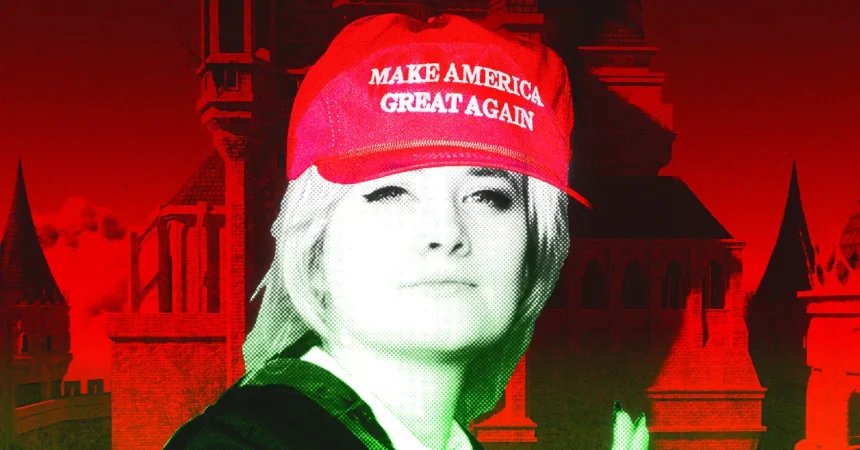
It starts, as so much modern extremism does, with a face that looks like it could be scrolling through the same feed as everyone else. The Malfoid isn’t a politician, a pundit, or a protest sign. She’s a vibe, a semi-ironic internet archetype pulled from the murky intersection of Harry Potter fandom, aesthetic Instagram edits, and toxic political commentary. Picture the kind of girl you’d see in a carefully curated fan edit: pale, blonde, sharp cheekbones, dressed in sleek monochrome, holding a wand or a glass of red wine, radiating an icy, ethereal superiority. But she’s not just a character. She’s a mascot, deployed by young, radicalized internet users as a kind of pop-culture-savvy banner for ethno-nationalism. She represents a weird and dangerous alchemy: the old racial and nationalist politics of blood and belonging, recast in the language of Tumblr aesthetics and Slytherin house pride. For a generation that often responds more strongly to visual culture than to traditional policy arguments, the Malfoid is the ultimate “guy’s girl,” updated for the digital age and given a dark, edgy makeover. She’s not like your grandmother’s idea of white supremacy, all desaturated pamphlets and polo shirts. She’s a Pinterest board, a playlist, a faux-aristocratic fantasy that makes the ugliest ideas in American politics feel intimate, stylish, and shareable. And that’s precisely the point. Wrapping white supremacy and old-fashioned conservative purity ideals in the glossy language of fantasy and fandom is an effective way to smuggle them into the mainstream, turning what should be repulsive into something that reads as familiar, smart, and even a little glamorous to a terminally online demographic.
The Malfoid is not an isolated novelty in right-wing politics; she is arguably the latest chapter in a long, strange love affair between the political right and the imaginative worlds of fantasy. For years, J.R.R. Tolkien’s The Lord of the Rings has been relentlessly co-opted by prominent figures on the American right, from tech billionaires like Peter Thiel to cultural powerhouses like Elon Musk. The epic battle between the free-men of Middle-earth and the dark forces of Mordor gets repackaged as an allegory for Western civilization under siege, a story in which preserving an idealized past becomes the highest moral duty. The Trump administration, meanwhile, has normalized the idea that communicating via memes is a legitimate form of governance. Trump’s own Truth Social feed is a constant stream of AI-generated imagery, cartoon versions of himself, and fantasy-inspired digital art, all designed to bypass the critical brain and speak directly to the gut. The federal government has gotten in on the act too: at various points, departments like the Department of Homeland Security have used memes and Tolkien references to make light of deeply serious issues, including ICE raids. More recently, the Department of Education has continued its “There is Magic in Learning” series on X, posting imagery that explicitly references The Lord of the Rings and Avatar: The Last Airbender in a bid to associate public education with the unmistakable glow of beloved fantasy sagas. The Malfoid, then, is not really a break from political communication; she is a more aggressive, more explicitly gendered, more poisonously romanticized synthesis of everything those earlier moves hinted at. When fantasy becomes a political tool, it doesn’t just entertain people. It gives them an emotional framework, a story to inhabit, and a face to make their fears look beautiful.
Leslie Hahner, a communications professor at Baylor University, sees this as a defining feature of modern politics: the total collapse of boundaries between internet subcultures and mainstream institutions. It used to be that niche symbols, in-jokes, and references belonged to small groups of fans and weirdos, far away from the levers of power. Today, those symbols circulate constantly in political campaigns, government communications, and major media coverage. Hahner argues that while memes can expand a message’s reach, this strategy becomes genuinely dangerous when it embraces the darker, more toxic elements of internet culture. Specifically, she points to the use of “incel imagery” in official communications as a deeply uncomfortable red flag. The question is not simply whether the image works; the question is whether the people using it understand what they’re actually doing. Hahner asks a devastatingly simple pair of questions: Is a government agency truly unaware of the symbol’s cultural baggage, or does it knowingly believe these associations are useful for attracting and exciting a particular audience? Either possibility should give us pause. If officials are unaware, that points to a profound lack of cultural literacy, an inability to recognize the very symbols of dehumanization and online radicalization that they are literally broadcasting to the public. But if they are aware, then we are no longer talking about a mistake; we are talking about a deliberate choice. A federal institution intentionally amplifying imagery tied to misogyny, racial resentment, and incel-adjacent anger is not a bureaucratic slip. It’s a signal, a dog whistle that the most radicalized corners of the internet can hear loud and clear, even if traditional media and the wider public miss it.
The Department of Education’s response to WIRED’s request for comment only deepens that sense of coded communication. Rather than explaining or denying the use of such imagery, the department quoted Albus Dumbledore from Harry Potter and the Deathly Hallows: “Of course it’s happening inside your head, Harry. Why should that mean it’s not real?” It’s a deeply strange, almost surreal response from a federal institution. But it also gets to the exact heart of the problem. The Dumbledore quote is more than a playful reference; it’s a cultural shibboleth, a way of saying, “We speak your language, and we are among you.” By utilizing the visual markers of the Malfoid and responding in the shared language of fandom, the institution signals a continuing cultural alignment to a radicalized, terminally online base without ever triggering the alarm bells of traditional media oversight. It is, as observers have noted, essentially an algorithmic wink. It reassures the most extreme corners of the constituency that the institution shares their foundational worldview, that the dark, blood-purity politics of the Malfoy family has somehow been encoded into the federal bureaucracy. There is no press release that announces this alliance. There is no policy document that says, “We are on your side.” Instead, it’s a meme. A quote. A wizard. A girl with platinum hair. And that is somehow more effective than any official communication could ever be, because it doesn’t feel like politics at all. It feels like you’re being seen, understood, and welcomed into a secret club that exists just beyond the view of everyone else.
This is the end of traditional political persuasion, at least as we once understood it. Policy papers, detailed legislative agendas, and campaign speeches simply do not excite young people the way they used to. Aesthetic identity does. Modern political operatives have learned, sometimes with unsettling speed, that young voters have been trained by platforms like TikTok and Wattpad to absorb information through hyper-specific tropes, archetypes, and fan-fiction dynamics rather than through cohesive, logical ideologies. Nobody wants to read a twelve-page manifesto about immigration reform, but they will absolutely watch a six-second edit of a girl who looks like she belongs in a Slytherin common room while a menacing orchestral score plays in the background. Ideas become moods. Policies become personalities. Political allegiances are less like rational choices and more like sorting hats, determining who you are, who you belong with, and who you are allowed to hate. In that kind of atmosphere, the Malfoid makes perfect sense. She condenses an entire worldview into a single image: the aestheticized longing for a world that never existed, the clean lines of racial purity, the smug comfort of being one of the special, the beautiful, the chosen. She is a viral object, a piece of cultural currency that travels through timelines and comment sections with the speed of a song you can’t get out of your head. And by embracing her, or at least by using her iconography, political institutions are deciding that the shortest path to loyalty is not through the mind, but through the feed.
The internet is no longer a reflection of our political reality. Our political reality is simply executing the tropes of the internet, and the state is perfectly happy to play along. For years, we comforted ourselves with the idea that the online world was a kind of carnival mirror, a distorted but still recognizable image of what people actually believed. Politicians would eventually have to come back down to earth and argue in front of microphones, budgets, and laws. But that was a fantasy. The Malfoid moment proves that the boundary between fiction and governance has dissolved completely. The meme isn’t just a tool to win an election; it’s the actual language of power. Politicians and institutions now operate inside the same mythic structures as the most obscure corners of the internet, and they are increasingly comfortable doing so. This isn’t merely a question of bad judgment or poor social media staff. It’s a transformation of what politics is for. The goal is no longer to persuade the undecided, to build coalitions across difference, or to make a practical argument about how to run a country. The goal is to create a visceral sense of belonging, to make people feel like they are part of an epic story, with all the beauty, the darkness, and the sense of inevitable victory that comes with fantasy. The Malfoid is a warning. She is the perfect symptom of a world where the state winks at the fringes, where racists make their peace with Harry Potter, where government agencies quote dead wizards, and where a fictional girl with a sneer can become more powerful than any policy. We are all living inside the meme now, and the question is whether we can wake up before the story ends badly.