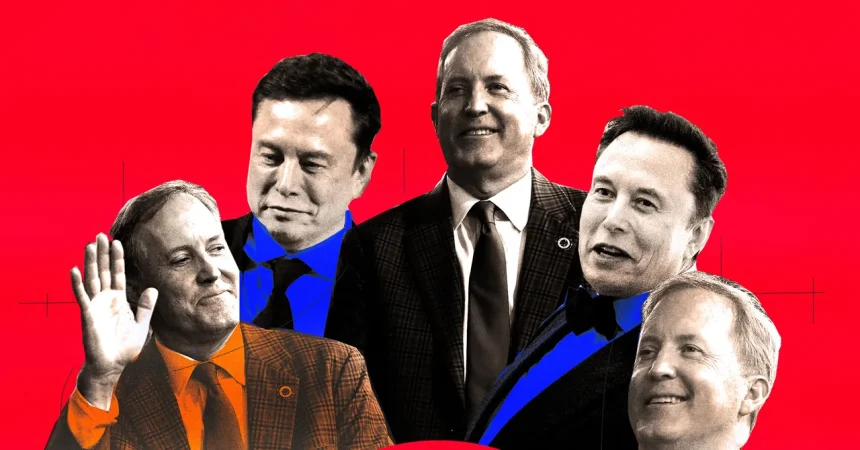
Elon Musk and Texas’s Republican leadership have long been comfortable with each other. The world’s richest man has built factories, launched rockets, and moved corporate headquarters into the state, while governors and attorneys general have welcomed him with open arms, tax breaks, and the kind of quiet access that money usually buys. But with the midterms approaching, that relationship is no longer quiet. It is being pulled into the open, scrutinized by voters, lawmakers, and judges. Federal Election Commission filings show that Musk has poured at least $158 million into super PACs supporting Texas Attorney General Ken Paxton’s Senate bid. State filings show he has given another $5 million to Governor Greg Abbott’s reelection campaign, making him Abbott’s single largest donor. Last week, Musk made his preference explicit, posting on X: “The fate of Texas and America is at stake. Vote for @KenPaxtonTX today.” For a state as deep red as Texas, the fact that polls now look dizzyingly close in several races suggests that even overwhelming financial firepower does not guarantee a landslide. It also suggests that Musk’s money is being spent in an atmosphere of real uncertainty, where every dollar and every endorsement could matter. The cozy relationship that once seemed like a background fact of Texas politics has become a central issue. Critics describe Musk’s financial support of the Texas GOP as virtually limitless, and they are no longer willing to treat it as normal. They see a billionaire trying to buy influence over the state’s most powerful offices, and they are demanding answers before the votes are counted. The filings are not just numbers on a page; they represent a fundamental shift in how political power is acquired and exercised in a state that has always prided itself on doing things its own way.
One of the most striking flashpoints involves Abbott. For years, the governor’s relationship with Musk has been a source of public curiosity, but Abbott has gone to great lengths to keep the details hidden. State Representative Gina Hinojosa, who is running against Abbott, sued to see the full contents of 1,400 pages of correspondence between the governor and Musk. Abbott’s office has tried to block the release, describing the communications as too “intimate and embarrassing” to be made public. That phrase alone is enough to raise eyebrows. What could be so personal, so revealing, so awkward about official communications between a governor and a businessman that the governor would rather fight in court than let the public see them? This week, a judge ruled that Abbott had illegally “obstructed and continues to obstruct” Hinojosa’s right to inspect the documents in her capacity as a state lawmaker, and ordered their release to her. Abbott has appealed, and a hearing is scheduled for November 2—one day before the election. The timing is almost cinematic: a last-minute legal battle over the right to know, playing out while voters are preparing to cast their ballots. Hinojosa has framed the fight as a matter of democratic accountability. If a governor is corresponding with one of the richest men on Earth, and if that correspondence involves tax breaks, business relocations, or policy decisions, the public has a right to know what was said. Abbott’s insistence on secrecy, she argues, suggests there is something to hide. The judge’s ruling was a victory for transparency, but the appeal means the final chapter has not been written. For now, the image of a governor calling his communications with Musk “intimate and embarrassing” is likely to linger in voters’ minds, and it does not exactly inspire confidence that Texas’s leaders are acting in the public interest.
On the Senate side, the stakes are just as personal. Ken Paxton is no stranger to controversy. As Texas attorney general, he was indicted on felony securities fraud charges, which he settled without a plea. Whistleblowers accused him of using his office to benefit the financial interests of a political donor. He was impeached by the Texas House, though later acquitted. Now he is running for the U.S. Senate, and he has Elon Musk in his corner. His opponent, State Representative James Talarico, has made Paxton’s record a central theme of his campaign. At a campaign event in El Paso on Monday, Talarico looked directly at the money behind Paxton and said: “Ken Paxton has the ultimate megadonor. Elon Musk is trying to buy this Senate seat.” It is a powerful line, and it captures a fear that many voters share: that in an era of super PACs and unlimited donations, elections are no longer decided by people but by bank accounts. Talarico is not just running against Paxton’s past; he is running against the idea that a Senate seat can be purchased. He has argued that Paxton’s legal troubles are not ancient history but a pattern of behavior that would follow him to Washington. The fact that Paxton has been able to raise and spend enormous sums, thanks in large part to Musk, makes the race feel even more lopsided. Yet the polls tell a different story. Despite the money, despite the endorsements, the race is close. Voters are being asked to weigh Paxton’s baggage against the resources he has assembled, and Talarico is betting that character matters more than cash. Whether he is right will depend on whether Texans are willing to look past the super PACs and see the person behind them. For many ordinary voters, the choice is not just between two candidates; it is between a politics that belongs to billionaires and a politics that still belongs to the people.
Musk’s involvement in Texas politics did not begin with the midterms. For years, he has enjoyed a remarkably warm relationship with the state’s leadership, and that relationship has come with tangible benefits. In 2021, Musk moved Tesla’s corporate headquarters from Palo Alto, California, to Austin. In 2024, SpaceX’s headquarters followed, moving from Hawthorne, California, to Starbase, Texas. These relocations were celebrated by Texas politicians as proof that the state could attract the world’s most innovative companies. But they were also accompanied by lucrative state contacts, tax breaks, and a level of allyship that goes beyond the usual business-friendly posture. Texas has long marketed itself as a low-regulation, low-tax haven, and Musk has taken full advantage. The question is whether the state’s leaders have been too eager to accommodate him. Critics point to the timing of Musk’s arrival and the changes that followed in the offices of the people who regulate and tax businesses. They see a pattern: Musk gets what he wants, and the politicians who give it to him get his money and his endorsement. It is a mutually beneficial arrangement, but it raises uncomfortable questions about whose interests are being served. When a billionaire can move his companies across the country, receive special treatment from state officials, and then pour millions into their campaigns, the line between public service and private privilege begins to blur. For ordinary Texans, the promise of jobs and economic growth is real, but so is the sense that the game is rigged in favor of the very rich. The story of Musk in Texas is not just a story of corporate success; it is a story of how power accumulates, how access becomes influence, and how influence becomes policy.
There is also a quieter, more troubling shift inside the Texas Attorney General’s office that coincided with Musk’s initial relocation to Texas. In the past, lawyers in the office would prepare notices of investigation—administrative subpoenas known as CIDs—based on public complaints or evidence that had been collected. Those notices would then be sent up the chain of command for approval. It was a process designed to ensure that enforcement decisions were grounded in facts and procedure, not in politics or personal favor. But according to the reporting, that process changed around the time Musk was planting his flag in Texas. The exact details of the shift are still being debated, but the implication is clear: the old, more disciplined approach to investigations may have been replaced by something more accommodating to powerful interests. If an attorney general’s office becomes less willing to investigate or challenge a major donor, then the entire regulatory system is compromised. Companies like Musk’s are supposed to be held to the same standards as everyone else. They are supposed to face scrutiny when they violate environmental rules, labor laws, or securities regulations. But when the person in charge of enforcement is also the recipient of millions of dollars in campaign support, the public has reason to wonder whether the rules still apply. The timing of the change—so close to Musk’s arrival—makes it impossible to dismiss as coincidence. It suggests that the relationship between Musk and Texas’s top law enforcement officials is not just about campaign donations; it is about the basic functioning of government and who gets to shape it. This is not a dry legal technicality. It is about whether ordinary people can trust that the law will be applied equally, no matter how much money a person has.
At the heart of this story is a simple but profound question: Can democracy survive the influence of a few billionaires? Musk is not the first wealthy person to try to buy political power, and he will not be the last. But the scale of his spending in Texas, combined with the secrecy surrounding his communications with Abbott and the changes in the attorney general’s office, makes this moment feel different. The state that prides itself on independence and self-reliance is now being forced to confront its dependence on the goodwill of one man. Musk’s endorsement of Paxton—“The fate of Texas and America is at stake”—is both a warning and a boast. He is telling voters that the future of their state depends on electing his allies. But many Texans are beginning to ask whose fate he is really talking about. Is it the fate of ordinary families struggling with high property taxes, failing infrastructure, and the cost of living? Or is it the fate of a billionaire who wants to make sure the people in charge remain friendly to his bottom line? The judge’s order to release the Abbott-Musk correspondence, and Abbott’s desperate appeal, suggest that even the state’s leaders know the answer would not look good. The hearing on November 2, one day before the election, will be a test of whether transparency can win out over secrecy. And the races themselves will be a test of whether voters can see through the money to the values they actually hold. In the end, the story of Musk and Texas is not just about one man or one election. It is about the kind of society we are building, and whether we are willing to let the richest among us write the rules.