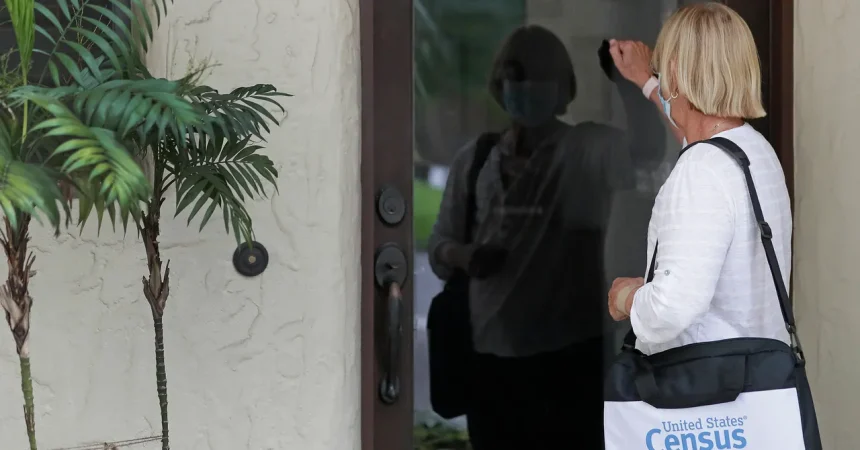
The Census Bureau has long tried to be the quiet, trusted arithmetic of American democracy. It counts every person in the country, and those numbers decide how many congressional seats each state gets, how hundreds of billions of federal dollars are distributed, and how the nation understands itself. The people who work there are supposed to be careful, apolitical professionals who treat data as sacred. But a WIRED review of internal records has revealed something far more unsettling: a hard-line conservative think tank tied to Donald Trump has quietly placed its own staff inside the Census Bureau. The America First Policy Institute, known as AFPI, has at least several employees detailed to the bureau, all working on a project described as “ad hoc data analyses” to answer questions from senior leaders at the Census Bureau and the Department of Commerce. These detailees were granted “special sworn status,” meaning they can access sensitive statistical data that most government employees cannot. The arrangement is not a routine scientific exchange. It is a political operation embedded in the machinery that produces the nation’s most important numbershare the census is supposed to tell the truth about who lives in America, and now people tied to a partisan movement are on the inside.
Among the names spotted in the records are Max Kossek, listed as a researcher at AFPI’s Office for Fiscal and Regulatory Analysis, and Ryan Montgomery, who is listed as a program assistant in the same office. Montgomery’s LinkedIn profile, however, says he is now a “research engineer” at AFPI, a title that sounds far more technical and official. Neither Kossek nor Montgomery responded to requests for comment. These are not household names, and that is exactly the point. They are young, early-career policy hands who have been placed inside a federal statistical agency, not because they are veteran demographers or career data scientists, but because they work for a think tank that wants influence. The census is not a think tank project. It is a constitutionally mandated count that affects every community in the country. The quiet arrival of people like Kossek and Montgomery shows how power often works in Washington: not through public debates or press conferences, but by placing your people in rooms where decisions are made, and where the person sitting next to you assumes everyone else is there for the same reason. There is nothing inherently wrong with detailees, the government often borrows experts from universities and research institutions. But those arrangements are usually transparent and based on expertise. Here, the line between policy advocacy and statistical governance has become dangerously blurred.
The most troubling name on the list is Thomas Lane, who is described as AFPI’s director for secure elections policy. Lane is not just a conservative policy employee; he is a former Trump campaign staffer and an election denier who was subpoenaed by the Department of Justice in 2022 as part of the investigation into attempts to overturn the results of the 2020 presidential election. He was not charged, but his history is documented. In a 2020 video posted by the Arizona Republican Party, a group of fake electors attempted to deliver the state’s electoral votes to Donald Trump, and Politico identified a man wearing a jacket with the name “Lane” on it, passing out documents for the electors to sign, making them appear “duly elected” and “qualified.” In 2024, CNN reported that Lane was prepared to serve as a backup elector for that same group. Earlier this year, Democracy Docket reported that Lane helped write part of an early version of the Save America Act, a law that would require voter ID to register to vote, while working for the Republican majority House Committee on House Administration. Parts of the Save Act have also been folded into the separate Save America Act, which would require proof of citizenship in order to vote, a move experts say could disenfranchise more than twenty million voters. And now this same person has been detailed to the Census Bureau, the agency responsible for the demographic data that shapes voting and representation. The census determines how political power is distributed. Placing an election denier there is not a neutral act. It is a warning about what the next census could be used for.
The other detailees may at first seem less political, but their backgrounds raise their own concerns. David Peterson is listed by AFPI as a research engineer with expertise in “computing, machine learning, and advanced software architecture.” Jackson Mejia is an AFPI fellow and an assistant professor at the University of Texas at Austin with a PhD in economics from MIT, focusing on tax policy. Both Peterson and Mejia did not respond to requests for comment. There is also Michael Corey, listed as an IPA from AFPI, which likely means an Intergovernmental Personnel Act assignment, a common vehicle for temporarily bringing experts into federal agencies. But AFPI does not list Corey as a staff member on its website, and the think tank did not confirm whether Corey is currently associated with it. An AFPI email address with Corey’s name does appear to exist, but that is not proof of much. The presence of people with technical and economic expertise might sound reassuring, until you remember that the census is not a math competition. It is a tool of power. A machine learning engineer or a tax economist can be very useful to a political operation, especially one that wants to shape how the country counts its citizenseur. A think tank does not need to send a hundred people into the Census Bureau. It only needs a few people in exactly the right positions, with the right access, and a clear sense of what the leadership wants to know.
Outside experts who study the census are alarmdeuced. Danah Boyd, a professor at Cornell University who studies the census and data governance, points out that there are established vehicles, like the American Association for the Advancement of Science, through which agencies like the Census Bureau might bring in multiple outside experts. Those programs are designed to support scientific research and to bring independent voices into government. AFPI, Boyd says, is not that. “This is not an institution that is set up to bring all the scientists in the world together or that has built this long-standing infrastructure of doing independent statistical research,” she said. “This is a partisan group with an agenda.” Her words cut to the heart of the concern. The Census Bureau has always borrowed professional expertise, but it has never borrowed a political agenda. The difference is not just a matter of optics. The census is used to allocate power and money, and if the people analyzing its most sensitive data are loyal to a political movement rather than to the integrity of the numbers, the damage could be profound. The public trust in the census has already been fragile, especially after the failed attempt to add a citizenship question in 2020. Having AFPI staff embedded inside the bureau, with access to sensitive data, is likely to deepen the suspicion that the census is becoming another front in the culture war.
The project these AFPI detailees are working on appears to be led by Michael Lachanski, the Census Bureau’s recently appointed deputy director for data, policy, and science. Lachanski is a former fellow at the Claremont Institute, a conservative think tank with its own connections to the Trump administration, and he is a political appointee. That means the person overseeing this project is not a career civil servant who rose through the ranks of statistical agencies, but someone chosen for political reasons. All of the AFPI detailees appear to have the special sworn status necessary to access sensitive Census data, which means they have taken an oath of confidentiality. But an oath does not erase a political history. It does not erase the fact that one of them helped spread the lie that the 2020 election was stolen. It does not erase the fact that another worked on laws that could make it harder for millions of Americans to vote. The Census Bureau’s strength has always been its reputation for impartiality, the idea that the numbers are the numbers, no matter who is in power. That reputation is now at risk. If the public comes to believe that the census is being manipulated by partisan insiders, the consequences will not be abstract. Communities may stop trusting federal data, states may contest their counts, and the very idea of a shared national story will fracture further. The quiet placement of AFPI staff inside the Census Bureau may be legal, and it may be procedural, but it is not normal. It is a slow, quiet erosion of one of the few institutions the country still believes in. The question is no longer whether politics is influencing the census. It is whether we will still trust the numbers when the count comes.