For decades, retro gamers lived in a fragmented world defined by physical borders and rigid technical standards. If you were a kid growing up in Europe or Australia during the nineties, you were effectively trapped in your own regional bubble. Because consoles relied on clunky lockout chips and physical cartridges designed solely for specific markets, importing a game from the United States or Japan was rarely as simple as plugging it in and playing. While clever enthusiasts developed various workarounds—like finicky dual-boot adapters designed to “spoof” the console—most players weren’t so lucky. We were at the mercy of different television standards, which essentially meant our gaming libraries were limited to what our local retailers deemed worthy of stocking, leaving us to look at international releases with a mixture of envy and helplessness.
The SN Operator changes this entire narrative, effectively relegating those regional headaches to the history books. This device treats physical media with the liberated freedom the internet promised us all along; it doesn’t care where a cartridge originated, nor does it recognize the arbitrary regional lockout chips that used to gatekeep our fun. As long as your cartridge is in working condition, the SN Operator will read it without hesitation. Because the device bridges the gap to modern displays, the old-world conflict between NTSC and PAL standards is finally silenced. You no longer have to worry about whether your TV can handle a foreign signal or if your console will reject the hardware entirely.
For the purists, this shift brings a massive material benefit: the restoration of true gameplay speeds. Historically, players in PAL territories like the UK suffered through games running at 50Hz, leading to sluggish animations and slower music compared to the 60Hz NTSC standard in America and Japan. Playing a game from that era on a PAL console often felt like moving through thick mud. Now, I can finally experience classics like Street Fighter II Turbo exactly as the developers intended, with the frantic, high-octane speed that was lost to us for years. North American collectors also gain a wealth of new opportunities, finally having the freedom to import cult classics like Japan’s Pop’n Twinbee series without the fear that their investment will end up as an expensive paperweight.
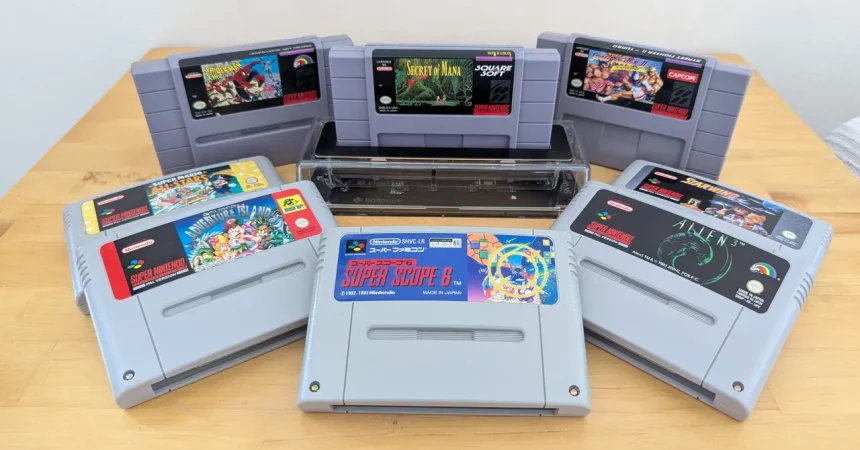
The technology powering the SN Operator is surprisingly thorough, turning a simple interface into an exhaustive research tool. The Playback software is smart enough to identify the specific regional version of your game, even calling out subtle historical quirks—like my UK copy of Star Wing, which famously had to change its name from the American Star Fox due to trademark disputes overseas. Beyond simple identification, the device offers genuine graphical enhancements for 30-year-old software. By utilizing super-sampling and upscaling, the SN Operator applies a polished, modern sheen to the SNES’s signature “Mode 7” pseudo-3D effects. It’s a remarkable way to see titles from your youth suddenly look crisp and vibrant on a high-definition monitor rather than a blurry, aging CRT television.
The peripheral support is equally impressive, breathing new life into gaming history’s most niche hardware. If you own titles like Mario Paint or strategy games like Populous II, the SN Operator allows you to swap out bulky, dusty period-accurate controllers for your modern, everyday computer mouse. The device even supports the notorious Super Scope light-gun games; while the old CRT-based light-gun hardware is long dead, the software allows a standard mouse to act as a surrogate. The only “problem” is that a modern high-DPI mouse is far more precise than the original chunky peripheral, making games like Super Scope 6—which, let’s be honest, was always a bit of a marketing exaggeration—decidedly easier to breeze through. It’s a joy to see such an obscure corner of the library get this kind of thoughtful attention.
Perhaps the most significant leap forward, however, is the overhaul of save management. The SN Operator honors the traditional experience—you can save your progress directly to the cartridge just as you would on original hardware, and you can even transfer those save files to your computer for safekeeping. But the real game-changer is the implementation of virtual save states. For massive, time-consuming JRPGs like Secret of Mana, this is nothing short of a miracle. I no longer have to stress about finding a save point before heading out the door or clearing my schedule for marathon sessions. Being able to freeze time, save instantly, and pick up exactly where I left off makes the daunting epics of the nineties feel perfectly suited for the demands of a modern lifestyle.