The group chat has evolved into the definitive modern institution, serving as the digital hearth where we gather, plan, and keep our social circles spinning. With WhatsApp boasting over 3 billion users, it is safe to assume that almost everyone reading this is currently tethered to at least one (and likely many) of these virtual hubs. Recognizing that group dynamics are the backbone of their ecosystem, WhatsApp has spent the year refining how these spaces function. From historical message access to member tags and event reminders, the platform is doubling down on the “group” experience. The latest update, rolling out gradually, isn’t just about adding shiny new bells and whistles; it’s about acknowledging the chaotic, high-stakes nature of modern group communication and giving us the tools to manage it better.
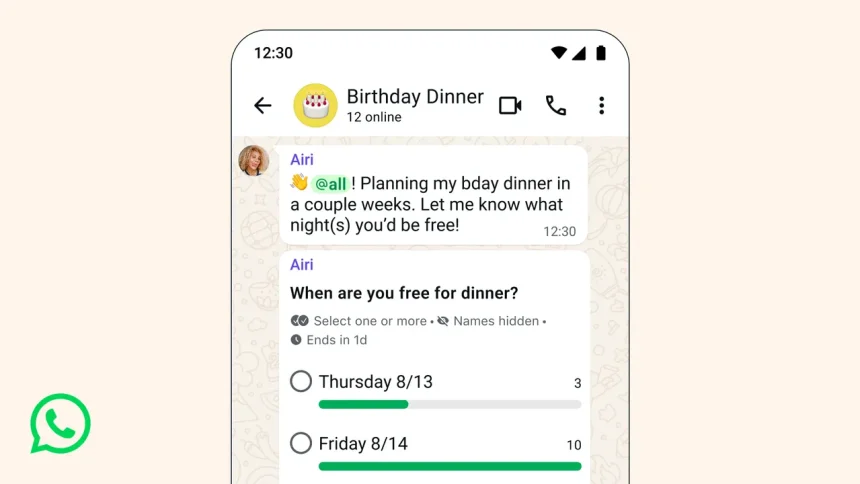
Perhaps the most disruptive change is the introduction of the “@all” feature, a powerful tool designed to cut through the digital noise. We all have that one muted group chat—the one where hundreds of messages pile up, ignored until we have the mental bandwidth to check them. By typing “@all,” a user can now force a notification onto every member, effectively overriding any personal mute settings. While this is clearly intended for urgent, “need-to-know” moments like sudden meeting changes or last-minute cancellations, it carries a heavy risk of annoyance. To prevent this from becoming a tool for spam, WhatsApp has smartly restricted the feature to administrators for groups larger than 32 people. Furthermore, if you’re the type of person who needs your peace, you can toggle off @all alerts in your settings without silencing the chat entirely.
The update also breathes new life into the polling feature, which, while useful, often became a point of friction when members stalled on making decisions. WhatsApp has introduced a “hard deadline” function, allowing poll creators to set an expiration time after which voting locks. This is a subtle but profound shift in group psychology; it removes the “I’ll get to it later” procrastination that plagues planning committees. Additionally, they’ve introduced the option to make polls anonymous. By allowing users to hide voter identities, the platform hopes to encourage more honest, unfiltered feedback—a necessary evolution for groups where power dynamics or social pressure might otherwise prevent people from voting their true conscience.
For those who frequently find themselves wishing to spin off a smaller conversation from a larger, overwhelming thread, WhatsApp has simplified the “splinter chat” process. You can now pull members from an existing group into a new, smaller one with a single tap, eliminating the tedious, manual invitation process. While this is officially marketed as a way to plan surprises or host side conversations, it is ultimately a acknowledgment of human behavior: we naturally gravitate toward sub-groups. By making it easier to fracture and refine our social circles, WhatsApp is leaning into the reality that while we love the “group” experience, we crave smaller, more intimate channels to avoid the cluttered noise of a hundred-person thread.
Looking beyond the group chat, WhatsApp is preparing to launch a long-awaited privacy feature: the ability to use usernames. In the near future, you will be able to connect with people without exposing your phone number, which is a massive leap forward for personal safety and convenience. This update allows for a more “social-media-style” interaction, where you can share a handle instead of your primary contact number. To keep things secure, users can add a four-digit security key for anyone trying to reach them, and high-profile handles are being protected from impersonators. It represents a significant shift from a platform tied strictly to your SIM card to one that functions more like a modern, privacy-conscious communication network.
Ultimately, these updates reveal a platform that is maturing alongside its users. WhatsApp is no longer just a messenger; it is a complex social infrastructure. By introducing tools that balance the need for urgent communication with the human desire for privacy and organization, they are trying to solve the “digital exhaustion” that comes with being permanently connected. Whether it’s the ability to silence an intrusive @all notification, the anonymity of a poll, or the ability to hide your phone number behind a username, these changes are a direct response to our need for better boundaries. The group chat may be our primary method of communication, but these new features remind us that we are still the ones in control of the conversation.