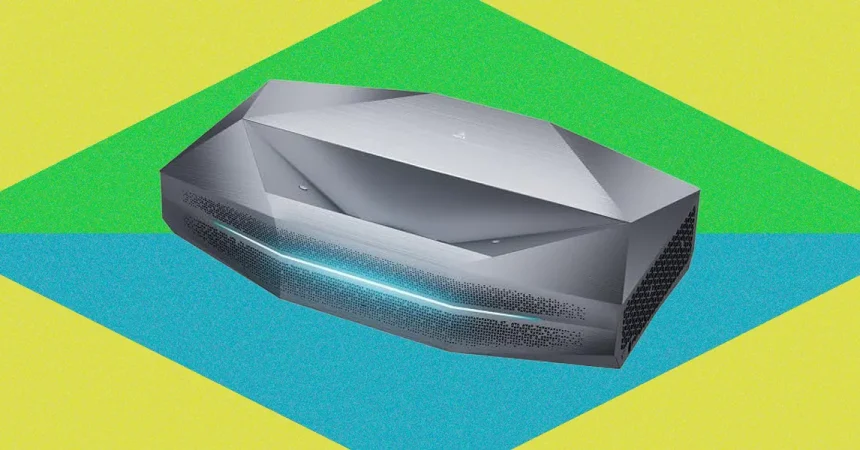
I’ve spent years reviewing screens, but every once in a while a piece of hardware comes along that makes me feel like I’ve been watching everything through a fogged-up window until that exact moment. The AWOL Vision Aetherion Max is one of those rare devices. I set it up in a dark, quiet room with an Alienware Aurora gaming laptop, loaded the latest Nvidia GeForce driver, and prepared to run some tests. I figured I’d spend an hour or so checking out the picture quality and then move on with my day. Instead, I ended up playing NBA 2K27 for a ridiculous amount of time, because the image was so lifelike that I couldn’t tear myself away. The lighting on the players’ faces, the subtle reflections on the court, the texture of the jerseys, the way the crowd moved in the background—it all came together to create a scene that felt less like a video game and more like a live broadcast from an alternate dimension. At one point, Anthony Edwards of the Minnesota Timberwolves appeared on screen, and I honestly had a moment where I thought he was physically in the room with me. The detail was that convincing. I’m not usually the kind of person who talks to the TV, but I caught myself muttering, “There’s no way that’s a rendering,” as I watched him dribble down the court. It was a jaw-dropping demonstration of what modern projectors can do when paired with a capable gaming PC. The colors popped without looking oversaturated, the motion was smooth, and the sheer size of the image made me feel like I was courtside rather than sitting in my own living room. I had to keep reminding myself that this was a projector, not a portal.
After I finally tore myself away from the basketball court, I switched over to something completely different: Onimusha: Way of the Sword on PC. This game is all about atmosphere, and the Aetherion Max delivered that atmosphere in spades. What really stood out to me was the pixel depth. On a smaller screen, you often lose the finer details in dark corners or distant backgrounds, but here, the entire image remained ultra-clear from the foreground to the far edges of the frame. Every samurai slash felt more realistic because I could see the blade’s path, the way light hit the metal, and the subtle movement of the character’s armor as he swung. There were moments when I actually flinched, which sounds silly, but the combination of crisp visuals and a massive screen makes your brain believe you’re part of the action. The projector also has an incredibly low latency of just one millisecond, which is a huge deal for gaming. There was no noticeable lag, no graphical stuttering, no frustrating delay between pressing a button and seeing the response. My controller inputs felt immediate, and in a game that requires precise timing, that responsiveness made all the difference. I’m not a particularly gifted gamer, but with the Aetherion Max, I found myself pulling off parries and combos that I’d never managed before. The hardware wasn’t just showing me the game; it was helping me play better, because I could trust that every movement on screen was happening exactly when I intended it to. It’s rare to find a projector that feels this good for fast-paced gaming, especially one that also produces such a beautiful image for movies and TV shows. I kept expecting some kind of compromise, but the Aetherion Max refused to make one.
The visual feast was matched by an audio experience that made me forget I was in my own home. The projector’s built-in speakers are surprisingly strong, but I wanted to see how far I could push them, so I connected the Aetherion Max to an Onkyo TX-RZ50 AV receiver and queued up two of the most immersive films I could think of: Civil War and Unbroken. The result was like sitting in a movie theater. Explosions had real weight behind them, dialogue stayed crisp and centered, and the surround sound wrapped around me so convincingly that I kept looking over my shoulder during tense scenes. I’ve reviewed plenty of home theater equipment, but this was one of those moments where I just sat back and thought, “Okay, this is what it’s supposed to feel like.” The projector’s own sound is also nothing to sneeze at, which is nice for people who don’t want to invest in a separate audio system right away. But when you pair it with a good receiver and a set of quality speakers, it becomes a completely different beast. There was, however, a small glitch that kept nagging at me. When I enabled height channel speakers for a 7.1.2 setup, the audio cut out intermittently. It wasn’t constant, but it was frequent enough to be annoying, and I couldn’t fix it no matter what I did. AWOL Vision is apparently aware of the problem and is investigating why it happens, so it may be addressed in a future update. For the time being, anyone with a full Dolby Atmos setup using ceiling speakers should know about this quirk. When I switched back to a standard 5.1 configuration, the sound was flawless, but the height-channel issue was a reminder that even the most impressive hardware can have a rough edge or two.
To really put the Aetherion Max through its paces, I ran a collection of demo reels that are designed to expose a display’s strengths and weaknesses. For the most part, the projector passed with flying colors. Close-ups of flowers were so vivid that I felt like I could reach out and touch the petals. A snowy mountain shrouded in white mist looked almost painterly, with the fog moving so naturally that I lost track of time. The deep blue ocean was rich and layered, and the way sunlight danced on the water was nothing short of mesmerizing. Two horses galloping across a field looked so lifelike that I could see the muscles moving beneath their coats. These scenes were the kind of thing you’d use to show off a projector to friends, and the Aetherion Max handled them beautifully. But there was one notable exception: a scene with dark trees against a dark background. No matter how much I adjusted the brightness, contrast, or gamma, the trees seemed to blend into the shadows, losing the depth and definition that made every other scene look so spectacular. I found myself leaning closer to the screen, squinting, trying to pick out individual branches, but the details just weren’t there. It wasn’t a total blackout, but it was a reminder that projectors sometimes struggle with shadow detail, especially in the darkest parts of an image. It’s a small issue, but it’s worth knowing about if you watch a lot of moody, low-light films. In brighter scenes, the projector is almost perfect, but the moment you enter a world of deep blacks and dimly lit forests, you may find yourself wishing for a bit more separation.
The other area where the Aetherion Max didn’t quite live up to its otherwise stellar reputation was skin tones. In the color benchmark tests, I noticed that two faces in a group shot looked far too similar in complexion, even though the subjects clearly had different skin tones. Other test clips showed a similar issue: a lack of tonal variety that made human skin appear flatter and more uniform than it should. I’m not a professional colorist, but I’ve looked at enough screens to know when something feels off, and this felt off. I spent a good twenty minutes adjusting the projector’s settings—toggling color profiles, fiddling with saturation, trying different gamma settings—but nothing seemed to help. The problem wasn’t that everyone looked orange or washed out; it was more that the projector seemed to compress the natural range of skin tones into a narrower band. It was strange, especially because the projector handled so many other colors with remarkable accuracy. But here’s the thing: in the context of real-world viewing, this is a subtle issue. You’re not going to notice it while watching a movie or playing a game, unless you’re specifically looking for it. It’s the kind of thing that would matter to a video editor doing color correction, but for the rest of us, it’s a minor quirk. I didn’t let it heavily influence my overall opinion, because the projector’s strengths are so much more prominent than this one weakness. If you’re the type of person who obsesses over perfect color accuracy, you might feel differently, but for the average home theater enthusiast, it’s not going to ruin your experience.
When I step back and think about the AWOL Vision Aetherion Max as a whole, the word that keeps coming to mind is “capable.” This is an amazing projector, a rock star of color accuracy, with crisp pixel clarity that holds up across the entire image and superior contrast that makes everything look cinematic. It handles gaming beautifully, with low latency and jaw-dropping visuals. It handles movies beautifully, with strong sound and a picture that makes you feel like you’re in a theater. It even handles everyday TV with a level of quality that makes other displays seem dull by comparison. Yes, there are a few flaws: the dark scene performance isn’t perfect, the skin tone benchmark left something to be desired, and the height-channel audio glitch is a real issue that AWOL Vision needs to address. But these are minor compared to the overall package. The price is in line with other high-end projectors, so you’re not being overcharged for the privilege, and what you get is a seriously capable home cinema model that will probably outshine anything else in the room. If you’re building a home theater and you have the budget, the Aetherion Max deserves to be at the top of your list. It’s the kind of product that makes you want to watch more, play more, and enjoy more. It turns a casual movie night into an event, and honestly, that’s the highest compliment I can give any piece of entertainment technology.