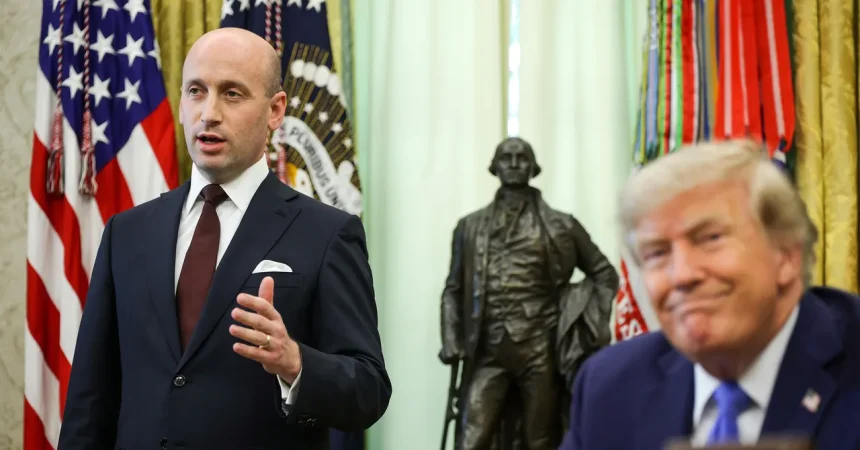
In the high-stakes, ever-shifting world of American politics, few announcements carry the weight of a White House chief of staff transition. It is a role that demands an almost impossible balance of strategic acumen, political loyalty, and the unenviable task of managing the whims of the most powerful person on earth. On a Friday that followed a bruising electoral defeat, President Donald Trump signaled a dramatic shift in his inner circle by naming Stephen Miller, his hardline ideological enforcer, as the new chief of staff. The decision, announced with the casual finality of a social media post, was more than a simple personnel change; it was a declaration of intent. It signaled that the President, stung by a searing rebuke at the ballot box, was not retreating to the center but instead doubling down on the most aggressive and polarizing elements of his political movement. The message was clear: the era of managing the administration with a steady, institutional hand was over, replaced by a period of unapologetic political warfare, where loyalty and ideological purity are prized above all else.
The man at the center of this seismic shift is Stephen Miller, a figure who has been a constant, looming presence in Trump’s political life since the heady days of the 2016 campaign. Unlike many political operatives who cycle in and out of favor, Miller has remained a fixture, a true believer who weathered the storm of the post-presidency years when many others abandoned ship. His loyalty was not just professional but deeply personal, a steadfastness that Trump has always valued above almost all other traits. In his previous roles as deputy chief of staff for policy and homeland security adviser, Miller was the architect of the administration’s most controversial and consequential policies, most notably the unrelenting crackdown on immigration. This was not an abstract policy preference for Miller; it was a crusade, one that he pursued with a fervor that often placed him at odds with more moderate voices within the administration. His elevation to the top staff job is a stark acknowledgment that the President no longer sees the need for a traditional gatekeeper but instead wants a general to lead his troops into the political battles he believes are inevitable, a choice that promises to reshape the very character of the executive branch and its relationship with the rest of Washington.
The immediate catalyst for this change was an electoral disaster. The midterm elections delivered a crushing blow to the Republican Party, with the loss of both the House and the Senate representing a devastating repudiation of the Trump policy agenda. In the wake of such a defeat, the search for a scapegoat began immediately, and the blame, according to sources close to the situation, fell squarely on the shoulders of the outgoing chief of staff, Susie Wiles. Despite her historical success in managing a surprisingly disciplined first year of the second Trump term, she could not escape the fallout. Privately, in the days following the election, Trump voiced his frustration, holding Wiles responsible for the party’s worst midterm performance in decades. This perception of failure, whether fair or not, sealed her fate. The narrative of a chief of staff losing control, being bypassed for key decisions, and facing hostile press stories had been building for weeks, and the election results provided the final, fatal blow. Her resignation, submitted just a day before the President’s announcement, was the quiet end to a tenure that had, at its peak, made her seem indispensable but ultimately proved unable to withstand the brutal currents of Trump-world politics.
In choosing a successor, Trump was presented with a choice between different visions for his administration. He weighed the credentials of Steve Witkoff, a special envoy and dealmaker, and Jay Clayton, the director of national intelligence, both men who represented a more conventional, establishment approach to governance. But facing the imminent threat of intense congressional investigations powered by a Democratic majority, Trump found the promise of technical management and diplomatic finesse less alluring than the combative, unyielding spirit of Miller. In a time of siege, the President chose a defender, not a diplomat. Miller’s deep-rooted loyalty, his proven willingness to fight for the President’s agenda without hesitation, and his aggressive media presence made him the logical choice. He is seen not just as a staffer but as a political soulmate, someone who understands Trump’s instincts and is willing to execute them with ruthless efficiency. This decision signals that Trump is digging in for a fight, prioritizing an ideological warrior who will view every policy dispute and investigative subpoena as a battle to be won, rather than a problem to be managed.
The reverberations of this change are already being felt throughout the West Wing, where aides are bracing for a period of intense upheaval. Miller’s reputation for ideological purity suggests that he will not tolerate dissent, and those perceived as too moderate or disloyal are likely to find themselves out of a job. The immediate targets of this coming purge appear to be the deputies of the previous regime, including James Blair and Richard Walters, who are seen as vulnerable because of their association with the failed midterm strategy. The atmosphere is one of apprehension, as staffers who thrived under Wiles’s more structured leadership face an uncertain future under a chief of staff known for his intensity and forceful personality. However, this shift is a source of relief for some, such as Defense Secretary Pete Hegseth, who had clashed with Wiles but is considered a strong ideological ally of Miller. Their prior collaboration on military initiatives suggests a smoother working relationship in the future, signaling that the new chief of staff will not only be a political operator but a central figure in shaping national security policy, further cementing the fusion of political and military strategy within the White House.
As Susie Wiles departs, leaving behind a legacy as arguably the most successful chief of staff Trump has ever had—a title earned by simply maintaining his confidence longer than any predecessor—the landscape of American politics is poised on the edge of a new, more volatile era. Her tenure, which saw the successful navigation of the early days of the second term, ultimately fell victim to the unforgiving nature of the political arena and the immense personal toll it takes. In her public farewell, she spoke of the honor of serving and the pride in the administration’s accomplishments, a gracious exit for a figure who managed the impossible for over a year. But her departure marks a definitive turning point. The promotion of Stephen Miller is not a mere adjustment; it is a transformation. It foretells an administration that will be more confrontational, more focused on cultural and political grievances, and less concerned with traditional governance norms. With the specter of investigations looming and the Republican Party licking its wounds, the White House is now under the command of a man who sees politics as a blood sport, and the stage is set for a bitter and relentless struggle over the future of the country.