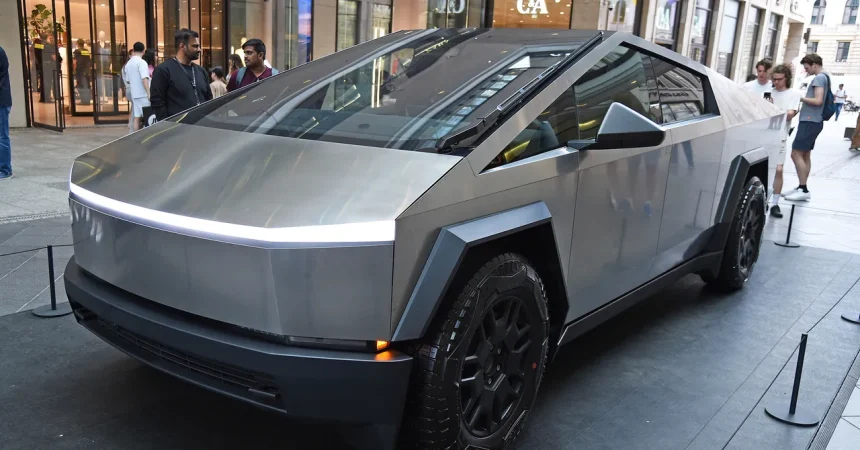
Tesla will end production of the Cybertruck at its Texas Gigafactory next year. It feels like the end of an era, though not exactly a beloved one. When the Cybertruck was first unveiled, it was impossible to ignore. The angular stainless-steel body, the bulletproof glass that shattered on live television, the idea that a pickup truck could look like a stealth fighter on wheels—it was either the future or a joke, depending on who you asked. But the future has a funny way of moving on. After years of hype, production struggles, and a deeply polarizing public life, Tesla is pulling the plug. For those who loved it, it’s a disappointment. For those who hated it, it’s validation. And for the rest of us, it’s a sign that something much bigger is happening in the auto industry. The Cybertruck wasn’t just a vehicle; it was a statement about excess. And statements, no matter how bold, eventually get replaced by things that actually work for everyday life. Its demise in Texas is not an isolated failure. It’s a bellwether. The era of giant electric trucks, at least as mass-market heroes, is winding down. And honestly, that might be the best news the electric vehicle world has gotten in a long time.
Calling the Cybertruck toxic might sound harsh, but there’s no better word for what it became. It wasn’t just the design, though the wedge-shaped body was always going to be a love-it-or-hate-it affair. It was also the company’s CEO. Elon Musk’s embrace of, well, you name it—political controversies, online antics, public feuds—made the truck a symbol for things that had nothing to do with driving. For a lot of people, buying a Cybertruck felt less like choosing a vehicle and more like taking a side. That’s a heavy burden for any product to carry, and it almost certainly hurt sales. It didn’t help that the truck was beset by recalls, including issues with accelerators and windshield wipers, or that the final price tag was far above what had originally been promised. The result was subpar sales, even by Tesla’s standards. The company never released exact numbers, but the production gaps and the quiet discounts told the story. The market had cooled on the idea before the truck even reached full production. The toxicity, to put it simply, caught up with it. But even if you strip away the politics and the personality, the Cybertruck had a fundamental problem: it was too big, too heavy, and too hungry for resources to be the kind of EV the world actually needs. It was a spectacle, but spectacles don’t survive on applause alone.
Let’s talk about that battery. The Cybertruck uses a massive 123 kilowatt-hour pack that weighs about 1,600 pounds. That’s roughly a quarter of the vehicle’s entire weight. To put it in human terms, it’s like carrying a grand piano under the floor, everywhere you go. That’s on par with the battery in Ford’s F-150 Lightning, another electric truck that was quietly canceled late last year. Ford’s batteries ranged from 98 to 131 kilowatt-hours, depending on the trim. These are enormous batteries by any measure, and they come with enormous costs—both financial and environmental. A battery that large requires a huge amount of lithium, nickel, cobalt, and other materials. It takes more energy to build, more energy to charge, and more energy to recycle. And because the vehicle is so heavy, it puts more stress on tires, brakes, and the road itself. It also makes the truck more dangerous to pedestrians and cyclists. A vehicle with a 1,600-pound battery is not just a personal choice; it’s a public safety issue. The physics are simple: the heavier the vehicle, the more damage it does in a collision. When you add in the poor visibility that comes with a towering pickup, you have a recipe for danger. That’s not an argument against EVs. It’s an argument against gigantic ones. We should want electric vehicles that make streets safer, not ones that turn every errand into a heavy-metal convoy.
The cancellations of both the Cybertruck and the F-150 Lightning within a year of each other are not a coincidence. They signal a shift. Automakers are finally paying attention to what buyers actually need rather than what looks impressive in a press release. Ford is planning to launch the Fathom next year, a sub-$30,000 electric pickup expected to be about the size of its compact gas-powered Maverick. That’s a completely different philosophy. Instead of trying to haul around enough battery to power a small town, the Fathom will be small, light, and affordable. Ford also killed a three-row EV in 2024, another sign that the company is stepping back from oversized electrification. Startup Slate is getting in on the act too, with a tiny electric pickup that can be converted into an SUV, with a bare-bones base model starting below $25,000. It features a svelte battery and has seen a massive surge in preorders. Yes, the Cybertruck also had a surge of preorders, and we know how that turned out. But the broader trend is unmistakable. Rivian’s R2, launched this year, has an 88-kilowatt-hour battery weighing about 1,200 pounds—still heavy, but noticeably smaller than the company’s flagship R1S. Rivian has also teased the R3, an even more streamlined SUV, in the coming years. The move toward smaller EVs isn’t just about styling or cost. It’s about the battery supply chain. With more people switching to electric, we need batteries that can be produced at scale without draining the earth. Smaller batteries mean more EVs can be built with the same amount of material. That’s not a niche concern; it’s the key to making EVs a practical replacement for gas cars.
None of this means big EVs are dead. The Kia EV9, a large three-row electric SUV, is among the top 10 EVs by sales in the United States. The Rivian R1S is also up there, and the F-150 Lightning has a surprisingly torrid resale market. Some people genuinely need the space, the towing capacity, or the range that only a big battery can provide. But look at the rest of the top 10 new EV sales, and you’ll see a pattern: crossovers, sedans, and mid-sized SUVs with moderately sized batteries. The market is speaking, and what it’s saying is that most people don’t need a 1,600-pound battery to get to work, drop off kids, or go grocery shopping. They need something that charges quickly, fits in a parking spot, and doesn’t feel like a tank. That’s why a number of newly announced EVs are trending smaller, or they’re designed as extended-range vehicles that combine a modest electric motor with a gas engine for backup. These hybrids and plug-in hybrids offer a practical bridge for people who want the benefits of electric driving without the anxiety of finding a charger every 200 miles. It’s a more nuanced, more human approach to transportation. Instead of forcing everyone into one extreme, automakers are starting to offer options that match real life. The future isn’t about building the biggest, boldest thing. It’s about building the right thing for the person who actually has to live with it.
At the end of the day, the Cybertruck’s death is a good thing. It’s good for pedestrians, who won’t have to share crosswalks with a six-thousand-pound stainless steel monolith. It’s good for cyclists, who have enough to worry about without trucks that can’t see them. It’s good for the battery supply chain, because every giant battery that isn’t built frees up materials for two or three smaller, more practical EVs. And it’s good for the electric vehicle movement as a whole. The Cybertruck was a spectacle, but it was never going to win over the millions of drivers who need an affordable, reliable, and easy-to-live-with car. The future of EVs isn’t a dystopian supertruck. It’s a friendly little hatchback, a compact pickup, a midsize SUV that sips electricity instead of guzzling it. It’s a future where more people can get behind the electric wheel, not just the ones who can afford a piece of sci-fi. So let’s not mourn the Cybertruck. Let’s thank it for showing us what we don’t want, and then let’s move on to something better. The road ahead is smaller, lighter, and a lot more sensible. And that’s exactly the way it should be.