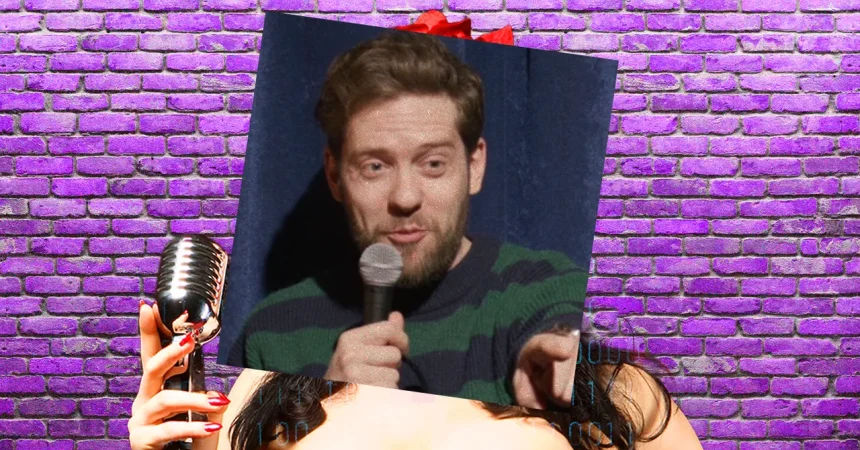
It started like so many modern indignities do: with a direct message sliding into an Instagram inbox, carrying a small, strange warning. Julia Jasunas, a stand-up comedian who has spent years building her voice and her act on stage, was scrolling through her phone last week when a fellow comic reached out with a piece of news that made her stomach drop. Did she know, the message read, that some random influencer had ripped off a joke from her act? At first, Jasunas felt the familiar surge of anger that every comic knows too well—the hot, prickly frustration of having something you’ve worked on, refined, and performed stolen out from under you. Plagiarism is hardly new in the world of stand-up, and comedians tend to be fiercely protective of their material, not because they’re precious about it, but because there’s almost no legal shield between a joke and someone who decides to take it. As Jasunas later put it, “We all look out for each other.” It’s a community built on trust and shared vulnerability, and when one person gets burned, everyone feels the heat. But even with that collective vigilance, she wasn’t prepared for what was waiting behind the link her friend had sent. She clicked, expecting to see some low-rent content thief trying to pass off her words as their own. What she found instead was something much stranger, much more unsettling, and far more emblematic of where we’ve landed in this strange, algorithm-driven moment in culture.
The video featured a woman named Aylen Skye, a buxom blonde with cheekbones sharp enough to cut glass and a quarter-million followers on Instagram. She introduced herself as a stand-up comic, but everything about her presentation screamed something else: crop top, Daisy Dukes, a kind of hyper-polished, impossibly perfect aesthetic that felt less like a comedy club and more like a fever dream of social media optimization. In the clip, Skye launched into a joke about renting out a room in her two-bedroom apartment to a cute guy. Jasunas listened in disbelief. It was her joke—not a loose adaptation, not a similar premise, but the exact same words, delivered verbatim, down to the “ums” and “ahs” she used as pacing devices. It was her voice, her timing, her phrasing, coming out of the mouth of someone she had never met and who, it quickly became clear, might not even exist in any meaningful sense. The more Jasunas dug, the weirder it got. Skye wasn’t just a random influencer; she was a monetized creation. The website she promoted in her videos redirected to explicit content on Fanvue, a subscription-based platform often described as an OnlyFans competitor, one that markets itself as the “No1 AI monetisation platform for creators.” And Skye, despite her polished performance, didn’t seem to be a real person at all. She seemed to be a product—an algorithmically generated avatar designed to capture attention, sell subscriptions, and siphon money from the very real labor of actual comics. Jasunas started reading the comments, looking for the usual chaos that follows any female comedian posting material online. There was none. No men berating her, no one objectifying her body, no one saying she wasn’t funny. Every single comment was positive, glowing, almost suspiciously supportive. “That’s how I knew she was fake,” Jasunas said, with the deadpan delivery of someone who has spent too long watching the internet eat its own.
For Jasunas, the experience was deeply violating, and not just in the way that having your work stolen always is. There was something uniquely grotesque about seeing her comedy, which she had built through years of lived experience and careful craft, funneled into a hyper-sexualized, AI-generated avatar designed to make money for someone else. “It’s one thing to have your jokes stolen,” she said. “It’s another to funnel your work into something so sexualized, for someone else’s profit.” The theft wasn’t just about the words; it was about the context, the intention, the commodification of her identity as a woman and a comic. She immediately reported the account to Meta, hoping that the platform would recognize the impersonation and take action. The response was a masterclass in corporate indifference. Meta told her that the video did not violate community guidelines because Skye wasn’t pretending to be Jasunas—she was just passing off Jasunas’s joke as her own. There was no impersonation, no false identity, just a wholesale appropriation of someone’s creative work, laundered through an AI-generated face and repackaged for profit. Jasunas couldn’t believe it. “They just didn’t seem to care,” she said. And while the majority of Skye’s posts have since been flagged as AI content, the account itself remains active, still posting, still accumulating followers, still monetizing the stolen labor of people who never consented to any of it.
Jasunas, it turns out, was not an isolated victim. WIRED’s investigation revealed that Skye had targeted multiple stand-up comics, and that she was not even the only AI-generated “hot girl” account doing this kind of thing. Across Instagram, a network of these synthetic personas has been systematically ripping off viral stand-up clips, taking material that already succeeded once and rebroadcasting it with a shiny, hyper-optimized veneer designed to maximize reach. The videos are almost always copies of well-known, already-viral performances, but the AI versions come with better lighting, better sound, and significantly tighter outfits. They are, in other words, engineered for virality in a way that real comedy rarely is. The accounts follow each other, share each other’s content, and present a unified front of algorithm-friendly artificiality. In addition to the stolen jokes, they post flirty, clearly AI-generated late-night show interviews with hosts like Conan O’Brien and Jimmy Kimmel, fabricating the kind of mainstream validation that real comics spend decades chasing. And they occasionally dip into “edgy” territory, posting racist or transphobic jokes designed to court the MAGA crowd, further inflating their engagement and expanding their reach. It’s a strange, unsettling ecosystem, one where authenticity is not just absent but actively mocked, where the worst impulses of the internet are combined with the latest in generative AI to produce content that is hollow, parasitic, and disturbingly effective.
The legal and regulatory gaps here are enormous, and they reveal how poorly equipped our existing systems are to handle the realities of AI-generated content. Instagram’s community guidelines prohibit impersonation, but they don’t prohibit copying someone else’s content, especially if that content isn’t formally copyrighted. Stand-up jokes, after all, are not typically protected intellectual property in the way that a song or a film might be; they live in a legal gray area where tradition and mutual respect are the only real safeguards. The platform also has no blanket prohibition against AI content, so long as it is labeled as such. Some of the accounts involved are clearly labeled as AI-generated, while others are not, and even within a single account, labeling can be inconsistent. This inconsistency allows the creators of these fake comedians to operate in a space of plausible deniability, claiming that they’re just using a creative tool, while the real human beings behind the original jokes are left with no recourse. Jasunas’s experience with Meta is a perfect example of the systemic failure: the platform could step in, could protect creators, could enforce a basic standard of decency, but it chooses not to, hiding behind a narrow interpretation of its own rules. The burden falls entirely on the victims, who are forced to navigate a bureaucratic maze while watching their work be repackaged, sexualized, and sold to the highest bidder. And even when they do everything right, they’re often met with indifference, automation, and a shrug.
What makes this story so deeply unsettling is what it says about the future of creativity in an age of generative AI. The people behind accounts like Aylen Skye are not artists; they are extractors, using machine learning to strip the labor from real human beings and convert it into a commodity. They take the most vulnerable parts of a comedian’s identity—her voice, her perspective, her lived experience—and flatten them into a generic, hyper-sexualized avatar designed to appeal to the lowest common denominator. They don’t care about comedy, about the craft of joke writing, about the long, lonely hours of open mics and empty rooms and refining a bit until it lands. They care about engagement metrics, subscription revenue, and the cold arithmetic of the attention economy. For comics like Jasunas, the threat is existential. If an AI-generated avatar can perform your jokes better than you can, with better lighting and sound and a body that draws eyes no matter what it says, what is the point of being a human comedian? The answer, Jasunas suggests, is that human connection still matters, that the laughter of a live audience, the shared experience of a room full of strangers, cannot be replicated by a synthetic face on a screen. But that answer feels increasingly fragile, increasingly naive, as the platforms we rely on to reach audiences continue to prioritize engagement over authenticity, profit over people. Jasunas keeps making her own content, keeps telling her own jokes, keeps hoping that the algorithm will eventually reward the real over the artificial. But the fact that she has to compete with a legion of fake blondes stealing her material is a grim reminder that the internet doesn’t care who suffers, as long as someone is watching.