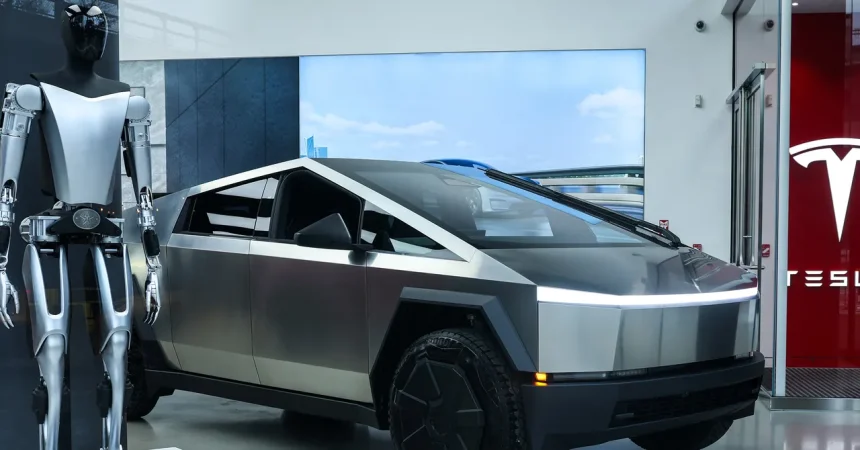
After months of speculation, delays, nervous laughter, and quiet strategy meetings, the news finally landed with the weight of a stainless steel door closing for the last time: Tesla is halting production of its polygonal pickup truck. For those who have followed the strange, noisy life of the Cybertruck, this moment feels less like a sudden surprise and more like the final act of a long, costly misadventure. It marks the end of an error—not just in engineering, but in vision. The Cybertruck was supposed to prove that an electric truck could be radically different, that a car company could bend reality, physics, and taste to the will of a singular, unforgiving aesthetic. Instead, it became an emblem of what happens when ambition outruns everyday practicality. The angular, bullet-shaped machine was never just a vehicle. It was a message, a meme, a promise, even a kind of personality test. But messages get tired, memes fade, promises break, and personality tests are only fun when they don’t cost eighty thousand dollars. What we are witnessing, then, is not merely a production pause. It is a collective exhale from everyone who was holding their breath waiting for the truck to finally make sense. The decision to stop the line, at least for now, is a quiet admission that the public does not want to be challenged every time they drive to the grocery store. They want a truck that works with life, not one that makes a life feel like a photography shoot. This is a human story disguised as a business story. Behind the headlines are engineers who wrestled with impossible materials, workers who built a machine they were never sure anyone would buy, and buyers who invested faith and fortune into a dream that promised to be unlike anything else on the road.
Let’s be honest about what the Cybertruck was. It was love at first sight for some, and a kind of architectural nightmare for others. There was no middle ground. Its designers chose a sharp-edged, triangular silhouette that made ordinary pickups look like gentle, rounded pets. The body was unpainted stainless steel, the windows were supposedly bullet-resistant, and the whole thing looked like it had rolled off a science fiction set and into a suburban driveway. That was the point. Tesla wanted to create something that would make people stop scrolling, stop laughing, and start talking. And it worked. The Cybertruck generated more free publicity in its first month than most automakers get in a decade. But attention is not affection, and polarization is not progress. The same sharp angles that turned heads in online videos also created real problems in the physical world. The truck was difficult to wash, hard to park, awkward to load, and almost impossible to repair without specialist equipment. Pedestrian safety standards forced Tesla to soften some edges, but the character remained. It was a vehicle designed to be seen rather than used, to be filmed rather than lived with. And that is its core tragedy. A truck is, by tradition, a tool. It carries things, hauls things, carries families, goes to job sites, gets muddy, and sometimes delivers that unmistakable signal that its owner works for a living. The Cybertruck, for all its promised toughness, always felt like a costume. It was a truck for people who wanted to be seen carrying things, not actually carry them.
The manufacturing story makes the picture even sadder. The Cybertruck was not just hard to design; it was brutally hard to build. The stainless steel exoskeleton refused to be bent in the usual ways. Welding it required new techniques. Fitting panels with acceptable gaps was a nightmare. The promised 500 miles of range never materialized in the standard version, and the towing capacity, when tested in real conditions, was far less than the marketing suggested. Every video review that pushed the truck off-road or hooked it up to a trailer became another chapter in an endless apology. Production delays became jokes in their own right. Tesla fans called it “production hell,” but even “hell” suggests a divine purpose. The Cybertruck’s journey felt more like a haunted house: every door you opened revealed another problem. There were recalls, software glitches, panel gaps you could fit a finger through, and a bed cover that occasionally acted as though it had a mind of its own. The company’s own workers, according to featured reports, struggled to keep the line moving. This is the human cost that doesn’t make it into the press releases. When production is halted, it is not just a strategic decision. It is a result of exhaustion, compromise, and the slow realization that machines, like people, cannot be bullied into being something they are not. The workers who spent years perfecting the truck’s unreasonable geometry must now wonder if their effort was wasted. It wasn’t, not entirely. Every failure teaches something. But teaching is expensive when the tuition is a whole assembly line.
From a market perspective, the halt is almost a relief. The traditional American truck buyer is a loyal, practical creature. They want a bed that can fit a sheet of plywood, a cabin that can hold a family, and a charging network that does not turn a weekend camping trip into a Sudden Death Quest. The Cybertruck, with all its angular glory, refused to understand that. It was built for the future, but the future is not a single shape; it is a set of behaviors. Meanwhile, competitors quietly did what Tesla failed to do. Ford’s F-150 Lightning, with its familiar form and honest utility, welcomed ordinary people into the electric truck world. Rivian’s R1T remembered that adventure is not a pose but a series of dirt roads and muddy boots. Chevrolet’s Silverado EV arrived with towing numbers and practical options. These trucks did not need to be polygons to sell. They just needed to be good. In the shadow of this practical competition, the Cybertruck began to lose its shine. Initial reservation holders, the true believers, drove their trucks home, posted videos, and then slowly started to whisper about quality issues. Resale values dipped. Online forums filled with questions about repairs, rust, and charging problems. The polarizing design, which had once seemed brave, began to look gimmicky. A truck that attracts attention because it looks strange is a novelty. A truck that keeps attracting attention because owners need to explain it is a burden. In the end, the free market did what free markets do: it voted with dollars and, more importantly, with silence.
But let’s not forget the cultural and emotional weight here. The Cybertruck became a symbol of something bigger than a vehicle. It was a totem of the hype economy—a world where perception, bold promises, and internet virality are more valuable than substance. Elon Musk, with his usual showmanship, presented the truck as a revolution. He invited people to believe in a future where the ordinary rules of design, safety, and manufacturing were merely suggestions. That invitation was exciting. It made people feel like they were part of a secret future, a vanguard of stainless steel and sharp edges. There was joy in that fantasy, and there was also community. Thousands of fans formed online clubs, planned meetups, and defended the truck against every critic. Some of them genuinely loved the thing. They did not see a wild mistake; they saw a brave departure. We should not laugh at them. Their belief was a form of hope. They wanted to live in a world where cars could surprise us again. The problem is that hope, when attached to a flawed product, eventually reaches a quiet morning when the owner looks at the silhouette in the driveway and feels not pride, but fatigue. That is what humanizing this story means. The Cybertruck is not just a failed product; it is a reminder that people will follow a dream, even a strange one, as long as it promises to make their lives more important. When the dream breaks, it breaks quietly, in the heart of each owner, long before the production line stops.
So what does the end of production actually mean? It is not the end of Tesla, and it is not the end of electric trucks. It is the end of a particularly stubborn belief that disruption is more important than usefulness. The Cybertruck was an experiment, and experiments are allowed to fail. The lesson, if we are willing to hear it, is one about humility. We cannot design for the future if we refuse to design for the present. We cannot make people better by forcing them into uncomfortable shapes. And we cannot build a beloved industry out of spectacle alone. The human beings who buy trucks are not standing in the future; they are standing at hardware stores pretending to know the difference between a torque wrench and a toaster. They want a vehicle that feels like a partner, not a statement. They want something that keeps them safe in a rainstorm, fits in a parking garage, and does not make them explain themselves to neighbors in supermarket parking lots. The Cybertruck, for all its fearless design, forgot that a vehicle is ultimately a place where people sit with their thoughts, play their music, spill their coffee, and drive their children. That is sacred, ordinary, and beautiful. The decision to halt production is not a defeat but an opening. It gives engineers a chance to breathe, designers a chance to listen, and buyers a chance to be heard. The phrase “end of an error” sounds harsh, but it is also merciful. Errors can be corrected, and this one has finally been allowed to stop. What comes next, we can only hope, will be a truck with edges that make sense, materials that behave, and a soul that remembers who it was made for.