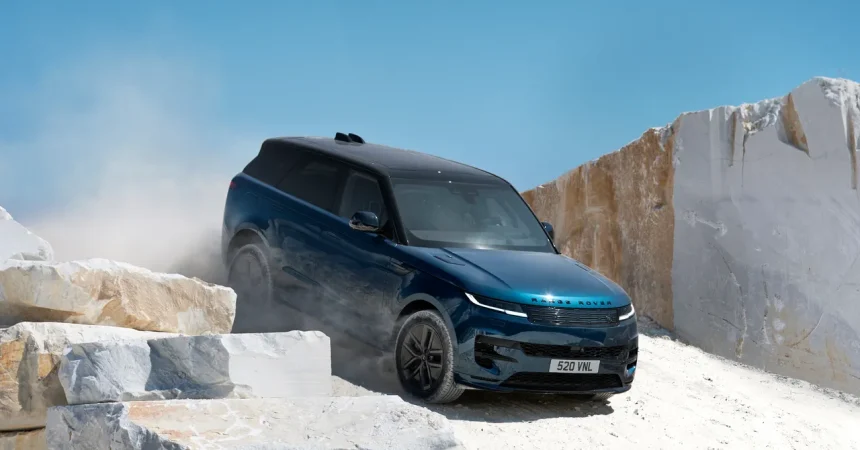
It’s easy to get lost in the glamour of a big automotive moment. The world has been watching Range Rover’s flagship electric SUV, the full-fat Range Rover Electric, which arrived in early September, and next week, all eyes will turn to New York for the final reveal of Jaguar’s long-awaited Type 01. But sandwiched between those two headline-grabbing launches is another electric debut that has arrived with considerably less fanfare: the Range Rover Sport Electric. It barely made a splash by comparison, but here’s the thing—it might actually matter more to JLR than either of its more famous siblings. The Range Rover Sport has always been the model that millions of people secretly want, the slightly smaller, sharper, and more affordable cousin to the showy flagship, and its sales often run close to, or occasionally even higher than, the Range Rover itself. That quiet popularity means the new all-electric version isn’t just another EV without a loud launch party—it’s a serious business move. And JLR needs serious right now. Earlier this month, the company announced it would be cutting 4,000 jobs over the next two years, evidence that while the brand still carries enormous prestige, the financial ground underneath it is less stable than its glamorous image suggests. The electric Sport therefore carries a freight of hope on its sculpted shoulders: the hope that it can give buyers the Range Rover experience, with all the presence and capability that entails, but in a package that’s more attainable, more efficient, and more in tune with the electric future everyone is racing toward.
On paper, the Range Rover Sport Electric is an engineering marvel, and the language JLR uses about it speaks directly to how it feels from behind the wheel. The company says this is the stiffest body ever fitted to any Range Rover Sport, which isn’t entirely surprising when you remember that the battery pack sits between the floor and the underbody, turning the entire chassis into a dense, rigid sandwich of aluminum and battery cells. That stiffness is the kind of thing designers and engineers obsess over, because it has a huge effect on how the car behaves: the less the body flexes, the more precisely the suspension can do its job, and the more planted and composed everything feels on the road. Combined with that heavy battery placed low in the floor, the Sport Electric also has the lowest center of gravity of any Range Rover Sport ever made. Lowering mass means less body roll, a reduced sensation of weight shifting around during cornering, and a general feeling of being glued to the road—like the car is hunkering down rather than riding high and aloof. And while the standard Range Rover Electric is already a masterclass in serene, effortless luxury, JLR claims the Sport’s torque response is actually 50 percent faster. What does that mean in practice? It means that when you ask for power, the response is nearly telepathic. There’s no waiting for a downshift, no hesitation, no mechanical pause while software decides what should happen. There’s only an immediate shove, delivered the instant your foot moves. That kind of responsiveness is soul-stirring in a way that’s hard to explain until you’ve felt it—it makes the car feel alive, eager, almost telepathically connected to your own intentions. For people who drive Sport models because they like a slightly more dynamic, driver-focused interpretation of luxury, that faster throttle response could be the single most persuasive reason to go electric.
Naturally, the electric Sport shares the same fundamental powertrain as the larger Range Rover Electric, but JLR has given it its own tuning, its own character, and, crucially, a lower price. Buyers in the UK can get one from £109,810, and while we’re still waiting for American pricing and details, the positioning is already obvious: this is how you get almost all the Range Rover electric goodness without paying the full flagship premium. The hardware itself is impressive. There are two electric motors, each rated at 260 kilowatts, working together to produce up to 550 PS—that’s European metric horsepower—and 850 Newton-meters of torque. To put that in context, that’s more torque than any other Range Rover Sport in history. This is not a car that feels gutless or compromised in the name of efficiency; it’ll do the silent-supercar thing too, launching from standstill to 60 mph in just 4.3 seconds if you engage Dynamic Launch Mode. That’s not quite hypercar territory, but for a luxury SUV with room for the whole family, a dog in the back, and all the luggage you can throw in, it’s genuinely ridiculous. There’s something profoundly vivid about the way electric power delivers performance, especially in a vehicle this versatile. You get all the ferocity of a sports car but without the soundtrack, no engine roar, no exhaust crackle. Just the electric hum of the motors, the rush of air and road noise, and the sudden realization that the vehicle around you is moving like a sprinter in boxer’s clothing. In some ways, it’s a more refined expression of speed than anything with a combustion engine, because you feel the forces, not the machinery.
Range anxiety, that old fear that used to cling to every electric car conversation, is getting harder to justify with vehicles like this. The Range Rover Sport Electric comes with a sizable 118.5-kilowatt-hour battery, and JLR is targeting up to 374 miles on the stricter European WLTP testing cycle. In American terms, where the EPA is famously more conservative with its estimates, that should translate to something around 320 miles of real-world range. For a vehicle this large, with this much power and this much luxury onboard, that’s a serious number. It means you can do a weekend drive to the country, a long cross-state trip, or a full week of school runs and errands without obsessing over charging. And when you do need to recharge, the Sport Electric doesn’t make you wait around for hours. It’s built on an 800-volt architecture, the kind of high-voltage system that’s become the gold standard for modern premium EVs because it allows much faster charging than the older 400-volt setups. JLR also fitted split-charging technology, which helps optimize the flow of electricity and manage the battery’s temperature more effectively. The result is that, under ideal charging conditions, you can add up to 136 miles of range in as little as ten minutes. Want to go from 10 percent to 80 percent? That should take about 22 minutes. In practical terms, that’s roughly the time it takes to grab a coffee, use a restroom, and stretch your legs. By the time you’re ready to drive again, the car is ready too. There are always caveats—real-world charging speed can vary with weather, charger conditions, and battery state—but the hardware is unquestionably there, making the electric Range Rover Sport an eminently usable daily driver rather than a fragile urban novelty.
Behind the engineering and the spec sheet is a more human story of a company trying to survive a storm. JLR has been through a turbulent period: shifting consumer tastes, the semiconductor crisis, volatile supply chains, and the astronomical costs of transitioning a legacy luxury brand to electric power. The job cuts announced this month are stark proof that the company is feeling the pressure, and that it’s willing to make painful decisions in order to stay healthy. But in the middle of that financial grimness, JLR is also investing heavily in its future, and the Range Rover Sport Electric is one of those investments in physical form. The Sport has always been the volume-friendly member of the Range Rover family, a vehicle that widens the brand’s appeal without diluting its character. For every person who buys a full-size Range Rover as a status symbol, there are two or three who buy a Sport because it’s just as gorgeous, just as capable, and a little more approachable in both size and price. That’s why this electric version is so strategically important: it takes the most commercially vital model in the lineup and makes it electric, giving JLR the best possible chance to lure loyal customers into EVs and, perhaps more importantly, attract new ones who might not have considered the brand otherwise. It also goes head-to-head with a crowd of luxury electric SUVs emerging from Germany, the U.S., and beyond, and in that fight, every advantage matters. The name recognition, the badge, the off-road credentials, the distinctive silhouette—all of those still matter, and mixing them with genuinely competitive range and charging speed makes the Sport Electric a far more credible challenger than a mere handout.
So yes, the Range Rover Sport Electric’s launch was quiet, squeezed between grander events, with nothing like the applause that accompanied the flagship or the curiosity surrounding the Jaguar Type 01. But in a way, that feels appropriate. This isn’t a car that needs a fireworks display or a dramatic reveal; it’s a car that will hopefully do its talking in showrooms, on driveways, and on the road. It’s built for people who want a luxurious, supremely capable, daily-driver electric SUV without living in constant fear of charging stops, and who want it wrapped in that unmistakable Range Rover design and heritage. With more torque than any Sport before it, a low center of gravity, rock-solid body structure, pulse-quickening acceleration, and a generous range, it has the ingredients to be more than just a supporting act. It could genuinely be the car that helps stabilize JLR during a rough period, the quiet workhorse that ultimately moves the needle. There’s still no official American pricing, and no one knows exactly how it will be received in the market, but the fundamentals feel right. Sometimes the most important product is the one that doesn’t control the news cycle, but simply does its job so well that it becomes indispensable. That’s the opportunity the Range Rover Sport Electric now has. And if it succeeds, it won’t matter that its debut was overshadowed. What will matter is that buyers looked at the price, felt the torque, watched the range meter climb, and decided they’d found the electric SUV they actually wanted.