Just seven months ago, Xona looked like a startup with a bold idea and not much else. The California-based company had closed a $170 million Series C, but its factory was still an empty warehouse, its satellites were still on paper, and the idea of replacing GPS felt more like a fantasy than a business plan. Then something unexpected happened: customers started knocking. “We hadn’t actually intended to do [another] funding round this soon,” says Brian Manning, Xona’s CEO and a former SpaceX engineer who co-founded the company in 2019 with seven fellow alumni from Stanford’s aeronautics and astronautics department. But the demand was impossible to ignore. Now, just months after that earlier round, Xona has raised $250 million more, in a Series D led by Future Ventures, the venture capital firm co-founded by Steve Jurvetson, one of the earliest backers of SpaceX and a longtime Tesla board member. The new round values Xona at $2.45 billion—almost double the valuation it would have commanded just a year ago. Jurvetson’s firm had first invested in Xona in 2024, and this time it contributed $78.5 million of the round itself. For a company that began with little more than a conviction that the world needed a better navigation system, the transformation has been dizzying. “We started the year with technically an empty warehouse, and now we have a functional satellite factory,” Manning says. That factory is the first step toward something much bigger: a commercial satellite network designed to do what GPS has done for decades, but better, stronger, and with far more precision. The money from this round will let Xona build out its constellation, hire more engineers, and get its service into the air before the world’s reliance on an aging government system becomes even more dangerous.
To understand why this moment matters, it helps to look at who is making the bet. Steve Jurvetson is one of Silicon Valley’s most legendary investors, a man who got in early not just on SpaceX but on Tesla, and who has long believed that the biggest opportunities in space are still ahead of us. His portfolio now spans what you might call the trifecta of satellite economics. There is SpaceX’s Starlink, which beams internet connectivity down from low orbit. There is Planet, which photographs the entire Earth every day and turns those images into a commercial data stream. And now there is Xona, which aims to disrupt the third great category of satellite use: navigation, a field that governments have controlled since the Cold War. Each of these categories involves different hardware, different orbits, and different customers, but Jurvetson sees a common thread. They all take infrastructure that was once the exclusive domain of nation-states and turn it into something entrepreneurs can build, sell, and improve. “Fortune favors the bold,” Jurvetson says, speaking like a man who has made his career betting on exactly that. In 2026, his confidence in Xona helped return him to Forbes’ Midas list of top venture investors for the first time in a decade. It is a sign that navigation, long considered too important and too difficult for private companies, is now seen as one of the most exciting frontiers in space. Jurvetson’s portfolio neatly spans the whole industry: Starlink for communication, Planet for imagery, and Xona for telling you exactly where you are. For a man who was once told that rocket science was a government job, the irony is delicious.
The reason there is room for a disruptor is that GPS, for all its brilliance, is starting to show its age. The U.S. Department of Defense built GPS in the 1970s, and for half a century it has been free, reliable, and quietly embedded in almost everything. Your phone finds you, your car navigates around traffic, planes land, ships steer, and farmers plant rows of crops using GPS. But the system was designed in a less complicated era. Its signals are relatively weak, which means they can be jammed by radio transmissions from someone who wants to confuse them. Worse, they can be “spoofed”—imitated with fake signals that trick a receiver into thinking it is somewhere it’s not. On the modern battlefield, this is already a crisis. Russia’s electronic warfare has become so effective that Ukrainian forces have been forced to supplement GPS with backup navigation systems just to keep their drones and troops moving. But it’s not only soldiers who are at risk. Commercial aviation still overwhelmingly depends on GPS, as do shipping, trucking, ride-hailing, and the global supply chain. Brian Manning likes to point out a simpler example: a driver on a highway where GPS can’t quite tell whether the car is on the main road or the off-ramp. “The world’s in a pretty dangerous place relying on GPS alone,” he says. As cars become more automated, those small errors become enormous risks. “As the world transitions from hands-on to hands-off, we need to go from kind of knowing what road you’re on to extremely reliably knowing what lane you’re in,” Manning says. We want to feel safe enough to take our hands off the wheel, and that means knowing your location with certainty far beyond what GPS can offer today. This is the gap Xona intends to fill: not a slightly-improved version of GPS, but a fundamentally more powerful, resilient, and precise positioning system built for the next century, not the last one.
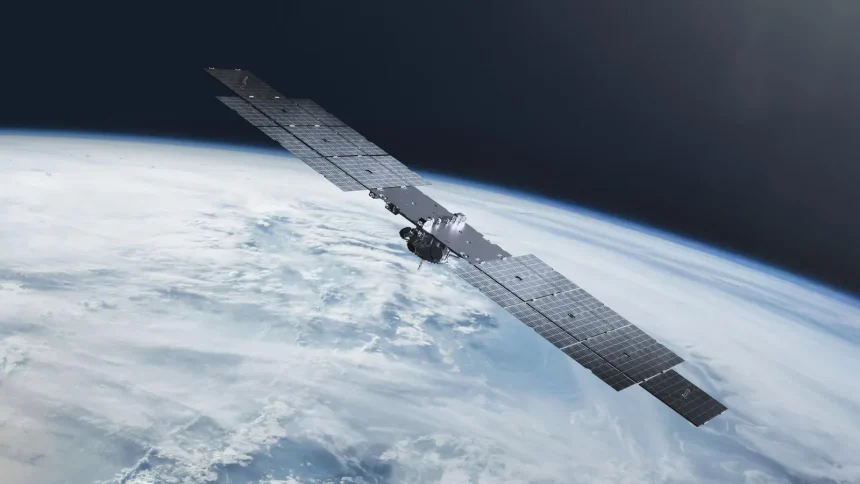
How exactly does Xona plan to do it? The answer follows the playbook that Starlink made famous: instead of a handful of expensive satellites in high, distant orbits, launch a swarm of smaller, cheaper satellites closer to Earth, link them together, and sell the service commercially. Xona’s initial network, called Pulsar, is designed to include 258 satellites in low-Earth orbit. Because they fly much lower than GPS satellites, their signals travel a shorter distance and can be transmitted with more power, making them far harder to jam or spoof. The wide-bandwidth radio waves, combined with advanced software on both the satellite and the receiver, allow for what Manning calls centimeter-level accuracy. To put that in perspective, GPS is typically accurate to within a few meters, and even then it often needs correction data to get down to a similar level. Xona believes it can offer that precision natively, without corrections, and with enough signal strength that a truck driving through a canyon, a plane approaching a runway in the rain, or a robot in a busy city street can know exactly where it is. This is the kind of reliability that autonomous vehicles, precision agriculture, surveying, and a hundred other industries have been waiting for. And because Xona is building a commercial network, it is not waiting for Congress to approve a budget or for a government bureaucracy to modernize. It is responding instead to paying customers, who have already started signing up. The company is following the same logic that made Starlink successful: build the infrastructure, get it into orbit cheaply and frequently, and let the market show you what it really needs.
The latest round of funding brings Xona’s total raised to more than $570 million, and it arrives just days after a crucial milestone. On Tuesday, Xona officially began rolling out its commercial network by launching six satellites into orbit aboard one of SpaceX’s Falcon 9 rockets—a fitting launch for a company that counts so many SpaceX veterans among its founders. Of those six satellites, four will eventually support customers, including Topcon, a Japanese company that makes positioning products for agriculture and construction. The other two are testing Xona’s own in-house satellite design, meaning that future satellites could be built and operated entirely by the company, without relying on legacy hardware. This is the beginning of what Xona says will be the first-ever commercial satellite network dedicated exclusively to navigation. Beta service, the company says, is expected to begin early next year. There is, of course, one elephant in the orbit: Starlink itself. Right now, Starlink does not offer standalone navigation services, but SpaceX has signaled interest in expanding into that segment. Theoretically, SpaceX could either launch new, purpose-built navigation satellites or try to upgrade the software in its existing internet constellation. The latter would be difficult, though early research suggests it may not be impossible. Jurvetson, who has investments in both companies and would likely benefit from either scenario, doesn’t seem worried. He argues that Xona’s advantage is that it designed its satellites from the very beginning for navigation, not as an afterthought squeezed into a communications spacecraft. That design clarity matters, because precision at the centimeter level requires careful engineering, not brute force. In space, as in many fields, the best tool for a job is the one built specifically for it.
If Manning’s prediction is right, we are living through the final years of GPS’s quiet monopoly. Within the next five years, he says, “everything around the world—every plane, train, truck, ship, watch, phone—is going to be guided by something other than GPS. We think it’s likely going to be us.” That is a bold claim, but Xona is no longer a startup with nothing but ambition. It has a factory, a growing constellation, a billion-dollar-plus valuation, and a serious backer in Steve Jurvetson, who has seen enough space history to know that the public systems most people take for granted can be overtaken by faster, smarter private ones. The road ahead is still hard. Xona must launch dozens more satellites, prove its service works in the real world, convince aviation and marine regulators to trust it, and compete with the very company that launched its first satellites. But the moment feels real. For decades, GPS was the quiet infrastructure underneath modern life, not visible until suddenly, one day, it wasn’t there. The rise of jamming and spoofing, the chaos of modern warfare, and the coming wave of autonomous everything have exposed its vulnerabilities. The dream of a private company stepping in to fix it is no longer theoretical. Humanity is entering a future where knowing exactly where we are will matter more than ever, and for the first time, there is a startup with enough money, enough talent, and enough courage to build it. Whether Xona ultimately succeeds or not, the old assumptions are already gone, and the sky is no longer the limit; it is the starting line.