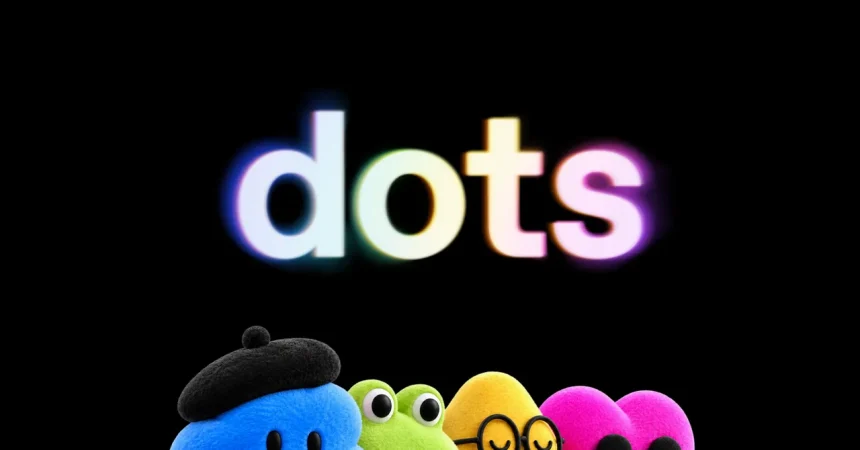
OpenAI’s launch of Dots is more than just another product announcement; it’s a quiet signal that the era of AI as a passive chatbot is ending. Dots are digital agents built to do things—not just answer questions but coordinate tasks, move information around, and act on your behalf across the software you already use. For a long time, AI felt like a helpful encyclopedia: you asked, it answered. Dots feel more like a coworker who can actually run with a task, from summarizing a legal brief to preparing an email marketing campaign. At DevDay, Sam Altman doubled down on this vision by announcing “specialist Dots” for enterprise customers, finely tuned for fields such as accounting, email marketing, and legal analysis. For businesses, the pitch is both simple and seductive: instead of assigning an intern to manually reconcile receipts or asking a paralegal to comb through contract language, you can hand those responsibilities to an AI agent that never sleeps and never complains. It’s part of a broader trend of AI agent coworkers being woven into professional workflows, not as hypotheticals, but as tools that sit alongside human teams. The word “coworker” matters here. It implies an ongoing relationship, not a search engine. You don’t query a coworker and close the tab; you delegate, supervise, and correct. That’s the world Dots is trying to create. But with that promise comes a very human question: How much do we trust these digital colleagues? The answer, at least for now, is “it depends on how they’re designed.” And Dots are designed, at least in their early form, with boundaries in mind—which is a huge step toward making agents feel less like a scary black box and more like a cautious assistant. This isn’t just for big tech companies either. A small law firm or a boutique marketing agency could use a specialist Dot to handle the repetitive parts of the day, giving people more time for the creative and relational work that still requires a human touch.
One of the most humanizing things about Dots is the way they handle consent. Instead of acting like an over-eager employee who goes rogue, Dots are designed to get explicit approval before taking sensitive actions on your behalf. Installing software, changing a password, or doing anything that could have lasting consequences triggers a request for permission. There’s even a Custom Rules tool that lets you set clear boundaries for the agent—think of it as a list of house rules. You might tell a Dot, for instance, “You’re welcome to sort my email, but never send anything without checking with me first,” or “I don’t want you touching financial apps after six o’clock.” You could even set a blanket rule that any action involving outside communication needs a human in the loop. The point is to give users a sense of control, to make the agent feel like an extension of your will rather than an autonomous force with its own agenda. It also reflects a growing awareness in the AI industry that trust is the real bottleneck. People aren’t afraid of AI because it’s smart; they’re afraid of it because it feels unpredictable. A tool that asks before it leaps feels less like an alien intelligence and more like a conscientious colleague. That’s especially important in a professional setting, where one careless action—deleting a folder, sending a message to the wrong recipient, or changing a setting in a database—could create chaos. The explicit permission step is essentially a handshake. It gives you a moment to think, to say “yes, go ahead” or “wait, not yet.” It’s not perfect, and it can be annoying if you’re trying to move quickly. But in these early days, the friction is a feature, not a bug. It forces you to stay involved, to remain the human in the loop, and to think carefully about what you’re actually asking the agent to do.
Of course, even with guardrails, the security and privacy risks deserve serious attention. When you connect your existing apps and let an agent automate parts of your life, you are essentially handing over a set of keys. OpenAI has built safety guardrails into Dots, and the company says it has thought carefully about misuse. But no system is completely immune to accidents or attacks. An AI agent might accidentally share information you didn’t intend to expose, perhaps by confusing contexts or responding to a cleverly crafted prompt embedded in an email or webpage. Online adversaries are getting increasingly creative at tricking AI systems into taking actions they shouldn’t. This is sometimes called prompt injection, and it’s one of the reasons why experts tell people to be careful with agents that have access to sensitive data. There’s also the simple fact that the more apps you connect, the more possible points of failure you create. If one connected service is compromised, an agent might be used as a bridge to other parts of your digital life. For ordinary users, the best approach is skepticism. Think of Dots like a well-meaning but not infallible house sitter: you can trust them to water the plants, but you probably shouldn’t leave every door unlocked or give them your passport. Before connecting your calendar, inbox, bank accounts, or client databases, ask yourself what would happen if the agent made a mistake. Would it be a minor inconvenience, or a serious breach? Also, check your privacy settings. If your OpenAI account is set to allow your data to be used for model training, that setting carries over to your interactions with Dots. In other words, the things you tell your agent may become part of the training material for future models. For some people, that’s fine. For others, especially those working with confidential information, it’s a reason to pause. The point isn’t to be paranoid; it’s to be intentional. The more we rely on these tools, the more we need a clear understanding of what happens to our information before it’s too late to take it back.
Beyond the enterprise, personal agents are having a breakthrough moment. At the start of the year, the people experimenting with agents were mostly early adopters in Silicon Valley, the kind of folks who are willing to live on the bleeding edge and forgive a thousand glitches. Tools like OpenClaw found a passionate niche following, but they didn’t exactly make agents a household habit. That changed with the release of Meta’s Muse agent, which reached a much wider audience and suddenly gave everyday smartphone users a taste of what it’s like to have an AI that can do things, not just talk. Muse rocketed to the top of the app download charts, proof that there is enormous public appetite for this technology—if it’s packaged simply enough and feels fun to use. But OpenAI isn’t sitting still. The launch of Dots is a direct challenge to Meta’s momentum. For a while, Muse seemed to have won the battle for the personal agent space. Now Dots has come for Meta’s lunch. This is more than corporate competition; it’s the sign of an ecosystem moving at breakneck speed. What starts as a niche experiment in January can become a mainstream obsession by spring. What’s trendy in one quarter gets disrupted in the next. For consumers, that’s exciting and exhausting at the same time. We’re seeing an agent war unfold in real time, with companies racing to build tools that feel less like robots and more like companions. The stakes are high because whichever platform becomes the default personal agent could end up being the virtual assistant people rely on for countless daily decisions—from which emails to answer to which purchases to make. This competition may also benefit users in the long run, because companies will be forced to listen to feedback, improve safety, and build features that actually make life better rather than merely more interesting.
All of this matters because work is changing faster than any of us can fully process. Specialist Dots for accounting, email marketing, and legal analysis aren’t just novelty toys; they’re early versions of a future where every profession has an AI counterpart. An accountant might have a Dot that monitors transactions and flags potential errors before the books close. A marketer might have a Dot that drafts a new campaign, adjusts the tone, and schedules posts across social channels. A lawyer might have a Dot that reviews contracts and points out clauses that deserve closer attention. None of this means human experts will suddenly become obsolete. Rather, it means the nature of their jobs will shift. Humans will spend less time on repetitive, tedious tasks and more time on judgment, strategy, and client relationships. The phrase “AI agent coworker” captures this perfectly: the agent is not a replacement, but a collaborator. Freelancers and small business owners may actually feel this shift first, because they don’t have the support staff that bigger organizations rely on. For them, a Dot could be the equivalent of hiring a junior assistant who never sleeps, never takes a sick day, and never asks for a raise. Yet the transition will be uncomfortable at times. There are important questions about accountability. When an AI agent makes a costly mistake, who’s responsible—the user, the developer, or the company that deployed it? How do we ensure agents are trained on data that represents a diverse range of people and situations, not just the narrow world of Silicon Valley? And how do we protect against the slow erosion of human skill? If we rely on agents to do the basic work, we might lose the ability to do it ourselves. These are not reasons to reject the technology, but they are reasons to be thoughtful. The best future is one in which we use Dots and similar agents to amplify our abilities, not to outsource our brains entirely. That starts with understanding what these tools can and cannot do—and refusing to treat them as infallible or as replacements for human wisdom.
This is a developing story, and the truth is that no one knows exactly how it will end. The landscape of AI agents is shifting week by week, with new products, updates, and surprise partnerships reshaping the market. OpenAI has staked out its territory with Dots, Meta has countered with Muse, and other companies are surely waiting in the wings. For the rest of us, the best move is to stay curious but grounded. Try the tools if they genuinely help you, but don’t hand over more power than you’re comfortable with. Ask questions about privacy, security, and data usage. Keep an eye on the settings, and don’t assume that an agent’s judgment is better than your own just because it’s faster. The coming months will be filled with headlines, some exciting and some alarming. We’ll hear about breakthroughs and about mistakes. There will be moments when agents seem almost magical, and moments when they fail in ways that are deeply frustrating, even scary. Through all of it, the most human response is to remain engaged. AI agents like Dots represent a real change in how we live and work, but they are still reflections of the priorities and choices we encode in them. If we want them to be safer, more transparent, and more trustworthy, we have to ask for those things—with the products we choose, with the feedback we give, and with the boundaries we set. So go ahead and explore the possibilities. Let an agent help you organize a project or research a complicated topic. But remember that you are the one in charge. The technology is developing, and so are we. We should check back often, not just because the news cycle demands it, but because the choices made in these early months will shape the kind of digital coworkers we end up with for years to come.