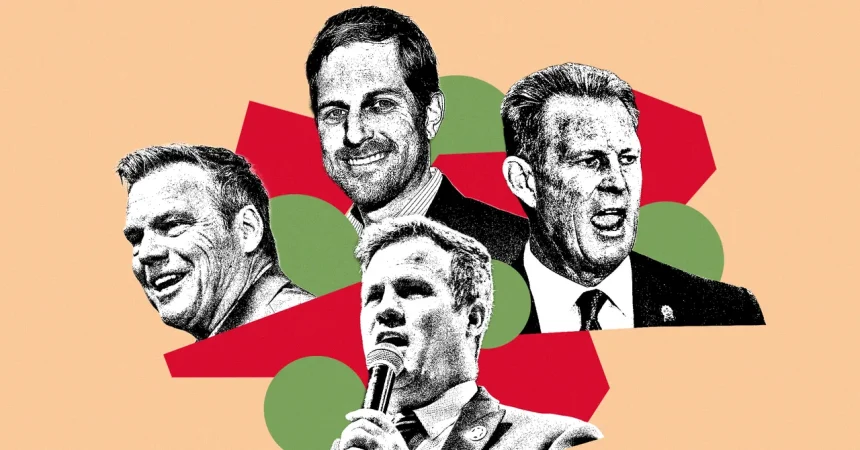
In the aftermath of the 2020 presidential election, a new kind of political figure began to emerge from the wreckage of the “Stop the Steal” movement. These were not just online provocateurs or fringe podcast hosts; they were lawyers, activists, and lawmakers determined to use the machinery of state government to challenge the legitimacy of American elections. Now, several years later, many of those same figures have set their sights on one of the most powerful offices in the country: state attorney general. The role of attorney general is often described as the people’s lawyer, but in an era of deep political distrust, it has become something more. It is a vantage point from which the rules of democracy can be enforced, reshaped, or quietly dismantled. In Kansas, Michigan, and Nevada, the 2024 races for attorney general are illuminating just how far the election denial movement has traveled, from the fringes of conspiracy to the threshold of real institutional power. The candidates in these races carry with them the baggage of contested election narratives, but their stories are also deeply human, shaped by ambition, grievance, and a version of patriotism that looks very different depending on who is telling it. For voters, these races are not abstract political battles. They are questions about whether elections will be run with integrity, whether every eligible person can cast a ballot easily, and whether the losing side will accept the outcome when the counting is done.
In Kansas, the race for attorney general has brought Kris Kobach back to center stage. Kobach is not a newcomer to election controversy. He first rose to prominence as a fierce advocate of strict voter identification laws, claiming that voter fraud was rampant and that the integrity of elections was under attack. His time as Kansas Secretary of State was marked by lawsuits, accusations of voter suppression, and a long and unsuccessful crusade to prove that non-citizens were casting ballots in large numbers. But after the 2020 election, Kobach’s focus shifted from voter rolls to the election results themselves. In the chaotic weeks after President Biden was declared the winner, Kobach served as an adviser to the Texas lawsuit that asked the Supreme Court to throw out the election results in Georgia, Pennsylvania, Michigan, and Wisconsin. He also assisted a member of the Michigan Board of State Canvassers who had initially voted to certify the state’s election results but later tried to rescind that vote, a move that could have thrown Michigan’s election into chaos. Kobach’s involvement in these efforts painted a clear picture: he was no longer just a law-and-order conservative worried about voter fraud; he was a player in the broader movement to overturn a free and fair election. By 2022, he was announced as a headline speaker at a rally in Kansas alongside Mike Lindell, the MyPillow founder and one of the most vocal and bizarre election deniers in the country. Lindell had spent months spreading baseless claims about voting machines, foreign interference, and rigged elections, and sharing a stage with him was a powerful signal. Now, facing Democrat Chris Mann in the race for attorney general, Kobach remains a polarizing figure. Recent polling shows a tight contest, a sign that Kansas voters are genuinely divided about what kind of legal leadership they want, and about whether the state’s top lawyer should be someone who has so deeply intertwined his legal career with election denialism.
Michigan offers a more complicated, quieter version of the same story. Here, Eaton County prosecutor Doug Lloyd won the Republican nomination for attorney general, but only after a primary race that was consumed by the legal and political fallout of the 2020 election. Early on, the race had included Matt DePerno, a lawyer who had become something of a folk hero among election deniers in Michigan. DePerno was present in Arizona during efforts to examine disputed ballots and became known for pushing false claims that local election officials in Antrim County had rigged voting machines. But by the time of the primary, DePerno was facing felony charges for his alleged role in a scheme involving the undue possession of a voting machine and conspiracy. He pleaded not guilty, and the case remained pending in district court. Lloyd, however, was a different kind of figure. He was not typically labeled as an election denier, and he presented himself as a more moderate, serious alternative to the fiery DePerno. His Democratic opponent, Eli Savit, tried to frame the race as a choice between a mainstream prosecutor and a Republican who would turn the attorney general’s office into a political weapon. Yet Lloyd has not completely separated himself from the skepticism that defines today’s Republican base. In a recent podcast interview, when asked about “credible concerns raised by voters about the 2020 election,” he signaled a willingness to revisit an issue that has been litigated, investigated, and debunked countless times. Lloyd suggested that the attorney general’s office, aided by the Michigan State Police, could actually investigate those claims. His language was careful, almost subdued, but the implication was clear: six years after the election, there were still questions to be asked, or at least questions to be seen as asking. Recent polling shows Lloyd tied with Savit, a dead heat that suggests Michigan’s attorney general race could turn on the question of whether voters see the office as a place for legal stability or a launching pad for renewed political combat.
Nevada presents the most dramatic example of how election denialism has woven itself into the fabric of a major statewide race. There, former President Donald Trump has endorsed the lawyer Adriana Guzmán Fralick for attorney general, and her platform is built on one of the most controversial pieces of election legislation in the country, the SAVE Act. At the federal level, the SAVE Act has been a centerpiece of Trump’s efforts to impose new restrictions on voting. The act would require registered voters to provide proof of citizenship, such as a passport or a birth certificate, before they can cast a ballot. This sounds simple enough, but the reality is far more complicated. Tens of millions of Americans do not have a passport, and many do not have easy access to their original birth certificate. For elderly voters, for people who have moved frequently, for low-income families, and for those who were born in rural areas or in times when record-keeping was less reliable, the requirement would create a barrier that could cost them their vote. Experts have repeatedly warned that the SAVE Act would disenfranchise millions of eligible voters, disproportionately affecting minorities, the elderly, and poorer Americans. Guzmán Fralick, however, has embraced the idea enthusiastically. In a Facebook post earlier this year, she praised Trump for fighting for secure elections and declared that Nevada should not have to wait for Washington to move. She promised that, as attorney general, she would push for the SAVE Nevada Act to remove non-citizens from voter rolls, count all ballots on Election Day, and end universal mail-in voting. The rhetoric is powerful, casting herself as a defender of election integrity against a federal government paralyzed by partisan dysfunction. But the practical effect, if implemented, would be to make voting harder for thousands of law-abiding citizens, all in the name of addressing a problem that election officials say does not exist. It is a human story, too, because behind the policy jargon are real people who might find themselves turned away from the polls, people who have done everything right and simply lack the right piece of paper.
What makes Guzmán Fralick’s candidacy even more striking is the company she keeps. She has touted the endorsement of Joey Gilbert, a far-right boxer turned MAGA influencer who rose to fame not through athletic achievement but through spreading conspiracy theories about the Covid-19 pandemic. Gilbert, who calls Guzmán Fralick a friend, was present at the rally on January 6, 2021, that preceded the violent attack on the U.S. Capitol. He did not enter the building, but he was captured on video near the infamous serial conspiracy theorist Alex Jones, chanting “1776.” That number is not just a historical date; in the radicalized corners of the election denial movement, “1776” is a revolutionary call, a suggestion that Americans may need to rise up again against an illegitimate government. For a candidate for state attorney general to embrace someone with that history, and to display that endorsement proudly, tells voters a great deal about where her political loyalties lie. It also raises the question of what she would do if she were in a position of legal authority during a contested election. Would she defend the votes of her citizens, or would she lend the power of her office to those who, like her mentor and his followers, believe that the system is corrupt and needs to be broken in order to be saved? Recent polling shows Guzmán Fralick trailing her Democratic opponent, Nicole Cannizzaro, by eight points. That may be comforting to those who hope that voters will reject her message, but an eight-point lead is not a landslide. In a state with a high number of nonpartisan voters and a history of close races, it is still a contest worth watching, and it demonstrates that the election denial movement is not purely a marginal force; it has enough energy to nominate a candidate with a real chance, even if not yet a winning one, for one of the most important legal offices in the state.
Taken together, these three races tell a story far larger than any single candidate. They show how the language of “election integrity” has been stretched and reshaped to accommodate claims that have been rejected by courts, state election officials, and multiple recounts. They show how candidates who once might have been dismissed as fringe figures now run serious campaigns for real offices, with the backing of a former president and a network of activists who believe that American democracy is fundamentally broken. But the story is also about the people standing in opposition, Democrats like Chris Mann, Eli Savit, and Nicole Cannizzaro, who are running not just as politicians but as guardians of the electoral system. Their campaigns are built on a simpler message: that the results of elections should be accepted, that every legitimate vote should count, and that the attorney general’s office should be used to protect the laws of the state, not to relitigate a past election. The polls in these races tell us that the country is profoundly divided, not only about policy but about the basic question of whether our elections are trustworthy. In Kansas, the race is too close to call. In Michigan, it is tied. In Nevada, the election denier is behind but still competitive. The outcome of these races will determine who has the power to investigate election claims, to decide what voter ID laws look like, to defend or dismantle mail-in voting, and to stand up to the pressure of a national movement that refuses to accept defeat. For the voters in these states, the choice is not just between two candidates. It is between two very different ideas of what America is and what it should be. On one side is a vision of a country where the government is trustworthy, elections are fair, and the rule of law applies equally to everyone. On the other is a vision of a country under siege, where every election is a battle, every ballot is a potential fraud, and every loss is a conspiracy. These are not abstract philosophies. They are the concrete realities that will shape the lives of millions of people in the coming years, and they are being decided in statehouse races that receive far too little attention. For anyone who cares about democracy, the best thing to do is to watch these contests, to listen to the candidates, and to remember that the fate of American elections is not determined in Washington alone. It is determined in statehouses and courtrooms and polling places across the country, in the offices of leaders like those in Kansas, Michigan, and Nevada, and in the hearts and minds of the voters who will stand in line to cast their ballots, hoping that their voices still matter.