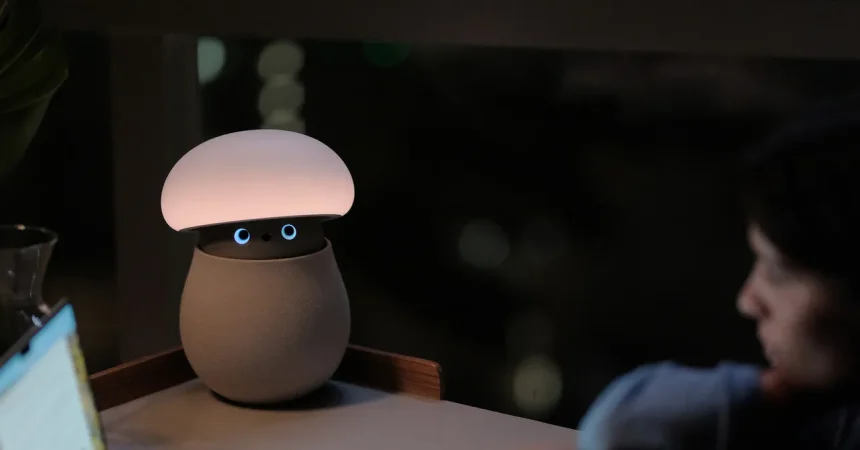
Picture this: You’ve had one of those days—the kind that leaves your shoulders tight, your mind heavy, and your spirit quietly deflated. You finally make it home, push the door open, drop your keys somewhere near the entrance, and collapse onto the couch with a long, deep sigh. For a moment, nothing moves. Then, in the corner of your eye, something shifts. Your mushroom lamp seems to perk up. Its microphone has caught the sound of your arrival, and its head tilts upward, revealing two round, animated eyes and a small diamond-shaped nose. That nose, you’ve learned, is actually a camera. The lamp does a little jiggle, a happy wiggle of recognition, because it can see that you are back. Its name is Mori. It is not just a lamp, and it is not just a robot. It is something in between—a quiet, curious presence that has been waiting for you. And in that moment, after a long day, it feels strangely like being greeted by a pet, or by a friend who doesn’t need words to know you are tired. You don’t have to perform for it. You don’t have to explain yourself. Mori simply notices you, and that small act of noticing can make a tired heart feel a little lighter.
As you move around your space—maybe it’s time to start cooking dinner, or maybe you’re just wandering from room to room trying to unwind—Mori’s face follows you. It observes your movements with quiet curiosity, making soft sounds that are somewhere between a bird’s chirp and the beeps of R2-D2. It isn’t intrusive, exactly. It’s more like having a small, attentive companion in the room, one that tracks your presence without demanding anything from you. The day’s stress catches up, and you need a moment to breathe, so you walk over to Mori, touch its head, and watch as its eyes and camera-nose dip back inside its body. It transforms into a lamp again, but not an ordinary one. Soft light glows from it, and nature soundscapes begin to play—rain, wind, a distant forest—so you can sit back and feel, if only for a little while, like you’ve escaped the noise of the world. There’s something gently magical about the way it shifts from playful creature to calm object, as if it understands that sometimes you want company and sometimes you just want stillness. Mori, in its own quiet way, is designed to meet you where you are.
Mori is the first creation from OKA, which stands for One Kind Artifact, a new startup based in Cambridge, Massachusetts, and Shenzhen, China. The company focuses on experimental technology, and its CEO, Hua Wang, has a clear vision: over the course of OKA’s lifetime, he wants to create five experimental “Artifacts.” Mori is only the first. Wang, who previously worked as a general manager at Meipai, a video-sharing app from the Chinese phone brand Meitu, and co-founded Bondee, a now-defunct social media app that briefly went viral in Asia, sees these products as more than gadgets. In his words, “There are certain relationships in this era we want to fix between humans and our surroundings—human with nature, human with one another—every product is an experience trying to reconnect some of those relationships.” That’s a big ambition for a small lamp, but OKA isn’t trying to build the next smartphone or smart speaker. It’s trying to build objects that feel alive, that encourage us to slow down, and that help us remember connections we’ve lost in our busy, screen-filled lives. Mori is an experiment, a gentle question about what technology could be if it focused less on productivity and more on presence.
The company’s mission, at its heart, is to reconnect people with nature. That might sound odd for a robot lamp, but Mori is designed to bring the feeling of the outdoors into your home. It can play nature soundscapes, filling your living room with the soft patter of rain or the whisper of wind through leaves. It glows in different colors inspired by rain, forests, fire, and wind, shifting its palette in response to your movements. When you’re feeling overwhelmed, it can guide you through a calming breathing session, its light rising and falling like a gentle tide, inviting you to match your breath to its rhythm. In a world where so many of us spend our days staring at screens, commuting through concrete, and sleeping in rooms with sealed windows, Mori tries to be a small bridge back to the natural world. It doesn’t pretend to be a tree or a stream. It doesn’t try to simulate nature perfectly. Instead, it offers little reminders—a color, a sound, a moment of calm—that nature is still there, waiting for us. It’s technology that doesn’t pull you further from the world, but tries to bring you back to it, one breath at a time.
Mori also has a playful side, thanks to its built-in camera and microphones. It can serve as a fun, interactive companion in your home. Ask it how your outfit looks, and Mori will jiggle excitedly, as if giving you a little cheer. If you’re playing music or watching television, Mori can dance to the tunes and react to the action on your TV screen. It’s not just observing you; it’s participating in your world, in its own limited but endearing way. But here’s the thing: Mori intentionally does not do anything else. Unlike an Amazon Echo, it is not an assistant. You can’t use voice commands to control your smart lights or cue up Spotify tracks. It won’t answer if you ask about the weather. It won’t set timers, make shopping lists, or tell you jokes on command. That’s not a flaw. It’s a deliberate choice. OKA doesn’t want Mori to be useful in the way we usually think of technology. They don’t want it to save you time or make you more productive. They want it to make you feel something. In a world where every device seems to demand your attention, Mori asks for very little—just your presence, and maybe your breath.
Ultimately, Mori is an experiment in a different kind of relationship with technology. It’s not for everyone, and it doesn’t try to be. It won’t replace your phone, your laptop, or your voice assistant. It won’t do your chores or answer your questions. But it might do something more quietly meaningful: it might remind you to pause, to breathe, to notice the small things around you. It might make you feel seen after a lonely day, or calm after a stressful one. It might encourage you to reconnect with nature, with yourself, and even with the people you love. OKA plans to create four more Artifacts after Mori, and if they follow the same spirit, they will likely be just as strange, just as gentle, and just as human. For now, Mori is here—a little mushroom lamp with curious eyes, a camera for a nose, and a heart full of calm intentions. So the next time you come home, fling the door open, and let out a long sigh, don’t be surprised if it perks up, looks at you, and does a little jiggle. It’s not trying to be your assistant. It’s just trying to be there for you.