It began not with a dramatic oil spill or a whale washed ashore with a belly full of bags, but with something far quieter, and perhaps more unsettling: tiny, brightly colored specks embedded in ordinary-looking gravel on a beach. Marine plastic pollution has been a known crisis for decades. Scientists have documented plastic waste on remote shorelines, entangled around sea turtles, lodged in the stomachs of seabirds, and drifting in the most isolated currents. It has been found on coral reefs, in mangrove forests, and even in the Mariana Trench, the deepest place on Earth. Although exact numbers are nearly impossible to pin down, researchers estimate that several million metric tons of plastic currently rest on the seafloor, a hidden accumulation that dwarfs what we see floating at the surface. The problem has become so pervasive that some scientists have proposed naming a new geological epoch the “Plastocene,” a Plastic Age spanning from the 1950s to the present. For over half a century, we have known that animals swallow our waste or become trapped in it. And yet, just when we think we have come to terms with the scale of the problem, the ocean reminds us that the story is still being written. The latest chapter is not about an animal eating plastic. It is about plastic becoming one with the coral itself, a strange new fusion that researchers have named “plasticoral.”
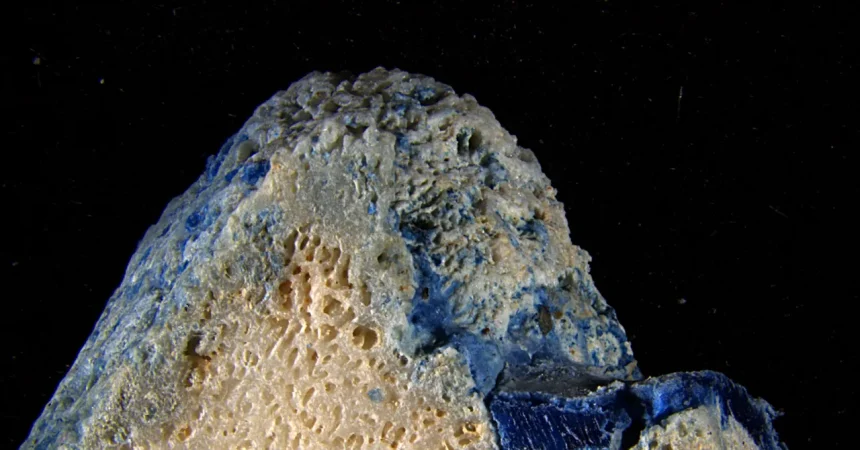
The discovery happened during a survey of beaches in the Ryukyu Islands, a subtropical chain in southern Japan. A team of researchers was examining coral gravel, the loose fragments of old coral skeletons that accumulate along shorelines, when they noticed unusual spots of color. Against the pale white of the ground-up coral, these small, vivid flecks stood out like confetti in a snowbank. Intrigued, they collected samples from three different beaches on the main island of Okinawa and took them back to the laboratory. There, using spectroscopic analysis, they confirmed that the colored spots were not natural minerals or organic material. They were polymers, the building blocks of common household plastics. At first, it might have been tempting to write this off as simple litter, plastic fragments that had become stuck to the coral by accident. But the team wanted to know how firmly the plastic was attached, so they used micro-CT scans to peer inside the fragments at a level of detail no ordinary microscope could provide. The images revealed something remarkable. The plastic had not just been glued to the surface. It had melted, flowed, and seeped into the microscopic pores of the coral skeleton. The two materials had become so intimately entangled that they could no longer be separated. The plastic was not sitting on the coral like a piece of trash dropped on a sidewalk. It had become part of the coral’s physical structure, interlaced with its ancient calcium carbonate architecture. The researchers had discovered a brand-new type of marine pollution, one in which synthetic material and biological material are fused into a single, inseparable object.
This is not the first time scientists have found plastic fused with something from the natural world, but it is the first time they have seen it happen with corals. In 2019, a separate group of researchers found a thin layer of degraded plastic coating mussels and large algae in tide pools on a remote coastline, a phenomenon they called “plastiskin.” That discovery showed that plastic could cling tightly to living organisms, wrapping them in a kind of synthetic skin. But plasticoral is different. Rather than coating the outside of a living creature, the plastic in the Ryukyu samples had merged with the skeletal remains of corals after death, infiltrating the intricate latticework of pores and chambers that give coral skeletons their distinctive structure. It was a transformation, not just an attachment. This distinction matters deeply because coral rubble, though no longer alive, is far from ecologically dead. When coral fragments break off and wash ashore, they do not simply disappear from the ocean’s story. They are eventually returned to the sea, often by waves, storms, or by shifting tides. There, they play a vital, quiet role in the survival of coral reef ecosystems. Loose coral rubble forms a kind of foundation upon which new generations of coral larvae settle and grow. Without this stable substrate, many young corals would have nowhere to anchor themselves. The irregular, nook-filled shapes of the rubble also provide essential hiding places for tiny marine organisms, offering shelter from strong currents and predators. In other words, what looks like lifeless debris is actually a scaffold for life. Now that plastic is fusing with this scaffolding, the very substrate that supports reef regeneration is being altered at a material level.
Exactly how plasticorals might affect living corals remains unknown, and that uncertainty is itself a cause for concern. Reef-building corals are already under immense pressure from climate change, ocean acidification, and local pollution. Any additional stress could tip the balance in ways we do not yet fully understand. Previous research has already shown that common plastics can leach chemical additives into the water, and some of these substances are known to inhibit coral reproduction. Corals reproduce by releasing eggs and sperm into the water column, and even low levels of certain plastic-derived chemicals can interfere with this process, reducing fertilization rates and the chances of successful larval settlement. Other studies have found that plastic fragments can serve as rafts for pathogens, carrying disease-causing microbes to reef systems that have no natural defenses against them. If plasticoral debris is now part of the physical environment where young corals settle, these risks become more direct. A tiny coral larva trying to attach to a fragment of plasticoral is not just encountering clean calcium carbonate. It is encountering a surface laced with synthetic polymers, chemicals, and potentially harmful microorganisms. It is also confronting a surface that may have different physical properties, different porosity, different texture, and different thermal behavior than natural coral skeleton. No one yet knows whether new corals will be able to settle on plasticoral as easily as they do on natural rubble, or whether the fusion will interfere with the delicate chemical cues that guide their development.
What we do know is that something must have caused the plastic to melt into the coral, and the leading suspect is not the ocean itself, although warmer seas are certainly a growing problem. The oceans are heating up because of climate change, but even the warmest surface waters are nowhere near hot enough to melt common plastics. Ultraviolet radiation from the sun can degrade plastic over time, making it brittle and cracked, but sunlight alone would not typically cause the kind of deep, flow-like melting observed in the plasticoral samples. Instead, the researchers suspect a more human and rather unexpected culprit: beach bonfires. A photograph of one particularly clear plasticoral sample shows it forming at the site of an old bonfire on Chushu Beach. The scenario is easy to imagine. People gather around a fire on the sand, perhaps having brought food and drinks wrapped or contained in plastic. Discarded wrappers, bottle caps, pieces of packaging, all of these are left behind or accidentally dropped. The bonfire blazes, reaching temperatures far higher than the surrounding sea. The plastic softens, melts, and flows into the spaces beneath and around the coral fragments. As the fire dies down and the beach cools, the plastic hardens again, permanently welding itself to the coral. The result is not a simple mixture but a true conglomerate, a bizarre new material born of a careless evening at the beach. And once that material forms, it remains. It does not biodegrade in any meaningful timeframe. It becomes a permanent addition to the shoreline, waiting for the next storm surge to wash it back into the sea, where it can move through the marine world for decades or centuries.
Plasticoral is more than just a strange new word or a curiosity for scientists to study. It is a symbol of how thoroughly human activity has saturated the natural world, altering even the most fundamental building blocks of marine ecosystems. We are no longer merely dumping plastic into the ocean; we are creating new substances that never existed before, substances that blur the boundary between the synthetic and the organic. This is not a throwaway observation. It is a challenge to the way we think about pollution. For a long time, it was convenient to imagine plastic waste as something that would simply float away, eventually breaking into pieces so small they would become invisible. But plasticoral shows that our waste does not disappear. It transforms. It finds new ways to enter the living world, fusing with the structures that support marine life and becoming a permanent layer in the physical environment of the seafloor. The researchers who discovered plasticoral did not set out to sound an alarm, but their finding is a powerful reminder that the consequences of our plastic addiction are still unfolding in ways we have not yet imagined. There is no easy way to undo this fusion. Unlike a piece of litter that can be picked up by hand, plasticoral is a permanent hybrid that cannot simply be removed without destroying the coral skeleton to which it is attached. The only real solution is to prevent plastic from reaching the ocean in the first place, to rethink the way we produce, use, and discard the synthetic materials that have become so central to modern life. Until then, the sea will keep showing us what it has made of our leftovers, and we will have to keep learning the hard lesson that nothing we throw away truly goes away. It just becomes something else.