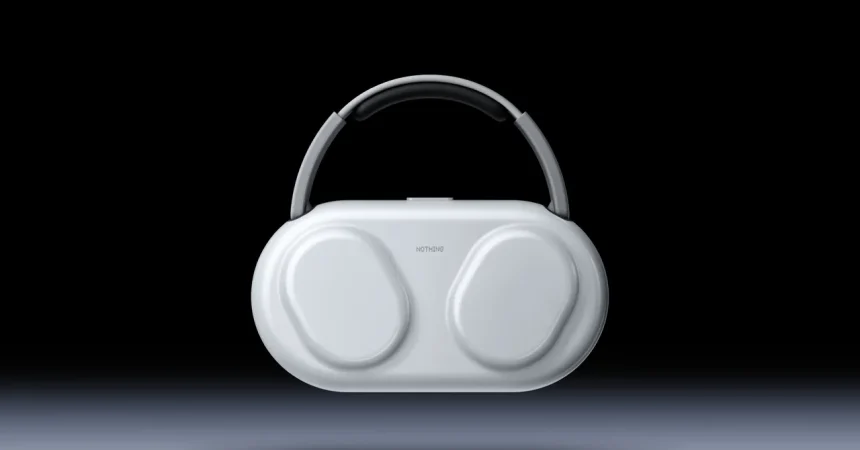
On a crisp Monday evening in New York City, Nothing took the stage to unveil its latest creation: the Headphone (1) Pro. If you’ve been following the brand since its first over-ear headphones landed last summer, you’ll recognize the family resemblance immediately. The new pair keeps that same striking, semi-transparent design language that Nothing has become known for, but the company insists this is not just a lazy refresh. The shape has been refined, the fit has been tweaked, and the materials have been upgraded, but the real story is hiding inside the earcups. With the Headphone (1) Pro, Nothing is making a serious play for audio enthusiasts by fundamentally rethinking how sound is produced in a pair of wireless headphones. It’s a bold move, especially for a company that’s still relatively young in the audio space, but it also feels very on-brand: a bit unconventional, a bit tech-forward, and unafraid to show off its inner workings to the world.
The headline feature here is the audio architecture. Most headphones, even premium ones, rely on a single dynamic driver per earcup—usually a 40-millimeter speaker that tries to handle every part of the frequency spectrum at once. That means the same tiny component is responsible for the thump of a kick drum, the warmth of a vocal, and the sparkle of a hi-hat. It’s a lot to ask, and the result is often a slightly muddled sound where bass bleeds into the mids, or treble gets a bit harsh when things get loud. Nothing has decided to solve that problem by throwing more hardware at it. Instead of one driver, each earcup of the Headphone (1) Pro contains three separate drivers, each assigned to a specific part of the audio range. It’s a tri-driver setup that’s more commonly found in high-end wired IEMs or studio monitors, not in consumer over-ear Bluetooth headphones. The idea is simple: give each frequency band its own dedicated speaker, and let each one do what it does best without interfering with the others. In theory, that means cleaner separation, less distortion, and a more expansive soundstage.
Let’s break down what each driver actually does. The low end is handled by a 40-millimeter bass dynamic driver, which is a fairly conventional component but tuned specifically for deep, punchy lows. If you listen to hip-hop, electronic music, or anything with a heavy sub-bass line, this is the driver that’s going to make your head nod. Then there’s a precision dynamic driver dedicated to the midrange—the realm where vocals live, along with pianos, guitars, and most of what makes a song feel human. Nothing says this driver is specially tuned to render consonant sounds like “S” and “T” with more detail, which might sound like a weirdly specific thing to focus on, but it actually makes a lot of sense. Those sibilant sounds are where a lot of audio detail gets lost, especially in compressed streaming formats. If the mids are crisp and articulate, the whole mix feels clearer and more intimate. Finally, there’s the treble driver, and this is where things get genuinely interesting. The high-frequency driver uses something called xMEMS technology, which replaces the traditional coil-and-magnet setup with a solid-state silicon diaphragm. In plain English, that means the driver can move faster and with more precision, which should make transients—those sharp, instantaneous bursts like a cymbal crash or a synth stab—sound incredibly clean and immediate. It’s a genuinely innovative approach, and it’s not just marketing fluff; xMEMS has been gaining traction in the audio world for its ability to deliver electrostatic-like clarity in a tiny, efficient package.
Of course, every headphone company claims its product sounds amazing, and you’re right to be skeptical. But at least Nothing has put some real engineering behind the promise. The three drivers aren’t just crammed into the earcup haphazardly; they’re arranged in a carefully designed chamber, and there’s a crossover network that divides the audio signal so each driver only receives the frequencies it’s supposed to play. That kind of attention to detail suggests a genuine commitment to sound quality, not just a spec sheet gimmick. And because Nothing is a company that loves to show off its hardware, you can actually see the tri-driver architecture from the outside. The earcups feature a couple of panels made from 9H Panda glass, so you can peek inside and see the three drivers sitting in their individual compartments. It’s a clever design choice that reinforces the brand’s transparent aesthetic while also giving you visual proof that something different is going on under the hood. The rest of the headphones are predominantly aluminum with titanium accents, which gives them a premium, industrial feel that sets them apart from the plastic-heavy competition.
Now, you might be wondering about the practicality of putting glass on a pair of headphones that are meant to be worn, tossed into bags, and probably dropped a few times. Nothing claims the glass is “shatter- and scratch-resistant,” and Philipp Von Lintel, an associate principal industrial designer at Nothing, shared some details about the durability testing. He said the glass had to survive drop tests from a height of more than one meter, repeated 18 times, before it was approved for production. That’s reassuring, but even if you do manage to crack it, the design has a backup plan. A plastic film underneath the glass keeps the internal chamber intact, so the headphones should still function even if the glass is damaged. Repair technicians can also heat the glass from the outside to remove it and access the internals, which means the glass isn’t a repairability nightmare. It’s a thoughtful approach that balances aesthetics with real-world wear and tear. The physical design has been refined in other ways too. The Headphone (1) Pro is slightly lighter than its predecessor—just two grams lighter, so you probably won’t notice the difference on a scale, but every bit counts when you’re wearing something for hours. The headband is wider and the padding is thicker, which should make long listening sessions more comfortable. The earcups also have an IP52 dust and water resistance rating, so they can handle light splashes and dust, though you’ll still want to keep them out of heavy rain. It’s a practical upgrade that adds a bit of peace of mind.
The one area where the new model actually takes a step backward is battery life. The original Headphone (1) offered up to 80 hours of playback with active noise canceling turned off. The Pro version drops that to 68 hours under the same conditions. That’s still a very respectable number—you’re not going to be charging these every day, and even heavy listeners will probably get a week or more out of a single charge—but it’s worth noting that the extra drivers and the glass panels come with a small power cost. In exchange, you’re getting a more sophisticated audio system, a more durable build, and a design that feels more premium in just about every way. For most people, the tradeoff is more than worth it. The Headphone (1) Pro feels like a natural evolution for Nothing. It takes the bold, transparent design that made the original so distinctive and pairs it with genuinely innovative audio hardware. The triple-driver architecture is a meaningful step up from the single-driver approach that dominates the market, and the use of xMEMS technology for the treble is a sign that Nothing is willing to take risks to stand out in a crowded field. Whether it’s the visual appeal of seeing those drivers through the glass panels, the promise of clearer vocals and sharper transients, or simply the comfort of a wider headband, there’s a lot to like here. It’s not perfect—the reduced battery life and the lingering anxiety of having glass on your headphones are minor concerns—but it’s a compelling package that should appeal to anyone who wants something a little different from the usual black plastic rectangles. Nothing has always positioned itself as a brand for people who care about design and technology in equal measure, and the Headphone (1) Pro fits that identity perfectly. It’s a statement piece that also happens to sound like it means business, and that’s a rare combination in the world of consumer audio.