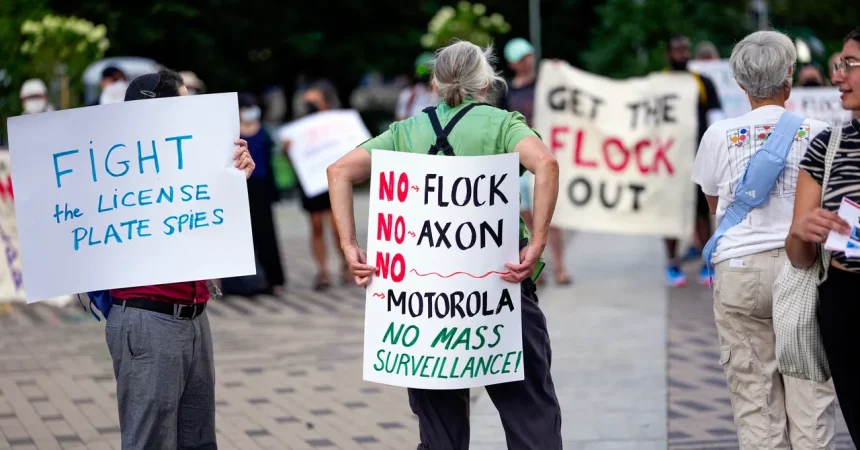
For months, a quiet but fierce battle has been playing out across American roads and highways. Automated license plate readers—especially those made by the fast-growing company Flock Safety—have been hailed by law enforcement as indispensable tools for solving serious crimes, catching stolen cars, and finding missing people. Yet the same cameras have sparked a nationwide backlash as reports emerged of police officers abusing them for personal, vindictive, or discriminatory purposes. Now, two members of Congress from opposite sides of the aisle are trying to draw a clear line. A bipartisan pair of lawmakers told WIRED they plan to introduce legislation today that would strip federal funding from states that fail to restrict the use of Flock cameras and other automated license plate readers. The bill, known as the No FLOCK Act—short for Federal License-Plate Observation and Camera Keeping—would direct the US secretary of transportation to withhold 10 percent of annual federal financial support for highways, roads, and bridges from any state that does not ban Flock and similar devices for all but five narrowly defined use cases. The message is unmistakable: if states want to keep the federal money flowing, they will have to prove they can police the police.
The legislation is being cosponsored by Congressmen Raja Krishnamoorthi, a Democrat representing Chicago suburbs, and Michael Cloud, a Republican whose Texas district includes Corpus Christi. The bill’s five permitted uses are tightly drawn: enforcing toll systems, identifying stolen vehicles, locating missing or endangered persons, finding vehicles registered to people with felony warrants, and investigating a vehicle involved in a felony offense. Notably, the bill excludes uses like conducting traffic studies, investigating minor drug crimes, and enforcing parking or speeding rules. That list of prohibited purposes is a direct response to the creeping expansion of surveillance technology into everyday life, where a camera intended for one public safety purpose can quietly become a tool for something far less innocent. “Our investigation into Flock exposed serious gaps in oversight, and this bipartisan bill would put clear limits in place to prevent abuse while preserving legitimate public safety uses,” Krishnamoorthi said in a statement. The lawmakers are betting that the threat of losing highway funding—the kind of money states rely on for road repairs, bridge maintenance, and new infrastructure—will be enough to force action where voluntary oversight has repeatedly failed.
Yet for all its sharp edges, the No FLOCK Act stops short of a complete ban, and that has left some advocates unsatisfied. The global protest movement against Flock and its competitors has made banning the systems outright its number one demand, arguing that mass license plate surveillance is fundamentally incompatible with privacy and civil liberties. The bill also does nothing to stop Flock users from broadly sharing license plate tracking data with other government agencies, including immigration authorities, a major concern for immigrant rights groups and civil liberties organizations. Flock itself did not immediately respond to a request for comment on the proposed bill, leaving some open questions about whether the company would fight the legislation or try to shape it. If the bill passes this year, states that fail to comply would begin losing out on tens of millions to hundreds of millions of dollars in annual transportation funding starting in October 2028. The delayed effective date gives states time to adjust their laws, but it also reflects the slow machinery of federal policymaking. The Department of Transportation calculates the amount of so-called surface transportation funds it gives to states based on factors such as how many roadways they have and how busy those roads are, meaning larger and more congested states would face the steepest losses. Congress has used this kind of financial pressure before, repeatedly threatening to withhold highway funds to push states into action on public safety. That tactic helped establish a national minimum drinking age, standard rules for what constitutes driving under the influence, and regulations for billboards alongside highways.
The No FLOCK Act is not the only legislative effort aimed at reining in Flock’s reach. Another bipartisan bill introduced in Congress recently called for banning the use of federal funding to purchase Flock cameras altogether. Together, these measures signal a growing appetite in Washington for oversight of surveillance technology, even as the tech industry’s lobbying machine churns in the background. Flock’s lobbying spending in Washington, DC, has been steady over the past 18 months, and the company recently hired a fifth firm to help with its efforts, according to federal records. That investment suggests the company sees the legislative threat as serious. But the broader political moment is also complicated. A number of issues related to emerging technologies—including rogue AI systems, data center construction, and law enforcement abuse of Flock cameras—have become major topics in the upcoming US midterm elections, now less than two months away. Voters are increasingly aware of how new surveillance tools are being used, and they are not always liking what they see. Still, it remains unclear whether any legislation designed to address voters’ concerns will advance through Congress anytime soon, let alone gain the approval of President Donald Trump.
The president has made his own position clear. On Sunday, Trump expressed support for Flock cameras, telling reporters that they help law enforcement authorities. Lawmakers largely agree with that assessment in principle, but they are deeply frustrated by the documented cases of abuse that have tarnished the technology’s reputation. Police officers have been caught using Flock footage for personal reasons, such as stalking former romantic partners, tracking ex-spouses, or monitoring people they had personal grudges against. One report found at least 100 instances of alleged abuse over the past eight years, and advocates say the real number is likely higher because many cases go unreported or are quietly handled internally. The human consequences of those abuses can be devastating: victims describe the chilling feeling of being watched without knowing who is behind the camera or why they have become a target. When a tool that is supposed to protect the public is turned against individuals, it erodes trust not only in the technology but in the entire criminal justice system. That is why the No FLOCK Act’s sponsors argue that limits are necessary, not just to prevent future abuse but to preserve the legitimacy of genuinely useful public safety tools.
The road ahead for the No FLOCK Act is uncertain, but its introduction marks a significant moment in the national conversation about surveillance, privacy, and policing. It brings together strange political bedfellows—a progressive-leaning Democrat from the Chicago area and a conservative Republican from Texas—united by a shared concern that unaccountable surveillance is a threat to liberty. The bill’s use of highway funding as leverage is a classic Washington tactic, one that has historically proven effective at getting states to adopt standards they might otherwise ignore. But the deeper question is whether the federal government should be in the business of setting boundaries for local policing technology at all. Supporters say yes, because state and local agencies have repeatedly failed to police themselves. Critics, including some law enforcement groups, argue that the bill goes too far in limiting a tool that has helped solve kidnappings, homicides, and other violent crimes. The truth likely lies somewhere in between: Flock cameras are neither the all-seeing savior their marketing suggests nor the dystopian nightmare their harshest critics imagine. What is clear is that the days of unchecked license plate surveillance are probably numbered. As more abuse cases surface, as the public becomes more educated about how these systems work, and as lawmakers from both parties begin to ask hard questions, the pressure for change is only going to grow. Whether the No FLOCK Act becomes law or simply serves as a warning shot, it has already changed the terms of the debate. The question now is not whether automated license plate readers should be regulated, but how, and who gets to decide.